Hurricane Helene has come and gone, it doesn’t seem like it has been over a year since this major storm hit Tattnall and surrounding counties. This was one of the most powerful storms to make landfall in Southeast Georgia on record. Some weather stations recorded over 90 mph gusts, and sustained winds of over 60 mph. Downed powerlines, trees in roads, entire pecan orchards uprooted and many large pine stands ultimately destroyed. It is estimated that the timber industry in Georgia suffered $1.28 billion loss.
Fast forward to today, and secondary remnants of Helene’s destruction are still visible. The clean-up may be complete but I have noticed and had begun receiving more and more calls about beetle infestations in pine tree stands. It is well documented that forested areas with wind damage are ideal areas for infestations of woodboring beetles. The dying woody debris attracts these insects into these areas. The two most important species to colonize these wind damaged areas are Dendroctonus and Ips.
There are four species of Ips bark beetles (also known as Ips engraver beetles or Ips beetles). The six spined Ips (Ips calligraphus), pine engraver (Ips pini), the eastern five- spined Ips (Ips grandicollis), and the small southern pine engraver (Ips avulsus). If you have ever seen an Ips beetles you know how small they are. These insects range from 1/16th to ¼ inch. Each beetle species create unique bark galleries which help identification efforts.
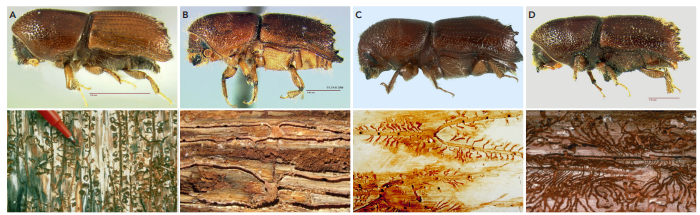
(C), and I. calligraphus (D). Credit: Taken from Southern Regional Extension Forestry Forest Health article entitled “Ips Bark Beetles in the Southeastern US.”
Ips beetles are attracted to weakened or stressed trees. The males begin feeding and release pheromones that attract females. Females begin to lay eggs, producing these bark galleries. The Ips beetles’ galleries form the shape resembling an I, H, or Y. Ips beetles can have six to ten generations in a season when conditions are warm. The reproduction slows down considerably when temperatures drop below 59 F.
Early signs of beetle infestations are discolored leaves or dying or dead branches. You may notice leaves shedding or turning yellow. This yellowing is markedly different than drought stress. In drought stressed pines you may notice browning of leaves but overall the tree is still green, but shedding is occurring. On trees with beetles, the entire tree may begin to turn yellow, starting in the crown, ultimately all leaves begin to turning brown. Luckily, if ips do kill trees it is usually limited to just a few adjacent trees. One exception would be widespread drought conditions, similar to what we encountered this summer. Excessively, dry weather has the potential to increase damage of ips beetles.
We can’t control the weather, but we can limit our risk to prevent beetle outbreaks by timely thinning, proper weed control (limit competition), removing excessive woody debris, limiting tree injury during management activities, and removing storm damaged trees.
This article was taken from Ips Bark Beetles in the Southeastern U.S. — Southern Regional Extension Forestry and resource.cfm