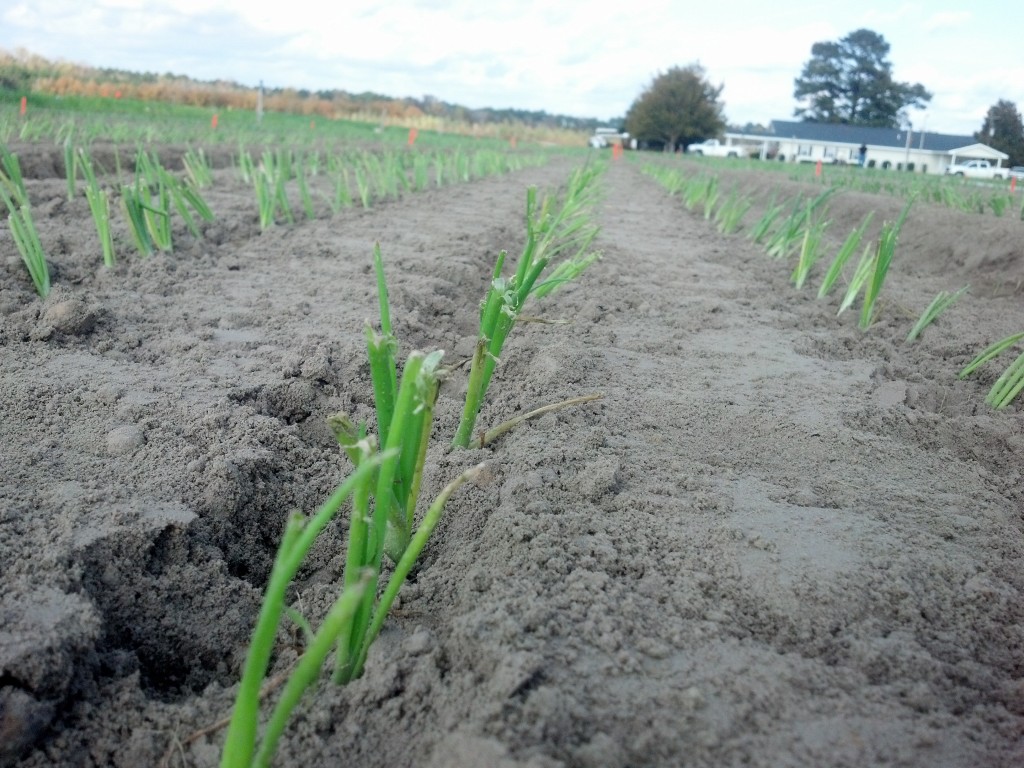
It may not seem like it but we are in the winter season. The low rainfall and high temperatures are reminiscent of fall. We are nearing some record or even above record temperatures for this time of year. I say this as a preface to growing your own fruit and vegetables. We are lucky to live in a part of the country that allows for year round vegetable and fruit production. My dream is to have different fruiting plants which produce all seasons of the year. As the title implies a good first option is blueberries. Hopefully this article will make you want to plant your own.
There are three major species of blueberry plants that can be grown in our state: the native rabbiteye, southern highbush, and the northern highbush. For our area, the rabbiteye is the best option. Since it is native to our area pests and diseases would be minimal, Allowing for a more carefree planting. Southern highbush are commercially grown in south Georgia. However, they require much more maintenance and are more prone to freeze injury from their earlier ripening. Finally, we have the northern highbush, these are more suited for the cooler areas of Georgia such as the mountains.
When deciding what variety of rabbiteye to select one of the most important points to remember is that cross-pollination between varieties will maximize your fruit set. So planting more than one variety is important. You can also extent your harvest window by planting early, mid, and late season cultivars. Here is a chart with early, mid, and late season cultivars:
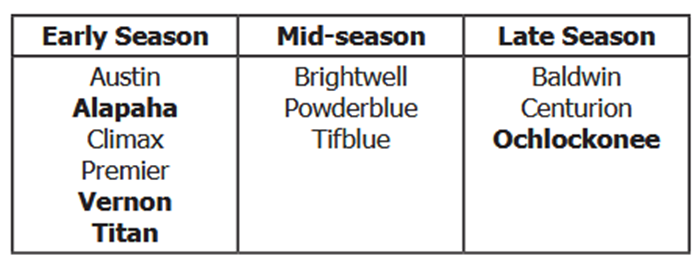
Titan is a newer variety released in 2011, and has the largest fruit size of rabbiteye to date. Vernon, another early variety also has large berries. Alapaha and Ochlocknee have medium size fruit with good eating quality and smaller seeds than Austin or Brightwell.
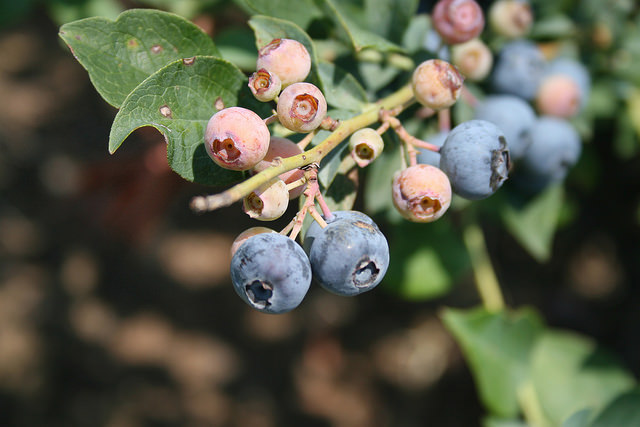
When planting remember winter is a good time to plant, the earlier the better. Planting during the dormant season allows for less shock to the plant and wetter soil for more root development. Ensure proper sunlight. Without adequate light fruiting will be limited, full sun is the best. Soil pH should be between 4.5 and 5.2, if a soils test is showing levels above this add sulfur. Do not mix the sulfur into the planting hole, simply add it to the top of the soil. If the pH is above 6.0 it will be difficult to grow unless soil amendments such as peat moss or milled pine bark is added. Place plants 5 to 6 feet apart in row and 11 to 12 feet between rows. Prune the plant back 1/3 to ½ and remove twiggy growth and tip remaining shoots to remove all flower buds. Do not fertilize at transplanting, wait until leaves emerge and new growth appears. One of the most important points to remember is to have adequate water. Have a system to water once to twice weekly if not more depending on soil moisture conditions. A well-watered plant will establish faster and will be more likely to survive verses a drought stressed plant.