The Weather:
It has been a wild ride. It seems like it is feast or famine when it comes to rain. But, the good news is that we got some of the rain we desperately needed. The bad news is that makes us susceptible for some diseases, insects, and weeds. This is not the year to skip sprays. It has been tough to get in the field for a while, but this week has let us dry out and get out there.
Scout Now for Lesser Cornstalk Borer
By: (Dr. Abney – UGA Entomologist )
Late May and early June lesser cornstalk borer infestations occur every year in Georgia peanut fields,
but the incidence of these early season infestations has increase over the last few years.
I received reports of LCB infestations from several consultants and county agents
last week from across the state.
Moth traps were also collecting large numbers of adult males in multiple locations.
There are at least three common responses to the information presented above:
1. Oh no! lesser cornstalk borers are here; I better go spray all my peanuts.
2. Lesser cornstalk borer? I’ve never had those. I don’t care.
3. I need to scout my peanuts to see if any of my fields are at threshold for LCB and need to be treated.
The third response is the correct one. Spraying for lesser cornstalk borer when they are not present is a waste of time and money.
It can be difficult to find LCB larvae, and folks get nervous about missing them.
The reality is, if you have lessers in a field,
you will see silk tubes and moths (not just moths in a trap,
but moths flying as you walk through the field).
Even in high pressure years, not every field will need to be treated for LCB.
We have the tools to manage this pest once it reaches threshold,
and growers who use thresholds to make treatment decisions will save money.
Our research has shown that catching large numbers of moths in a pheromone trap
does not necessarily mean that a field needs to be treated; it does mean that the field needs to be scouted.
Proper scouting is the key to making the best management decision.
The best management decision is the one that results in the largest check in the grower’s pocket at the end of the season.
Here is a link to a video we did a few years ago about scouting for lessers in early season peanut.
Cotton Update:
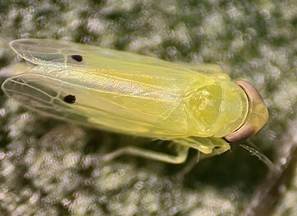
Figure 6: Cotton Jassid
If you haven’t heard, cotton jassids have been confirmed in Tifton from an okra patch.
Cotton jassids have not been found in the Baker County area.
When scouting, look for the key identifying characteristic:
the two black spots located on the wings of the adult insect.
Because similar-looking leafhoppers are around,
we can only confidently identify adult cotton jassids.
Nymphs cannot be accurately distinguished in the field.
Continue monitoring fields and report any suspected finds
so we can better track movement and distribution of this pest.
Plant Bug Control in Cotton
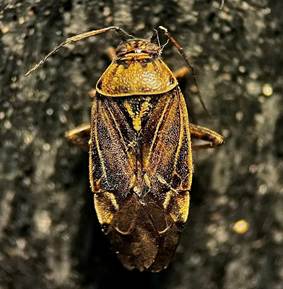
Figure 7 :Tarnished Plant Bug (TPB)
I have had reports of Tarnished Plant Bugs (TPB) in Ben Hill County.
I have also had reports of some fields being treated. I saw many of these insects overwintering on wild radish.
Thresholds: First 2 weeks of squaring:
• Sweep Net: 8 plant bugs/100 sweeps
• Drop Cloth: 1 plant bug/6 row feet
Third week of squaring through bloom:
• Sweep Net:15 plant bugs/100 sweeps
• Drop Cloth: 3 plant bugs/6 row feet
Plant Bug Management (Phillip Roberts):
Tarnished plant bugs and clouded plant bugs have become a more consistent pest of cotton in parts of Georgia.
A few bullet points below to consider when planning your plant bug management program:
• Early planted cotton appears to be at greater risk for plant bugs during squaring.
• Later planted cotton appears to be at greater risk for late season plant bugs.
• Primary damage during squaring is feeding on small squares; these small, damaged squares will be shed by the plant.
• The best sampling tool for adult plant bugs migrating into squaring cotton is a sweep net.
• Square retention should be monitored from the onset of squaring until early bloom;
our goal is to maintain at least 80 percent of fruit as we enter bloom.
• Plant bugs may feed on larger squares; this often occurs when we have plant
bugs reproducing in the field. Large squares will often remain on the plant and result in dirty blooms.
• If you see dirty blooms, the field should be scouted for immature plant bugs.
The best sampling tool for immature plant bugs is a drop cloth.
• Plant bugs may also feed on small bolls resulting in internal boll damage.
• Clouded plant bugs should be counted 1.5 times
(i.e. 2 clouded should be counted as 3 tarnished)
and added to your plant bug count.
• Scout and use thresholds.
• Consider aphid infestations when making plant bug sprays.
• On farms where plant bugs are consistent and problematic,
consider using ThryvOn or Diamond.
• Optimal timing for Diamond insecticide,
which is an insect growth regulator and is only active on immature plant bugs,
is just prior to plant bugs hatching. This often occurs near first bloom.
• Consider adding Diamond if you are making a second plant bug spray for migrating adults.
Diamond needs to be added to a “knock down” insecticide which has activity on adults.
• ThryvOn cotton needs to be scouted and treated if thresholds are exceeded.
