Here is some information on cotton defoliation from UGA Cotton Agronomist Dr. Camp Hand.
Update for the week of September 7th, 2026:
The big call I’m getting right now is on timing. Our crop as a state is all over the board, ranging from early to late and areas that got rain and those that didn’t. The main question comes down to “Do I defoliate if it’s ready or keep pushing it?” This is mainly surrounding dryland cotton that has started growing again. There are a few things to keep in mind when having this conversation. First, our last effective bloom date (or the last day a flower is likely to mature into a harvestable boll) is right around September 15 (i.e. in the next week). So unless it has been blooming for 2 weeks or more I’m not sure I’d chase it. The other question is how much more money do they want to put in it? Many of us around Tift/Worth/Colquitt and the surrounding counties have been fighting whiteflies hard over the last 6 weeks or more. Over around Pierce/Coffee/Appling/Bacon counties, some growers have sprayed for jassids. If we try to push this cotton to “put a top on it”, we are going to have to keep protecting against these pests and others (stinkbugs, late season plant bugs, etc.). This will also allow them more time to continue feeding and reproducing, potentially putting us in a worse situation in 2027. So unless there is a major reason to try and push this crop further than we have to, I say when it is ready, knock the leaves off. However – this is one of the situations where I may need more info to make a good recommendation. Feel free to call and we can talk through scenarios.
There are three major ways to determine if a cotton crop is mature:
- 60 to 75% open boll (Open bolls/Total Bolls*100)
- 4 Node Above Cracked Boll (Illustrated below)
- Sharp knife method (Use a sharp pocket knife or PVC cutters to cut into the uppermost harvestable boll – if seed coats are dark and cotyledons in the seed are developed, it is mature and will open)
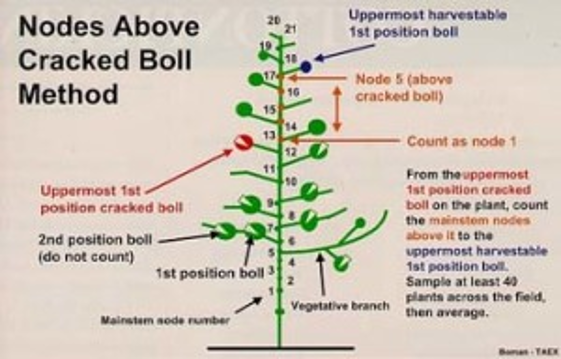
I talked with Scott Carlson last week and he sent me pictures of a field in Worth County that he was evaluating for defoliation. He told me it was ranging in NACB, but when he cut into the bolls he thought they would open. This is a great example of why we need to look at the crop from multiple different angles. We always need to verify the maturity of a crop using two methods. Ill-timed defoliants (particularly early) can be detrimental for yield and quality.
After looking at the weather for the next week or so, it looks like we are still in a scattered shower type pattern. Little chances every day, probably coupled with some overcast conditions. The good news is that temperatures will come down this week. However, it does look iffy in terms of applying defoliants. First, I prefer a few sunny days after application to ensure good uptake and activity. But secondly, rain free periods do become a concern. Thidiazuron (Dropp/Freefall/Klean-Pik/etc.) has a rain free period of 24 hours, but if mixed with a phosphate (tribufos – i.e. Folex/DEF), that can be cut to 12 hours. With the pattern we are currently in, it’s tough to guarantee 12 hours, much less 24. Although I don’t like waiting if the crop is ready, if conditions aren’t conducive for optimal defoliation we may need to push a few days.
In terms of recipes for the week IF someone NEEDS to spray this week:
3.2-4 oz/acre thidiazuron (Dropp) (go higher end for higher regrowth potential)
8-10 oz/acre tribufos (Folex/DEF) (higher on lower temp days)
32-42 oz/acre ethephon (Prep/Setup/SuperBoll)
*Please note that the listed suggestions are for the week of September 14th, 2026
Update for the week of September 14th, 2026:
Remember a couple of key points from last week’s email – determining defoliation timing and last effective bloom date (Sept. 15 i.e. Tuesday). These two topics will help answer many questions.
A big part of deciding what to do defoliation wise is not just the weather forecast, but keeping in mind what happened in the last few days as well. Many of us caught some sort of rainfall last week, meaning that if there is any residual fertility in the field this crop may want to start to regrow on us if it hasn’t already. Only one chemistry helps control regrowth, and that is our thidiazuron product (Dropp/Klean-pik/Freefall, etc.). In my mind, knowing that we had rain last week and this crop may want to go or already has, I think we need to increase the rate on this.
Last week I mentioned how rates are determined. Above is a good example, but on the other products (Folex & most PPOs, and Prep/Setup/SuperBoll), as temperatures go down, rates go up. Plant is working slower at lower temps so may need a little more help in getting the message, so we need some higher rates. The main exception is that if someone is going to use ETX, 1 oz/acre is the rate to use across the board plus a surfactant. Another exception is that when temperatures get below 65 F, thidiazuron activity is reduced significantly. So when temps go down to that level, we typically pull that product from the mix and may switch to a ginstar type product.
I also got a question last week about surfactants or AMS with defoliants – unless it is required by the label, I don’t recommend them. With the PPOs, it is stated in the label to either use COC or NIS – however, if a grower decides to use the standard 3-way, a surfactant is not required by labeled directions.
Another conversation I overheard last week was about using diuron in a defoliation mix. Diuron alone is not labeled for defoliation – the only way to legally use diuron as a defoliant is by spraying Ginstar/Cutout/Adios/etc. It doesn’t add anything anyhow, so why go through the trouble?