The rain everyone around us is getting over the past few weeks has really seemed to be missing Appling County with only a few places here and there receiving just a few tenths. We have a good chance for rain tomorrow and I pray we get it as it is much needed to finish out this crop. I have not seen much to any disease pressure in peanuts so far and this is good, I have heard of reports of velvet bean caterpillars in the county but nothing close to threshold. Dimlin is very effective on VBC, but not on all caterpillars, so ID is critical. Whiteflies have picked up in the county over the past week, scouting at this time is also critical for whitefly management decisions. I have not seen much of any stinkbug pressure across cotton fields. We did find a small hot spot of jassids in a field this week, but once again nothing close to threshold so no need to panic. Dr. Serinna has some really important information in the Cotton Team Newsletter regarding Base Acre Allocation and the OBBBA, I would give that a read. Reach out with any questions.
p.s. Prostko has preached over the past few years that burning down Tropical spiderwort with a herbicide application post corn harvesting can be a very impactful management practice by preventing seed going into the soil seed bank. Give us a call to talk over the treatment options.
Topics in this Update
- August Cotton Team Newsletter (UGA Cotton Team)
- Dry Conditions in East Georgia (Mr. Wade Parker, SED Area Agronomist)
- Row Crop Disease Update (Dr. Bob Kemerait, UGA Plant Pathologist)
- 2026 GA Custom Rate Survey
- All About The Pod Podcast (UGA Peanut Team)
August Cotton Team Newsletter (UGA Cotton Team)
Dry Conditions in East Georgia (Mr. Wade Parker, SED Area Agronomist)
The past several weeks has been extremely dry in areas of Southeast and East Georgia (especially the northern part of the district). The month of June was moisture friendly, but I can not say the same for July. The isolated and scattered showers were extremely spotty, with only a few getting measurable precipitation. This negative weather pattern abruptly changed this past weekend when many dry areas received 3-6.5” of rain. Most of the rain fell fast and in a short period of time, and due to the dry conditions, there were few puddles or even water in the ditches a day after the event. The big question or unknown in cotton and other applicable crops is; do we have enough time to make a decent crop? It depends.
The rain fell on July 31-August 1-2. Many dryland acres of cotton have cut-out and have white bloom(s) in the top and the general upper portion of the plant. In these situations, the rain received will or could allow the plant to return to growth and reproduction, assuming fertility is still present in the soil. The crop must continue to receive rain as there is no margin left for error. From a physiological standpoint, growers can expect at least 23 +/- days for a pinhead square to transition to a white bloom. Then, from a white bloom to a mature bloom, usually requires 25 +/-days. These days are assuming very little stress and the plant acquiring the necessary heat units for development. To put this in perspective, a pinhead square on August 1 should be a white bloom by August 23. As a rule of thumb, a white bloom produced prior to September 8 should cross the finish line. If this timeline were to transpire, growers would get an additional two weeks of white bloom to add to their production. There are many variables that can affect this outcome: timing of first frost, extreme heat or unusually cool temperatures, activity in the tropics, and management of any cotton jassid outbreaks. I think it is fair to say many acres of dryland cotton have suffered permanent yield loss and growers must manage this crop accordingly and be extra careful on unnecessary inputs that will not produce a return on investment. I do not think adding extra nitrogen or applying high priced foliar products that deliver little will assist in production. There is probably a lot of the top-dress nitrogen still present in the soil, waiting to be utilized.
Row Crop Disease Update (Dr. Bob Kemerait, UGA Plant Pathologist)
Areolate Mildew in Cotton
Areolate mildew is well-established in at least one field of cotton there. With our current conditions (high humidity, thick leaf canopy, and sporadic rains) this disease will ignite. Fungicides are recommended here to protect yield.
In the past we are able to use azoxystrobin, but we have confirmed fungicide resistances now.
The safest bet is Priaxor or Miravis Top.
Best fungicide timing is 3rd week of bloom or later (cotton in Jeremy’s pictures is likely 4-5 week of bloom) AND when found when scouting.
If cotton is 3rd week of bloom and not scouted, consider to spray or not based upon favorable conditions.
Quick disease primer
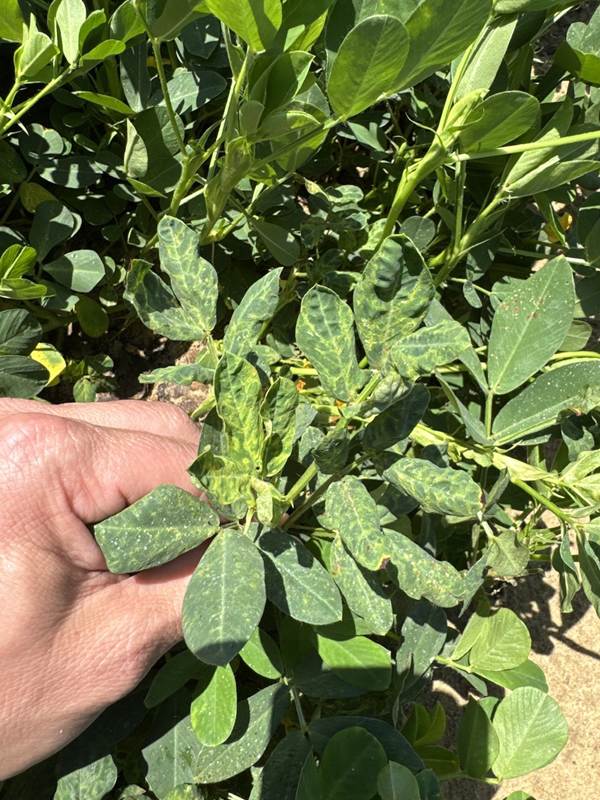
1. Spotted wilt on peanut – leaf distortion can be a symptom
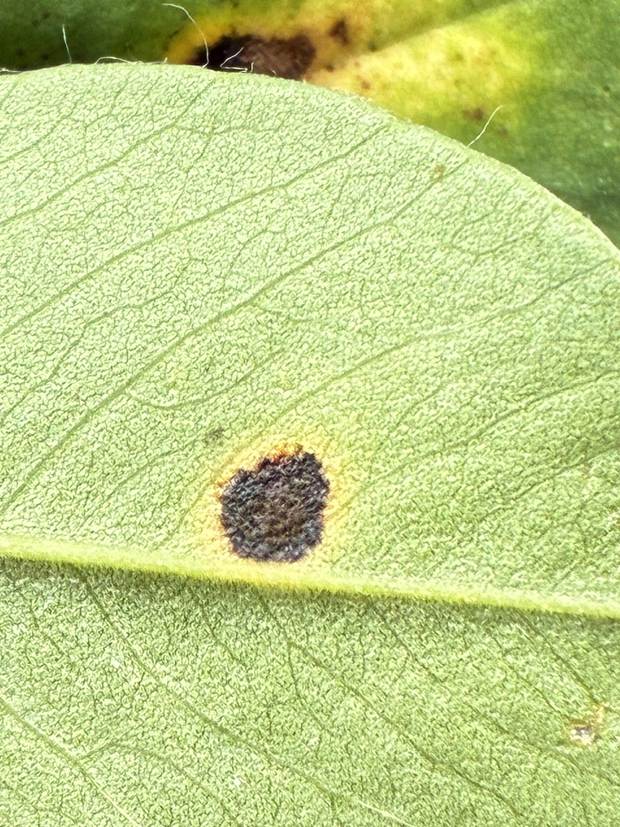
2. Late leaf spot- chocolate spores on the UNDERSIDE of the leaflet
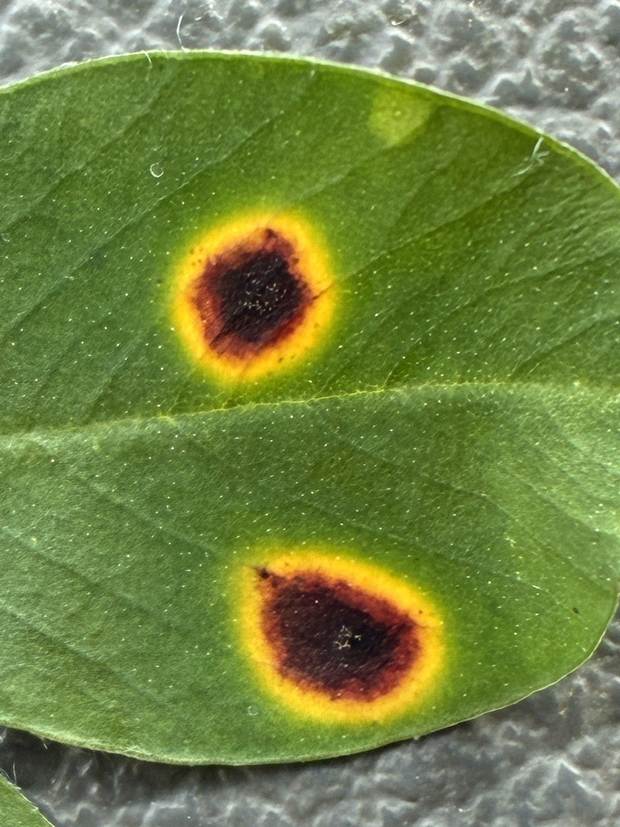
3 Early leaf spot, silver needle spores on TOPSIDE of leaflet Cale, pic 5
2026 GA Custom Rate Survey
The 2026 Georgia Custom Rate Survey is live and available via link listed below. Survey link: 2026 GA Custom Rate Survey The 2024 Extension publication can be accessed at the following link: 2024 Georgia Custom Rate Survey Summary. Thanks for your consideration and support of this important project that produces beneficial commodity input information for Georgia producers and Extension clientele.
All About The Pod Podcast (UGA Peanut Team)
https://www.podbean.com/eas/pb-jh86x-1b26758
All About The Pod – Episode 21, Season 4 – Moving into August with Risk Increasing for Disease and Insects.
https://www.podbean.com/eas/pb-rh9wq-1b1c8f3
Episode 20, Season 4 – Hot Temperatures, Scattered Rain, and Pest Mangement