Planting has come to a wrap and cotton/peanut stands are looking really good overall. Post herbicide applications are going out over cotton and peanuts, and first trips of peanut fungicide applications will ramp up over the next couple of weeks, along with calcium applications. It is also not too long until it is time to start thinking about PGR applications in Cotton. Also, looking at the 10-day forecast we have at least 5 days with a decent chance of rainfall. A lot is looking good so far for 2026, I hope it stays that way, but do be on the lookout for cotton jassid as it has now been detected again in Georgia this year. No need to panic, but do be aware. If you detect cotton jassid in cotton or on any other plant, please contact your local county extension office. See below articles and updates from cotton and peanut extension team specialists.
Topics in this Update:
- June 2026 Cotton Team Newsletter (UGA Cotton Team)
- Questions and Answers from Today: Field Corn, Grain Sorghum, Soybean, Peanut (Dr. Eric Prostko, UGA Weed Specialist)
- Row Crop Disease Update (Dr. Bob Kemerait, UGA Plant Pathologist)
- Cotton Jassid Detected in Georgia (Dr. Phillip Roberts, UGA Cotton Entomologist)
- All About The Pod Podcast (UGA Peanut Team)
- Talkin cotton podcast (UGA Cotton Team)
June 2026 Cotton Team Newsletter (UGA Cotton Team)
Questions and Answers from Today: Field Corn, Grain Sorghum, Soybean, Peanut (Dr. Eric Prostko, UGA Weed Specialist)
This morning was an interesting day for various weed science related questions on multiple crops (field corn, sorghum, soybean, peanut). Since most questions are common to all (sooner or later), I thought I would share:
Question#1: How much Dual on Concep treated sorghum would it take before you would start seeing damage?
Answer#1: Probably would need to be above 2.5 pts/A on our soil types before you would start seeing significant injury. Research from Kansas State University a few years ago would suggest that what would be the equivalent of 4 lb ai/A of Dual Magnum (4.2 pts/A) did not cause major yield losses when Concep treated sorghum seed was planted.
Check out this 1992 publication from Kansas State University:
https://extension.k-state.edu/historicpublications/pubs/SB659.pdf
Dual Injury Pictures on grain sorghum:
| Figure 1. Dual injury on grain sorghum (https://grdc.com.au/__data/assets/pdf_file/0029/627914/avoid-metolachlor-damage-in-sorghum-grdc-20251003.pdf) |
Question#2: Is this herbicide injury on field corn?
Answer#2: No, this is not herbicide injury. Most likely a magnesium deficiency which can be confirmed via a leaf tissue test.
Question#3: I have a peanut field that rain kept us from spraying behind planter. No herbicides have been applied. What do you suggest?
Answer#3: If peanuts are less than 28 days after cracking: Gramoxone 3SL @ 8 oz/A + Ultra Blazer 2SL @ 16 oz/A + Basagran 4LC @ 8 oz/A + Zidua 4.17SC @ 2.5 oz/A or Anthem Flex 4SE @ 3 oz/A + NIS @ 32 oz/100 gals (0.25% v/v). Zidua or Anthem Flex would be preferred in this situation because they both contain pyroxasulfone which is slightly better on Texas panicum than the other Group 15 herbicides (Dual Magnum, Enversa, Outlook, Warrant) and neither Prowl nor Sonalan was applied.
Question#4: Can I apply Prowl over the top of soybeans (V5) at 16 oz/A?
Answer#4: Prowl is NOT labeled for postemergence (POST) use in soybean. When applied POST, I have seen it cause galling at the soil surface which can result in stem breakage later in the year. NO Bueno! Group 15 herbicides can be used.
Question#5: I have peanuts that are now 33 DAP that have mostly nutgrass but some escaped pigweeds and sicklepod. I am assuming the pigweeds are ALS-resistant but they are 2-3″ tall while nutgrass is pretty thick in places. Would it not be best to spray Cadre + 2,4-DB + Dual and hope the 2,4-DB takes out the small pigweed? I don’t want the nutgrass taking over.
Answer#5: 2,4-DB is not very effective for pigweed control when tank-mixed with Cadre but it does help with other weeds such as sicklepod and morningglory. In this case, I would suggest the following: Cadre 2SL @ 4 oz/A + Cobra 2EC @ 12.5 oz/A or Ultra Blazer 2SL @ 24 oz/A + Dual Magnum 7.62EC @ 16 oz/A + 2,4-DB 2SL @ 16 oz/A. Other Group 15 herbicides (Enversa, Outlook, Warrant, Zidua) can be used in place of Dual Magnum if desired.
Question#6: Can I use Basagran + Dual Magnum for Benghal dayflower/tropical spiderwort control in peanut and should I add a crop oil to this mixture?
Answer#6: Yes, Basagran 4LC @ 32 oz/A + Dual Magnum 7.62EC @ 16 oz/A is a very effective treatment for dayflower species. Additional crop oil is not needed because the Dual Magnum is an EC (oil-based) formulation and has adjuvant-like properties.
| Figure 3. Spreading dayflower control in peanut with Broadloom (generic Basagran) and Dual Magnum with no additional COC. |
Row Crop Disease Update (Dr. Bob Kemerait, UGA Plant Pathologist)
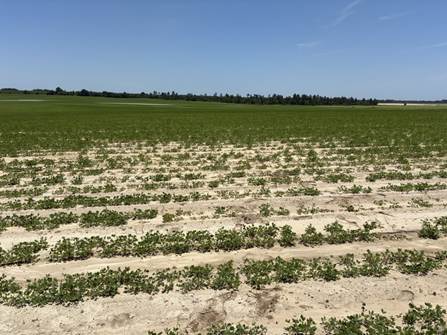
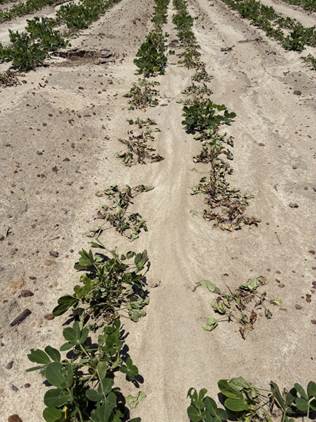
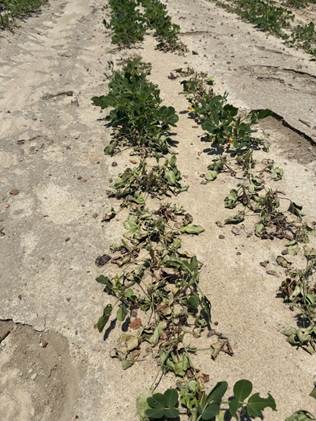
Pics below. It’s a big spot of wilted peanuts. Looks like disease, maybe Aspergillus crown rot IF you look only at individual plants. But the pattern in the field doesn’t fit that as crown rot is scattered. Some thought given to lightning strike, but a bit too big that. I’m thinking it’s likely zinc toxicity- if so one would find the diagnostic split stems. Justin and Big Country are hunting. Why zinc toxicity? Maybe where a galvanized building once was. Maybe an old burn pile. Sometimes after intense corn production or where once stood a pecan grove. Look for split stems….
Cotton Jassid Detected in Georgia (Dr. Phillip Roberts, UGA Cotton Entomologist)
We detected low numbers of cotton jassid adults on okra on the Experiment Station in Tifton today June 10, 2026. We collected 5 adults in about 100 sweeps. The first detected jassids in 2025 was on July 9th by Justin Odom in Seminole county. It is likely jassids had been in that okra for several weeks on that date.
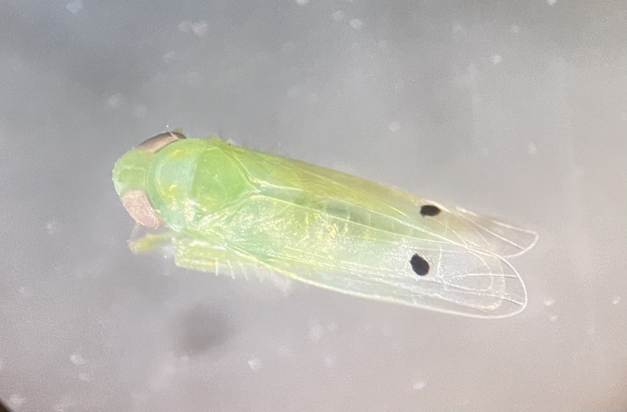
As a reminder we can only identify adults, we cannot identify the immature or nymph stages. Adults can be identified by the presence of two prominent black spots on the wings (see pic by Justin Odom below). If you detect jassids on any plant in your county please let me know. We also plan to track jassid detection in cotton by county. Understanding their movement/migration and spread will provide useful information in 2026 and beyond. So any assistance you can provide would be greatly appreciated. A little effort by a lot of folks can have big impact.
All About The Pod Podcast (UGA Peanut Team)
https://www.podbean.com/eas/pb-imdsf-1acef4d – Episode 12, Season 4 — Planting Conditions, Stands, and Reminders
https://www.podbean.com/eas/pb-xgfe2-1ad7d28 – Episode 13, Season 4 — Rainy Conditions, Planting, and Pest Updates
Talkin cotton podcast (UGA Cotton Team)
Below is a link to the latest Talkin Cotton Podcast. Please note that when we recorded this morning jassids had not been detected but we rerecorded a segment that is at the end of this episode discussing the current jassid situation.
Feel free to distribute as you see fit.