We have planted over half of our peanut and cotton acres in the past 2 weeks, and I would estimate that a little over half of peanut and cotton acres that will be planted this year are emerged. With the recent heavy rainfalls, I have seen some warrant damage to cotton and valor damage to peanut. Prostko has preached for the past several years now that all of his data shows there is no yield impact related to valor damage as long as used according to the label (correct rate, correct time of application), also none of the warrant damaged cotton looks to be threatening the stand of cotton. Over the past 2 weeks UGA extension has planted and installed research plots in Appling County. Current planned research trials include seeding rate study in cotton, a nitrogen rate study in cotton, a cotton and peanut variety trial, and deer feeding impact on peanut production study. The current 10-day forecast shows a 50% chance or greater of rainfall for the next 5 days. The spotty showers over the past few days have given everyone some level of rainfall and little soil moisture is no longer an issue at the moment. The 10-day forecast also shows some cooler days scheduled for next week, Dr. Kemerait has been keeping the agents up to date on how the current weather is affecting plant disease risks and those details can be found further in this update.
Topics in this Update:
- May Peanut Pointers (UGA Peanut Team)
- Row Crop Disease Update (Dr. Bob Kemerait, UGA Plant Pathologist)
- “Cracking” Time Tips for Peanuts (Dr. Eric Prostko, UGA Weed Specialist)
- All About The Pod Podcast (UGA Peanut Team)
- Talkin’ Cotton Podcast (UGA Cotton Team)
- UGA Row Crop Scout Schools in June
May Peanut Pointers (UGA Peanut Team)
Row Crop Disease Update (Dr. Bob Kemerait, UGA Plant Pathologist)
Cool and Wet Dirt
Had two conversations yesterday that I haven’t had in quite a while. The gist of both conversations was the same; “we’ve had more rain than we need at the moment, but we’re not complaining”. I even saw some reports that parts of Brooks Co got over 10 inches of rain the night before last. That much rain, all in one event, will obviously create new problems, some could be disease related.
For example- peanut dirt at the moment is wetter and a bit cooler than it has been. In times such as this, is azoxystrobin or azoxystrobin + prothioconazole better infurrow with our peanuts?” To set the stage, azoxy is a choice fungicide for Rhizoctonia, but no longer Aspergillus crown rot. Prothioconazole is a treatment of choice for CBR (which may occur in Terrell Co, but not that often recently) and possibly, maybe, a little, for early-season White mold. Cooler and wetter soils are more favorable for Rhizoc and maybe CBR, but less favorable for aspergillus crown rot and early-season white mold. Bottom line, I would look at cost.
Crop Protection Network
No southern corn rust is yet reported in Georgia, or anywhere else in the US as of now, but it is coming. My best guess is that about D-Day, 82 years after June 6th, 1944, it will be reported, and probably by our someone far SW of Tifton. But for now, we have not found it. Stay up to date on the status of southern corn rust by checking the link below.
https://cropprotectionnetwork.org/maps/southern-corn-rust

Northern Corn Leaf Spot
See the pic below, these dark lesions are northern corn leaf spot (also known as Carbonum leaf spot) are caused by Bipolaris zeicola. Largely confined to the lower and older leaves, this disease is cosmetic only. Caused by the sister pathogen, Bipolaris maydis, southern corn leaf blight IS a problem, but largely appears later in the season.

Time to spray for southern corn rust on tasseling corn?
I received an urgent call? Their corn will soon be tasseling and he wants to know what the “best” thing to spray is??? I told him… . 1) a compliment for being proactive in disease management. 2) as we are still in May and no rust has been found, a fungicide application now, even on tasseling corn, is premature. It is advisable to wait a bit, unless some other disease, such as northern or southern corn leaf blight is a factor. 3) while some fungicides are better than others, given current conditions- still in May with no rust found, any pre-mixed-mode-of-action fungicide, with price as a consideration, is appropriate. 4) emphasized to him again point 2.
Efficacy ratings for fungicides used in corn
See this chart on the CPN website, note, southern corn leaf blight does not appear; I recommend using the ratings for northern corn leaf blights. (Yes, I am a co-author, my colleagues in bigger corn states do value corn growers in the SE USA)
https://cropprotectionnetwork.org/publications/fungicide-efficacy-for-control-of-corn-diseases
While we’re on this type of subject, a similar page for comparison of soybean fungicides is available at a sister website:
Rhizoctonia in cotton
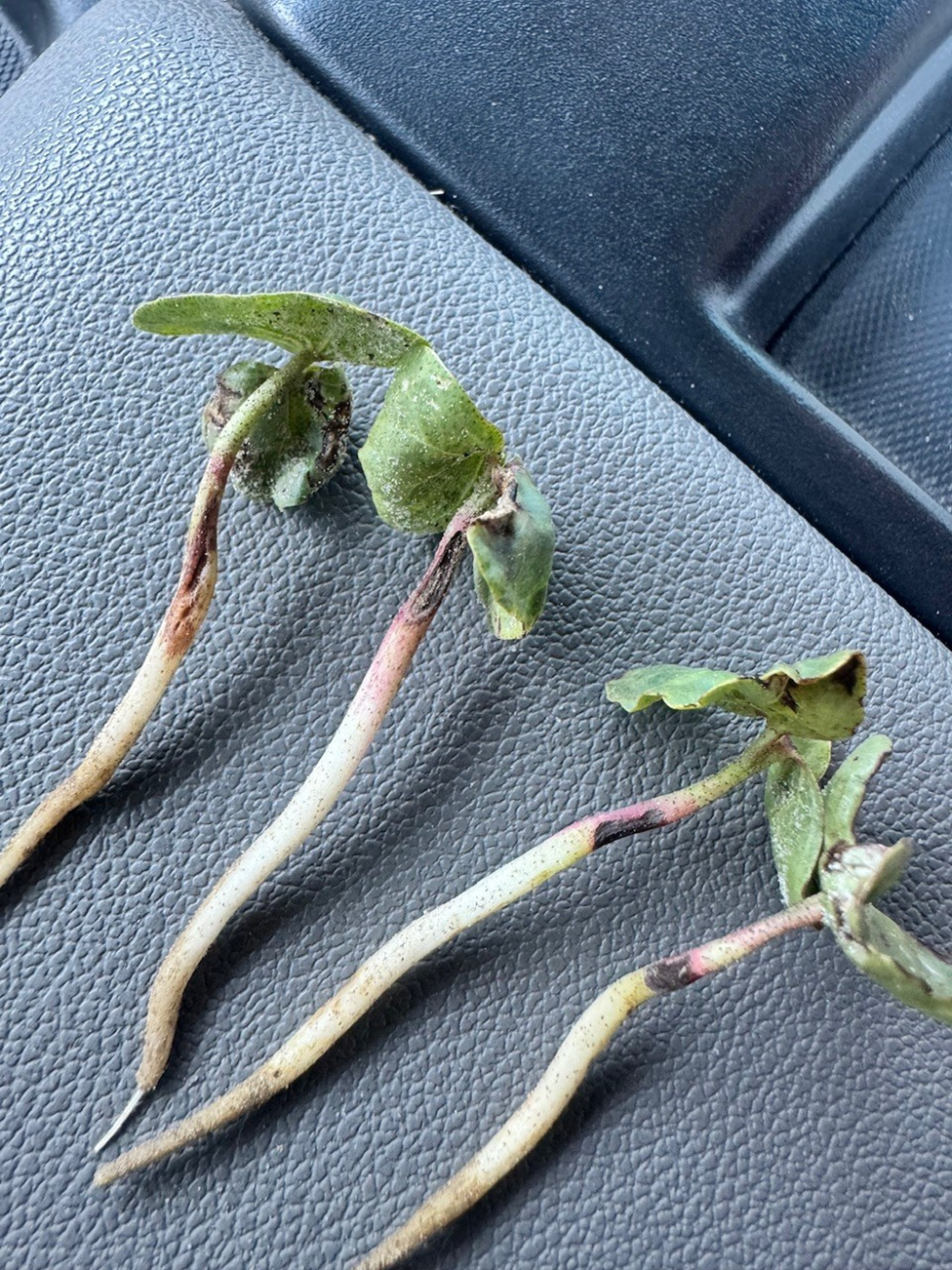
Most of you are familiar with the “disease triangle” where the risk for disease is based upon the presence of the pathogen, presence of a susceptible host, and an environment favorable for disease. Hence, the pic below. Pictured here are excellent examples of seedling disease of cotton (soreshin) caused by Rhizoctonia solani. Note the dark lesions that girdle the young stem just below the soil line. Rhizoc. All cotton seedlings are susceptible to this disease; fungicide seed treatments are a BIG help, but cool soils, slowed emergence, etc last week were just too much. Cool temperatures + cotton seedlings + ubiquitous Rhizoc = seedling disease. One remedy, had we known, would have been to apply azoxy (6 fl oz/A) in-furrrow.
Aspergillus crown rot in peanut
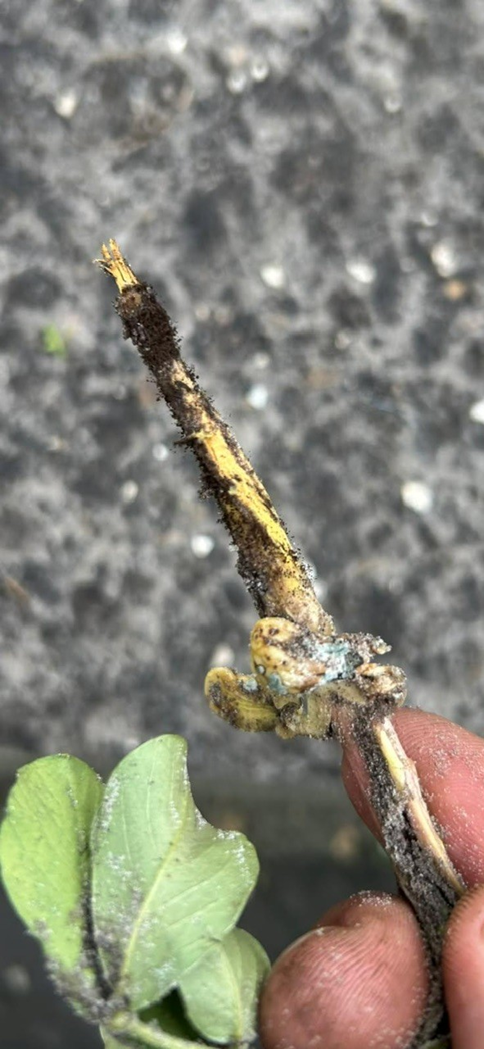
Pic below. They are classic images, classic, of Aspergillus crown rot disease. Not the abundant black, sooty sporulation of the A. niger pathogen. This disease is best managed by, a) planting quality seed, b) avoiding planting into excessively hot, dry soils unless irrigation is available, 3) use of a stout fungicide seed treatment and 4) possibly using fluopyram (Velum) in-furrow. Still very very good pictures. Note the typical shredding of plant tissue… classic.
“Cracking” Time Tips for Peanuts (Dr. Eric Prostko, UGA Weed Specialist)
Many peanut growers are likely to begin or already have begun treating their fields with early-postemergence (“cracking”) applications of Gramoxone (paraquat). Here are a few tips for success as well as some pictures from “cracking” treatments that I applied just last week:
1) Cracking applications can be applied from peanut emergence up until 28 days after cracking. Cosmetic injury (stunting and leaf necrosis) should be expected. Generally, this injury will not result in peanut yield loss as long as the label is followed (i.e. application rate and time). Here is the Gramoxone label for those that might (should) be interested:
https://s3-us-west-1.amazonaws.com/agrian-cg-fs1-production/pdfs/ Gramoxone_SL _3.0 _Label1de.pdf
2) 15 GPA and coarse droplets (VMD50 ≥ 270 microns) are preferred. Gramoxone is NOT LABELED for aerial applications when applied postemergence in peanuts.
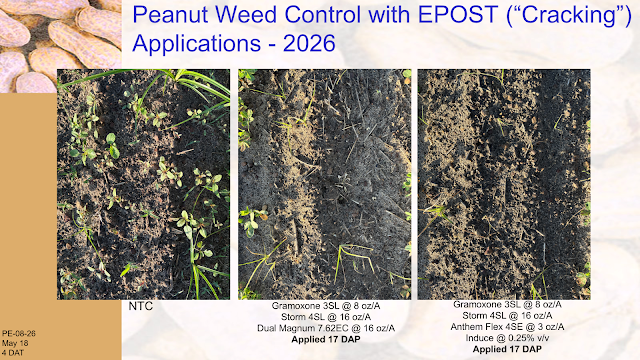
3) The UGA recommended treatment (without walking the field) is as follows: Gramoxone 3SL @ 8 oz/A + Storm 4SL @ 16 oz/A + 1 Group 15 herbicide (either Anthem Flex 4SE @ 3 oz/A or Dual Magnum 7.62EC @ 16 oz/A or Enversa 3ME @ 48 oz/A or Outlook 6EC @ 10.5 oz/A or Warrant 3ME @ 48 oz/A or Zidua 4.17SC @ 2.5 oz/A). I do not have a Group 15 preference. Anthem Flex will cause more cosmetic injury due to one of its active ingredients (carfentrazone, trade name: Aim).
4) NIS @ 0.25% v/v (32 oz/100 gals) should be included except when Dual Magnum or Outlook are used. Both of these herbicides are EC formulations (oil-based) and therefore have adjuvant-like properties.
5) Growers can make their own Storm (aka “Georgia” Storm) by tank-mixing Ultra Blazer 2SL @ 16 oz/A + either Basagran 4SL @ 8 oz/A or Basagran 5SL @ 6.4 oz/A. This is a more appropriate ratio for south Georgia and also will be slightly cheaper.
6) Gramoxone mixing order (from label):
4.4.3 GRAMOXONE SL 3.0 IN TANK MIXTURES: 1. Fill spray tank 1/2 full with clean water or other approved carriers such as clear liquid fertilizer. 2. Add nonionic surfactant to tank 3. Begin tank agitation and continue throughout mixing and spraying. 4. Add dry formulations (WP, DF, etc.) to tank. 5. Add liquid formulations (SC, EC, L, etc.) to tank. 6. Add Gramoxone SL 3.0 to tank. 7. Add crop oil concentrate or methylated seed oil to tank where/if needed. 8. Fill remainder of spray tank
7) Some field pictures from earlier today. Treatments were applied 4 days ago:

All About the Pod Podcast (UGA Peanut Team)
https://www.podbean.com/eas/pb-7mme5-1ab9ee4 Episode 10, Season 4 — Changes in Weather and How Its Impacting Planting
https://www.podbean.com/eas/pb-zxi5j-1ac5ab Episode 11, Season 4 — Weather Update, Planting Considerations for Thrips, Disease and other Pests
https://www.podbean.com/media/share/pb-imdsf-1acef4d?utm_campaign=w_share_ep&utm_source=w_share_pb&utm_medium=dlink Episode 12, Season 4 –Planting Conditions, Stands, and Reminders
Talkin’ Cotton Podcast (UGA Cotton Team)
You Can Fix A Stand Fast If You Fix Downforce: https://www.buzzsprout.com/2350262/episodes/19181874-you-can-fix-a-stand-fast-if-you-fix-downforce
UGA Row Crop Scout Schools in June
Insect scouting schools will be conducted on June 1, 2026 at the UGA Tifton Campus Conference Center in Tifton and June 9, 2026 at the Southeast Research and Education Center in Midville. Crops covered include cotton, peanuts, and soybean.
These programs offer basic information on insect pest identification and damage, natural enemies, and scouting procedures. The training will serve as an introduction to insect monitoring for new scouts and as a review for experienced scouts and producers. Program topics include, Bug and Larval Insect Pests, Beneficial Insects, Scouting Procedures, Safety, and an In-Field Review.
Each program will begin at 9:00 a.m. and conclude at 12:30 p.m
For additional information about the Tifton program, contact Kelly Schauberger at 229-386-3374. For information about the Midville scout school, contact Peyton Sapp at 706-554-2119.