Hunt Sanders
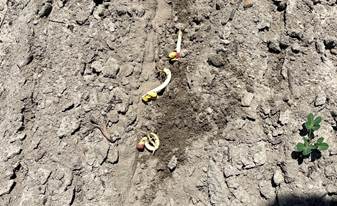
Most of the calls I have receive are related to stand issues. Do some digging. See what percentage of the seed is rotted or germinated. Conditions this year (cool nights and wet after planting) have caused emergence delays up to 16-20 days.
Peanuts: That first week of May planting has had some issues due to heavy rainfall right after planting. For example, out peanut variety trial (planted May 6th) had no emergence at 7 DAP. I took stand counts 12 DAP and had emergence, but stands were skippy Roughly 3-4 plants/ft). Fast forward to 20 DAP, stands were better (5-7 plants/ft).
If you’re stands are averaging 3 plants/ft, I would leave them. If they drop below 3, give me a call. Let’s take some counts and make a decision soon.
Cotton: Similar issues in some cotton stands. Planted and large rain events (4”+) right after planting. This shocks the seed, increases seed rot, and delays emergence. If your stands are averaging 14-15 plants per acre (1 plant/ft), I would leave them. If they drop, let me know and let’s make a decision.

Peanut Herbicide Update:
Lots of cracking sprays going out/soon to go out. Remember 15 GPA, coarse droplets nozzle, spray gramoxone at 8oz + 16 oz Storm.
To make own Storm, 16 oz blazer + 8 oz of 4lb Basagran + group 15 herbicide (Anthem Flex or Outlook or Warrant or Dual Magnum or Inversa or Zidua). If you do not have Prowl or Sonalan out and have bad Texas panicum, use anthem flex or Zidua. They are better on Texas panicum than the other group 15s.
Pigweed in peanuts:
Most populations of Palmer amaranth in Georgia have some level of resistance to Cadre and other ALS inhibiting herbicides (WSSA/HRAC Group 2). Consequently, UGA recommends that peanut grower’s tank-mix either Cobra or Ultra Blazer with Cadre when applied postemergence in peanut fields with emerging populations of Palmer amaranth.
Do I cut out Thimet now that its late May?
Check peanut Rx, if you are in a low-risk situation of TSWV, then it is not a WRONG decision, but do realize you are still at risk. Even though you are at low risk, you’re at a higher risk than if you include it.
You have to decide what’s best for your farm.
Options could include dropping Thimet and putting out imidacloprid, or don’t put anything out, then come back at 14-17 days with acephate spray. Come back and check the peanuts. Are there adult trips? If not, may not need anything.
For southern corn rust, what is the BEST fungicide?” Dr. Bob
This is a really hard question, especially now, when conditions are favorable for southern rust and corn is tasseling, BUT we haven’t found any. If corn in the state of Georgia was in a firefight with southern rust (we aren’t) and your corn was about to tassel, I would say that anything you spray should meet the standard of TrivaPro. I didn’t say spray TrivaPro. I said it is the standard. But what about now? If I was most corn growers with corn at tassel, I would wait and see, at least for a little while. Southern rust does not go from 0 to 60 in a New York minute. And, also, I believe that if you do spray a fungicide on this early-planted corn, consider timing, mixed-mode of action products, AND cost.
Do fungicides protect stalk integrity? In my wheelhouse, only if they are truly protecting the crop from a blistering epidemic of rust. Southern rust can suck the life and strength out of a corn stalk. “Can” but “NOT ALWAYS” are key words.