Hunt Sanders
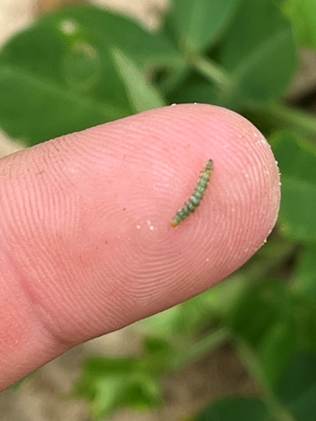
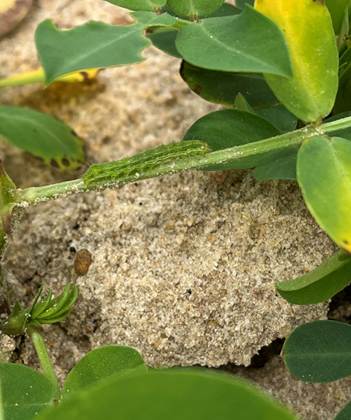
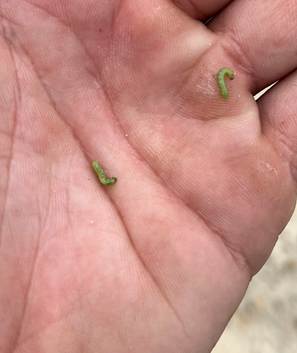
Tobacco Bud Worms (TBW) (Figures 1 and 2) and Beet Army Worms (BAW) (figure 3) in Peanuts.
I have started finding TBW and BAW in young peanut fields. Current populations are low, with counts generally below 0.75 worms per foot.
Given the small size of the peanut plants, I would consider treatment when populations reach approximately 2 worms per foot to avoid defoliation or “Stripping of the plants”. At this time, I suspect parasitic wasps and other beneficial insects will help suppress these populations before they become economically significant.
It appears there may have been a recent moth flight, but overall moth numbers seem relatively low. For now, growers should simply be aware that these pests are present and continue to monitor fields closely.
Questions and Answers from Today: Field Corn, Grain Sorghum, Soybean, Peanut (Prostko):
This morning was an interesting day for various weed science related questions on multiple crops (field corn, sorghum, soybean, peanut). Since most questions are common to all (sooner or later), I thought I would share:
Question#1: How much Dual on Concep treated sorghum would it take before you would start seeing damage?
Answer#1: Probably would need to be above 2.5 pts/A on our soil types before you would start seeing significant injury. Research from Kansas State University a few years ago would suggest that what would be the equivalent of 4 lb ai/A of Dual Magnum (4.2 pts/A) did not cause major yield losses when Concep treated sorghum seed was planted.
Check out this 1992 publication from Kansas State University:
Dual Injury Pictures on grain sorghum:

Question#2: Is this herbicide injury on field corn?

Answer#2: No, this is not herbicide injury. Most likely a magnesium deficiency which can be confirmed via a leaf tissue test.
Question#3: I have a peanut field that rain kept us from spraying behind planter. No herbicides have been applied. What do you suggest?
Answer#3: If peanuts are less than 28 days after cracking: Gramoxone 3SL @ 8 oz/A + Ultra Blazer 2SL @ 16 oz/A + Basagran 4LC @ 8 oz/A + Zidua 4.17SC @ 2.5 oz/A or Anthem Flex 4SE @ 3 oz/A + NIS @ 32 oz/100 gals (0.25% v/v). Zidua or Anthem Flex would be preferred in this situation because they both contain pyroxasulfone which is slightly better on Texas panicum than the other Group 15 herbicides (Dual Magnum, Enversa, Outlook, Warrant) and neither Prowl nor Sonalan was applied.
Question#4: Can I apply Prowl over the top of soybeans (V5) at 16 oz/A?
Answer#4: Prowl is NOT labeled for postemergence (POST) use in soybean. When applied POST, I have seen it cause galling at the soil surface which can result in stem breakage later in the year. NO Bueno! Group 15 herbicides can be used.
Question#5: I have peanuts that are now 33 DAP that have mostly nutgrass but some escaped pigweeds and sicklepod. I am assuming the pigweeds are ALS-resistant but they are 2-3″ tall while nutgrass is pretty thick in places. Would it not be best to spray Cadre + 2,4-DB + Dual and hope the 2,4-DB takes out the small pigweed? I don’t want the nutgrass taking over.
Answer#5: 2,4-DB is not very effective for pigweed control when tank-mixed with Cadre but it does help with other weeds such as sicklepod and morningglory. In this case, I would suggest the following: Cadre 2SL @ 4 oz/A + Cobra 2EC @ 12.5 oz/A or Ultra Blazer 2SL @ 24 oz/A + Dual Magnum 7.62EC @ 16 oz/A + 2,4-DB 2SL @ 16 oz/A. Other Group 15 herbicides (Enversa, Outlook, Warrant, Zidua) can be used in place of Dual Magnum if desired.
Question#6: Can I use Basagran + Dual Magnum for Benghal dayflower/tropical spiderwort control in peanut and should I add a crop oil to this mixture?
Answer#6: Yes, Basagran 4LC @ 32 oz/A + Dual Magnum 7.62EC @ 16 oz/A is a very effective treatment for dayflower species. Additional crop oil is not needed because the Dual Magnum is an EC (oil-based) formulation and has adjuvant-like properties.
