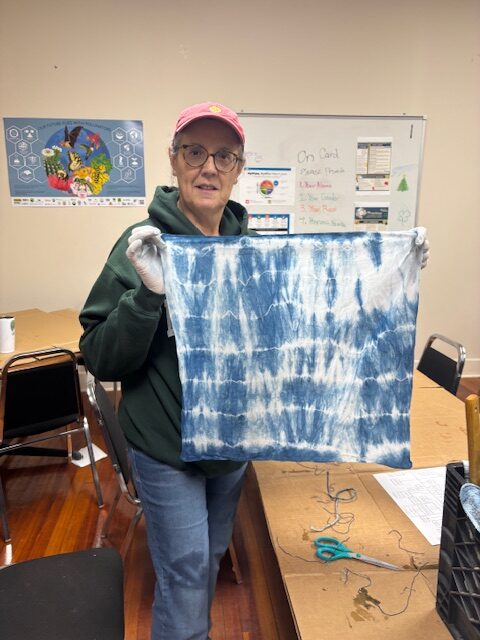
Working with a former cash crop to dye bandanas, we discussed the history and dye making process of Indigo. This month (December 6) we hosted our monthly Meet Me in the Garden program with the topic of Indigo. After, we participated in dying bandanas with Indigo.
History
Indigo has been used for centuries to dye textiles. Records of use in Peru date back to 4,000BCE.
In 1755 Georgia began its Indigo exportation, following South Carolina’s lead. It peaked for Georgia in 1770 and became the primary cash crop. This boom lasted until 1897 when indigo was first synthesized.
Dye
In order to produce the dye, indigo branches would be cut off the main stem and submerged in a vat full of water. Over the next day, the fermentation process would start. Part of the liquid is pulled off the top and mixed well to add oxygen into the watery mixture. Finally the famous blue color would start to emerge. There is a sediment that will fall out of the mixture that would be pressed and dried into brick-sized molds to give a final product that is easily transported and sold.
Sourced from: New Georgia Encyclopedia: Indigo
Pictures