by Marcia O’Shaughnessy, Fulton County Master Gardener Extension Volunteer
This article is part of Garden Buzz, a series from Appen Media and the North Fulton Master Gardeners, where rotating columnists explore horticulture topics like herbs, insects, and wildlife conservation. Find all Garden Buzz articles here.
Pruning our woody trees and shrubs is one of the most important parts of caring for them. There is a purpose for every plant you have in your landscape: it could be there for privacy, for flowers or fruit, or to support local wildlife.
The urban environment causes plants to grow differently than they would in their native habitat. Trees in a subdivision get much more sun than they would growing in a forest where their growth is focused upward toward the sun. In a subdivision, trees can develop heavy side branches and uneven growth that leads to splitting, breaking and falling on our homes and cars.
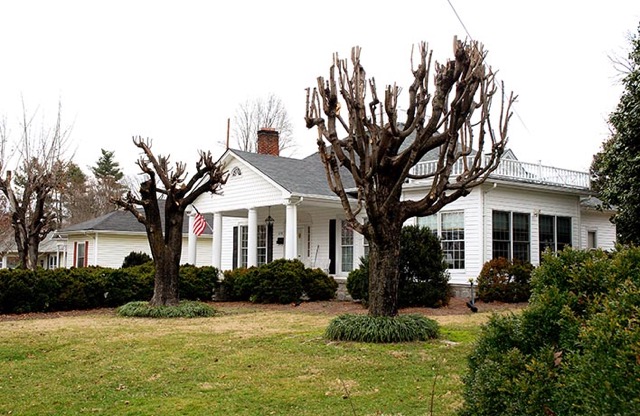
Structural pruning safeguards the function of large shade trees and protects property. Shrubs grown for hedges are often enthusiastic, vigorous growers requiring attention to keep them in the desired bounds. If flowers are the desired goal, the timing of pruning is critical. Pruning a young plant creates the framework for the plant to do what you want later on. The earlier you begin guiding the plant in the direction you want, the better.
In order to do that, you must have a basic understanding of plant growth and how plants respond to pruning. When a seed germinates and begins to grow, it only grows from one point, the very tip, called the apex or the terminal bud. This apex produces a hormone, auxin, that flows down through the plant and inhibits the growth of any lateral or side buds. This is called apical dominance, and the strength of it varies from species to species. When the apex is cut off, the flow of auxin is stopped and directed to lateral (side) buds, which begin to grow.
Pruning stimulates new growth
The size of the root system remains the same, and it’s now supplying a smaller plant. The remaining leaves and branches are getting an increased flow of nutrients and more light, and the plant will respond with greater growth.
The two basic pruning cuts
Heading cuts off the terminal buds, eliminating apical dominance and stimulating growth near the cuts. This is the most invigorating, sometimes aggressive, type of pruning and results in dense compact growth and loss of the natural plant form.
This is the type of pruning best used for hedges and can be used to rejuvenate some, not all, overgrown ornamental broadleaf shrubs, such as crape myrtle, holly, and ligustrum. These shrubs can be cut back severely to 12 inches and they will recover.
Thinning retains the natural form of the plant and is the least invigorating style of pruning. It is accomplished by cutting back an entire branch to its point of origin. Because apical dominance is undisturbed, there is not a lot of bushy side shoot growth. Thinning is important in maintenance: to guide the direction of growth, shorten branches, and let light and air into the crown.
The best time to prune
The best time for structural pruning of trees is in the winter, when sap flow is at a minimum. The worst time is in spring, when sap is surging to push out new growth.
When the leaves are off the trees, it’s easy to see the form of the tree and think about what the goal is for the tree. Look for the four Ds: dead, diseased, dying or damaged wood. That is the first and easiest step to take. DYI trimming can be done up to 12 feet without a ladder, and up to 20 feet with a pole tool. Wear a hard hat for trimming tall limbs, and always wear safety glasses to protect your eyes. With anything taller it is best to hire an ISA Certified arborist.
Pruning flowering shrubs
Pruning flowering shrubs, on the other hand, can be a little more complicated, as pruning at the incorrect time can prevent future flowering. Prune spring-flowering shrubs (lilac, azalea, spirea, etc.) right after they finish blooming, before they set buds for next year. Summer- and fall-blooming shrubs should be pruned in late winter or early spring.
These techniques do not apply to conifers, or cone-producing evergreens with needle-like leaves. Conifers will not grow back if pruned past the green part of a branch.
It is important to care for your pruning tools by keeping blades sanitized, sharp and clean. Painting wounds made by pruning is not advised. Correct cutting technique is the best guarantee of clean healing. When pruning, it’s important not to damage the branch collar, a ring of tissue at the base of a branch, and the bark ridge, a ridge of tissue where two branches come together. Prune just outside of these areas, and don’t leave a stub. Stubs slow healing and provide entry for disease.
Now is the time to take this information out into your landscape. Start with the easy step first: identify the four Ds – dead, damaged, dying, and diseased. Then look at your trees and shrubs through the lens of purpose and ask yourself what you want this tree or shrub to do. Form follows function, literally in this case!
Happy Gardening!
About the Author

Marcia O’Shaughnessy is a Master Gardener who believes in the value the Extension Service plays in improving the lives of Georgians by returning to them the information and advances made at the University of Georgia. In 1995 she was given a copy of ‘Gardening with Native Plants of the South’ by Sally Wasowski and had an epiphany after reading the book, becoming a staunch believer in the importance of native plants, especially in the suburban landscape. She is very happy that they are no longer the sole province of specialty nurseries, but readily available most places plants are sold.
