Climate science
-
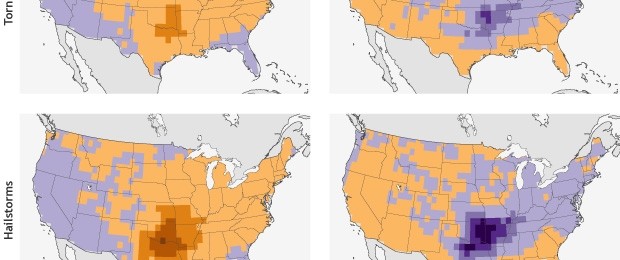
A new study released by NOAA last week shows that in El Nino years, the number of tornadoes and hail storms decreases compared to non-El Nino years. As you might expect, in La Nina years, the opposite of El Nino, severe weather increases in the Southeast. Note the split between the Florida peninsula and more…
-

The NOAA Climate blog had a long article last week on global impacts of El Nino on summer climate. It talks about what we might expect to see in other parts of the world this year and what the impacts are in the United States as well. You can read their blog here.
-

The journal Science published an article today which shows an updated historical climatology of global temperatures produced by NOAA. The newly revised temperature timeline shows that unlike previous analyses, the new timeline shows that there has been no substantial slow-down in the rate of temperature increase on the globe. The previous theory about the “hiatus”…
-

The Florida Climate Institute has a page of FAQ’s (frequently asked questions) available on the topics of climate variability and climate change in Florida and the Southeast. While some of the answers are specific to Florida, many of them are applicable across the Southeast. You can find them at https://floridaclimateinstitute.org/resources/faqs#faqnoanchor. They also released a press statement…
-
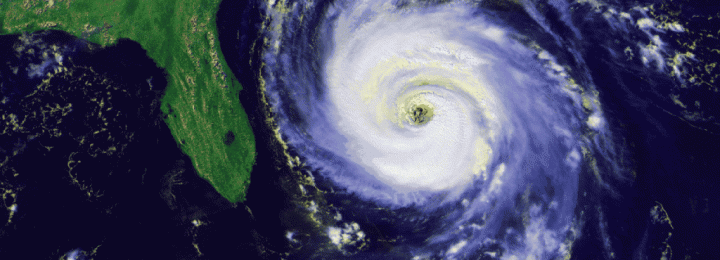
Today is June 1, and that means the official start to the Atlantic hurricane season. Of course, this year we’ve already been visited by Tropical Storm Ana, which brought rain to the eastern Carolinas and some high surf along the coast. Quite a few other seasons had a storm before the “official” start date, so…
-
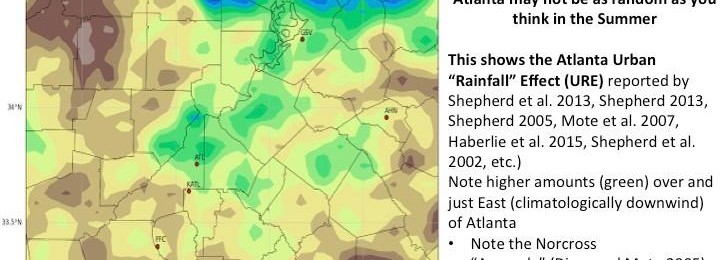
Jordan McLeod of the Southeast Regional Climate Center put together this nice graphic showing the impact of Atlanta on summer rainfall in North Georgia. Dr. Marshall Shepherd of UGA provided the commentary and posted it on Facebook.
-
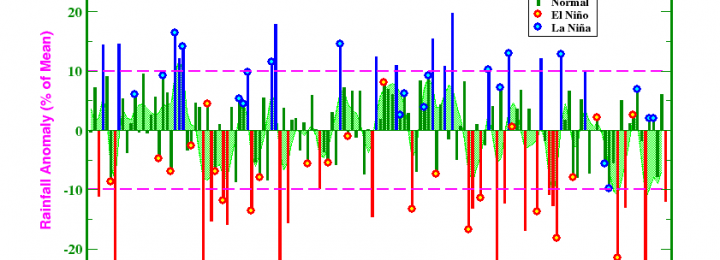
A heat wave in southeast India has caused the deaths of over 1,100 people over the last week. India recorded its highest maximum temperature of 47 degrees Celsius — 117 degrees Fahrenheit — at Angul in the state of Odisha on Monday, according to B.P. Yadav, director of the India Meteorological Department. The extreme high…