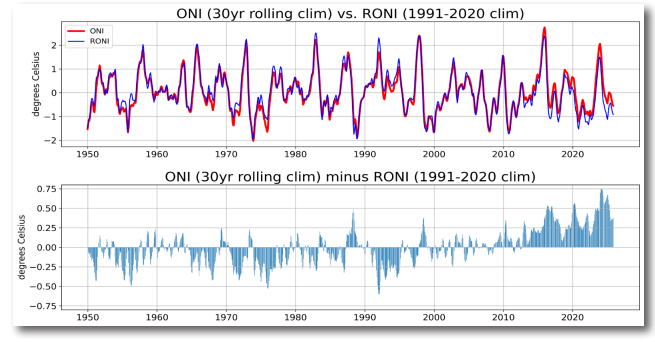
NOAA’s Climate Prediction Center noted that they are updating the index they use to track the rise and fall of El Nino and La Nina to a new index that is less affected by the trend towards rising temperatures than previously-used indices. Here is what they say: “The Climate Prediction Center is making the shift to use the Relative Oceanic Niño Index (RONI) to better designate past events and predict future ENSO. The traditional Oceanic Niño Index (ONI) relies on a departure from 30-year average that struggles to keep pace with anomalous changes in tropical sea surface temperature (SST), which is particularly problematic in real-time when using a time lagged climatology. RONI solves this problem by comparing the ENSO region to the global tropics, thereby reducing the dependency on the climate base period.” You can read more about it and view their information circular at https://www.cpc.ncep.noaa.gov/products/analysis_monitoring/enso/roni/announcement.php. You can also see their newly reclassified historical index for years back to 1950 at https://www.cpc.ncep.noaa.gov/products/analysis_monitoring/enso/roni/.