Hunt Sanders
Preparing for the season:
One of the most important things you can do to protect yourself, your farm, and steward pesticide use is by keeping good records of what you do during pesticide applications. If you don’t already have a good pesticide record keeping system, I encourage you to reach out soon to get something set up that fits you and your operation. There are lots of tools available, including both digital and paper based. It’s important to pick something that’s easy for you to keep up with when the season gets hectic. If you like paper forms, consider making yourself a notebook to keep in every sprayer/spray tractor.
It doesn’t matter how good our records are, if we aren’t safe in the way we use pesticides, then that means game over for the ability to continue using them in the future.
Your health, and the health of your family, is worth more than feeling uncomfortable when wearing PPE
Managing Potassium:
Potassium plays a vital role in regulating water movement, enzyme activation, photosynthesis, and overall plant stress tolerance. Adequate potassium levels support strong vine growth and help plants withstand drought and disease pressure.
However, in peanut production systems, more is not always better. High levels of potassium, especially when concentrated in the upper soil profile, can interfere with calcium uptake by developing pods. This competition between potassium and calcium is particularly important because calcium is not translocated within the plant. Instead, developing pods must absorb calcium directly from the surrounding soil environment.
When potassium levels become excessive, particularly in the top four inches of soil where pod development occurs, calcium availability to pods can be reduced. This imbalance can lead to serious quality and yield issues.
One of the most notable consequences of excessive potassium in peanut fields is an increased incidence of “pops”. In addition to pops, high potassium levels have also been associated with increased risk of pod rot. Pod rot can be caused by a complex of soilborne pathogens, and while potassium is not a direct cause, nutrient imbalances can weaken pod integrity and increase susceptibility to disease pressure.
The recommended approach is to apply potassium during pre-planting or early growth stages, allowing time for the nutrient to move into the soil profile before peak pod development begins.
Insect management for peanuts?
Though thrips pressure is predicted to decline over the next few weeks, I still expect peanuts to have injury. It only takes a couple adult female thrips on a peanut plant to lay enough eggs to cause significant injury. Peanuts with an effective in-furrow insecticide will likely not need any additional management, but if a grower did not apply an insecticide at plant or if there was an application problem, a foliar insecticide application will probably be needed.
Though not common, be on the lookout for foliage feeding caterpillars in peanuts later this month. Tobacco budworm can occasionally cause severe defoliation on seedling peanut, and it does not take long for this to happen when plants are small.
Splits and “bald” peanuts
Growers need to inspect the seed before planting. If they’re seeing an elevated number of splits, or what we call bald peanuts, they need to decide: Is this OK for me to live with and bump the seeding rate up, or do I need to encourage a grower to send them back? I would say it is easy to overestimate the number of split/bald peanuts in a bag, as they stand out. (see pictures from David Hall).
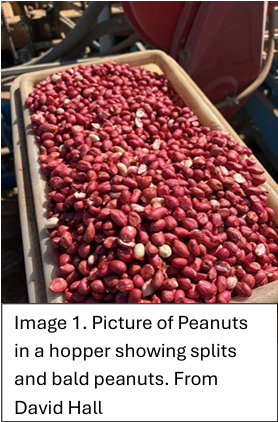
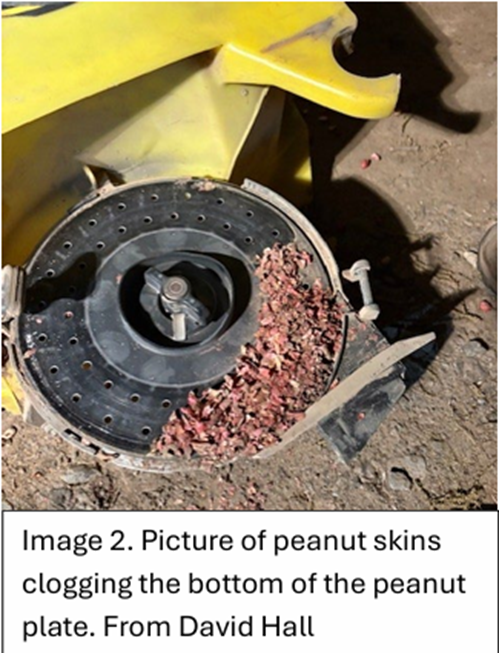
You might want to take a handful and calculate the percentage rather than visually estimate the percentage. Prostko took some samples and calculated the percentages for some of the seeds he had. He said that, visually, it looked like 10% of the sample were split or bald peanuts, but it turned out to be under 4% after he counted. In other words, it can look worse than it is.
A few Things to consider:
1.) Protect your seed by keeping it dry and out of harsh conditions
2.) Know the germination percentage of each variety/lot that you have. You can send samples to the GA Dept of AG seed lab if you want to check germ before you plant. It takes ~10 days to get a germ sample back.
3.) No fertilizers are recommended in-furrow on peanuts.
4.) Inoculants are a cheap and effective insurance practice to ensure you get good nodulation. Inoculant is strongly recommended if the field has not had peanuts planted in 4 or more years.
5.) Planting more than 7-8 seeds per foot tends not to provide a return on investment unless you know you have germination issues with a specific variety and you have to plant it. Even then, do not plant more than 7 seeds per foot on singles, as you will increase the risk for seed rot.
6.) Make sure to revisit each field in 7-14 days to ensure you have a good stand and do not need to replant or spot plant.
7.) There are a few cool nights predicted in the next week. This will slow down emergence some
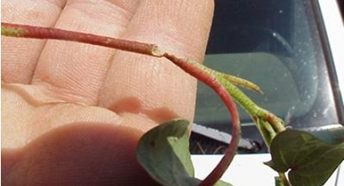
Grasshoppers: An Unpredictable Pest: Grasshopper problems are sporadic, isolated, and almost always associated with reduced tillage fields. Grasshopper damage is unpredictable but can potentially threaten a stand. Grasshoppers may feed on foliage, but most economic damage occurs when grasshoppers feed on the main stem of small seedlings. See below images of plants damaged by grasshoppers.

A few things to remember in Corn production
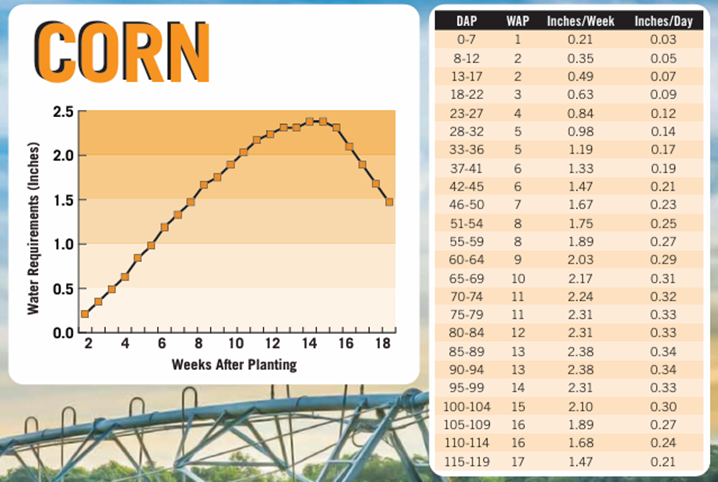
- Don’t get behind on irrigation: The utilization of any irrigation scheduling method is typically better than no plan or method at all, particularly with corn.
- The most simple and practical way of scheduling corn irrigation is to use a moisture balance or checkbook method.
- Systems such as Irrigator Pro (software by USDA), or other scheduling apps such as the SI CropFit (formerly SmartIrrigation Corn App) are typically free and available to help you make decisions regarding when to irrigate
- Monitor for disease and insects
- Nitrogen applications after pollination are currently NOT recommended unless a severe nitrogen deficiency is detected.
- All sulfur should be applied in the sulfate (SO4) form. Applications with nitrogen may prove efficient.
- It is best to apply boron with the nitrogen application. The application of other essential nutrients should be based on plant analysis results.
There are several resources your county agent has access to for assisting the public:
- SpotOn Digital Sprayer Calibrator & nozzle cleaner tool – Accurate flow rate checking of individual sprayer nozzles.
- Fertilizer Spinner-Disc Spreader Calibration – spread pattern testing of fertilizer spreaders.
- Hay Moisture Tester – Evaluation and assessment of hay to bale at optimum moisture content – decrease mold growth and increase feed value. Test baled or unbaled (in field)
- Forced Motor Planter Calibration – at-plant insecticide hopper box calibrations. Potential benefits: increase insecticide application efficacy with the appropriate and effective application of product label and recommended control rate. Decrease
- Mobile Irrigation Lab – Pivot efficiency evaluation/Irrigation audits to support water conservation and decrease irrigation costs.
- Harvest Moisture Testing – Corn and soybean moisture testing to decrease drying time and fuel costs.
- Enviroscape Watershed Model – Environmental education programming tool. Interactive demonstration of the sources and effects of water pollution. Present and illustrate watershed/stormwater concept.
- Rainfall Simulator Tabletop Educational Program tool –
- Digital wind meter educational tool – Anemometer measures wind speed to support safe pesticide applications and reduce drift.
- Pivot Calibrations
- Drone imagery/scouting