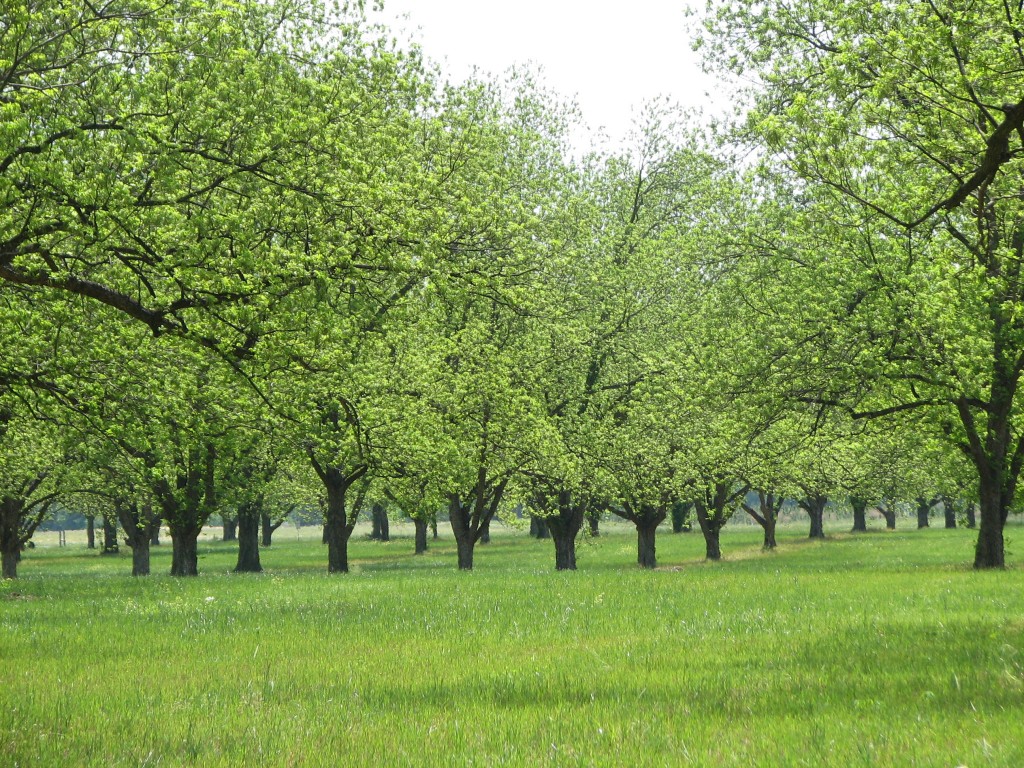
The summer solstice just passed and we are about half-way through the 2026 pecan season. As each year does, 2026 has come with its own set of conditions. Overall, I would say that over the state as a whole, the crop looks a little better than last year. Our pecan bloom appeared strong in April and we had good pollination conditions through May, which was warm and excessively dry throughout the state. This, of course helped a lot with leaf scab pressure and it was very light up to the end of May/early June. However, since that time the scab pressure has ramped up considerably. More on that later. June also brings with it the expected nut drop and we have seen the typical drop on Desirable. From the trees I have seen, it appeared heavier on older Desirables than on younger trees. Most other varieties have seen some level of drop as well. This is nothing out of the ordinary. This “third drop” of pecan is accentuated by self-pollination (which can occur to an extent even when pollinators are present in the field given the right set of conditions and timing of flower development) and drought. Most evidence points to this being a result of poor endosperm development. Endosperm is the liquid inside the nut that nourishes the kernel as it develops. This drop is a natural part of the tree’s biology.
As the season has progressed, the crop looks more hit and miss than it appeared early on. The older Stuarts, Schleys, and Moneymakers seem to be the most spotty, with light crops on those trees that had a good crop last year. Younger trees of newer varieties appear to have a better crop than many of the older orchards in many locations, which is not much of a surprise. From what I have seen and the folks I have talked with, the crop in East Georgia is a little more variable than West Georgia and the crop around Ft. Valley may be a little lighter than we had hoped.
The biggest concern at this point is of course, scab. We had a stretch of several rainy days in a row at the end of May and the last week has been very wet, with up to 6″ reported in some locations over a series of daily rain events. This provided optimal conditions for scab development and we are seeing scab show up, primarily on nuts at this point. Much of this has been in orchards with poor air flow, primarily those that are planted tight or in low areas and areas surrounded by woods. But, given the conditions, scab could show up anywhere at anytime. This brings up the question of what to use to protect the nuts at this point. Not much has changed in answer to that question. The top nut scab products remain Miravis Top, Miravis Prime, and Dodine or Dodine/Tin combos. When scab pressure is high, there is always the temptation to rely heavily on the “cadillac” products, in this case Miravis Top and Miravis Prime. You definitely need those as part of your fungicide rotation from here out, but I can’t caution you enough about overuse of these products (and all fungicides for that matter).
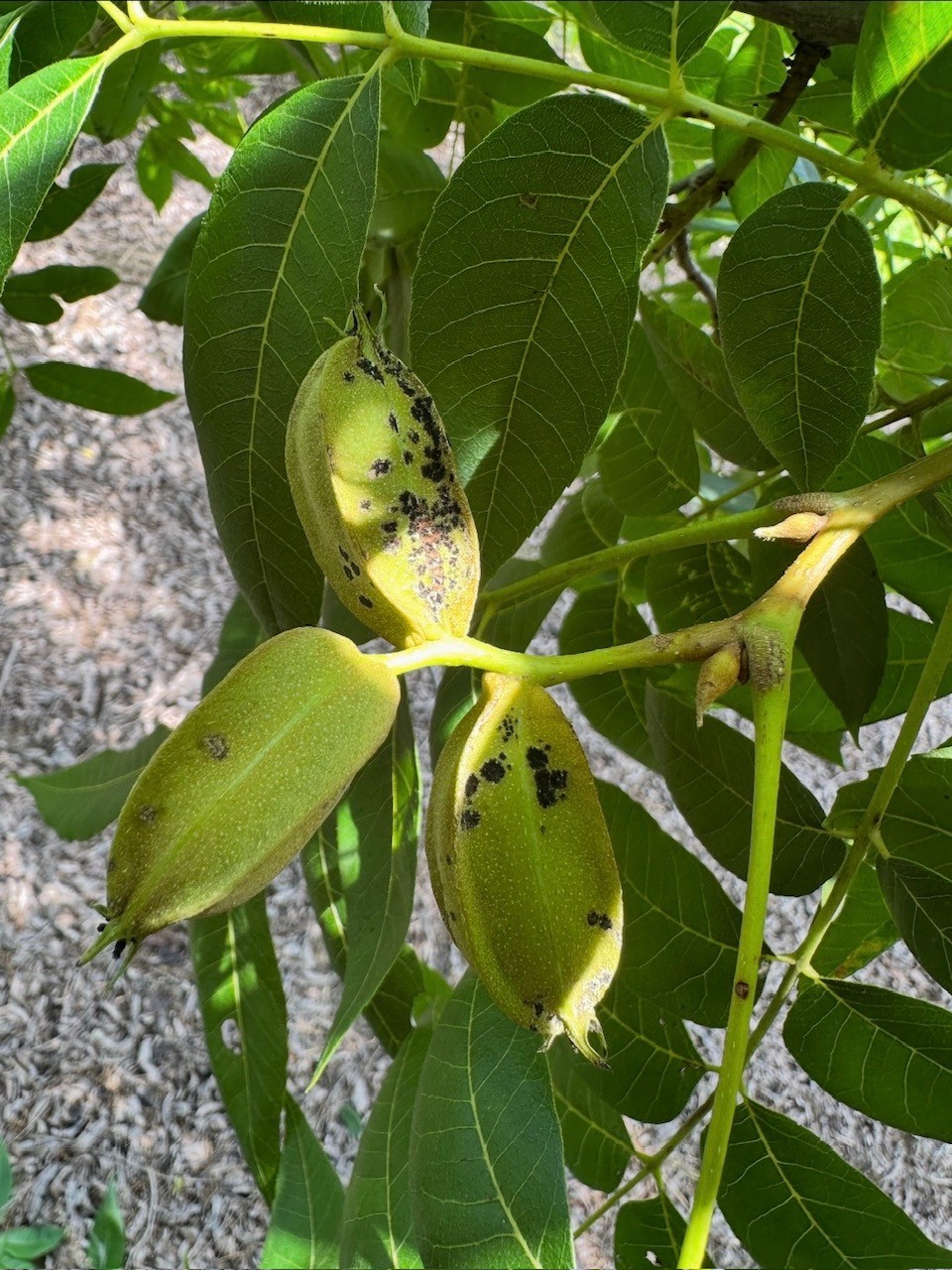
Our pathologist, Dr. Clemen Oliveira has observed some cases of insensitivity development with Miravis Top and Miravis Prime in 2025 and 2026. It is not occurring everywhere but it has been found in more than one orchard in different areas of the state. These products have been a game-changer for us in control of nut scab and we desperately need them to remain so. That can only happen if we are good stewards of this chemistry. You don’t want to over-use these materials. This is why we recommend them ONLY for nut scab season from June-August. They work on leaf scab as well but we have other materials that do a great job on leaf scab. We need the Miravis products for nut scab.
While the label says you should use no more than 2 sequential applications of Miravis Top, I strongly caution you against using any Miravis products back to back. We feel it is best to rotate Miravis Top or Miravis Prime with Dodine or Dodine/Tin every spray. Miravis Top has two fungicide chemistries, a group 3 and a group 7. Miravis Prime also has two chemistries, a group 7 and a group 12. Therefore if you spray Miravis Top and then go to Miravis Prime the following spray, you aren’t really rotating chemistries. You are throwing that group 7 out there two sprays in a row, making it that much easier for scab to adapt to it and develop resistance. For the purposes of rotation, you should treat Miravis Top and Miravis Prime as the same product. The same goes for rotating Miravis Top with something like Custodia or TopGuard or Absolute or anything with a group 3. The best rotation partners for the Miravis products are Dodine or Dodine/Tin. The Dodine/Tin combo still provides some of the best nut scab protection out there. By the label it is suggested to use the Miravis products only 4 times per season. However, in the interest of protecting the future of this chemistry, I recommend trying to keep your Miravis product applications down to 3 per season if possible, using them at critical times (now through July) and rotating them each time with Dodine or Dodine/Tin until mid August and never use them back to back.
We have also seen a little anthracnose out there on leaves in some orchards. Anthracnose symptom expression is latent, meaning the infection occurs weeks prior to symptom development. Once you see symptoms it is too late to do anything about it. Most growers are spraying one of the phosphite materials early season (April/May). Some are also rotating in group 3 fungicide during that time. These are the best products out there for anthracnose but even when using them, the disease can creep in given the right conditions largely just due to timing of the sprays. Diseases like this often come in when we are trying to stretch out scab sprays. Bear in mind that although you may see anthracnose in an orchard, it would likely be a lot worse without the use of these products.
Don’t fall asleep on shuckworm. You should already have the first shuckworm spray on Pawnee and there will be another due in a few weeks. For most varieties, early July would be a good timing for the first shuckworm spray and you will get the second in August if you are spraying for stink bug/weevil at that time.
Finally, given the high cost of fertilizer this year, many growers chose to go with a lower N rate early on in their split applications. If you have a good crop and are considering making that second N application, you can do that anytime from now through August. This second application will primarily be helping the tree for the following year so timing is not that critical. With this in mind, you may want to check around on fertilizer prices. I was told by a fertilizer dealer last week that prices are coming down, dropping about $40/ton from two weeks ago to last week, and further drops are expected. So, if you are planning that second application, you may want to hold off and see if the price comes down a little more. I don’t think the trees will know the difference in waiting a few weeks.
