by Carole MacMullan, Fulton County Master Gardener Extension Volunteer
This article is part of Garden Buzz, a series from Appen Media and the North Fulton Master Gardeners, where rotating columnists explore horticulture topics like herbs, insects, and wildlife conservation. Find all Garden Buzz articles here.
What can be discovered on a walk through the woods? The most obvious answer is trees, but there is so much more to be discovered: wildflowers in bloom, mushrooms, ferns, moss, leaves, acorns, deer, squirrels, chipmunks, invertebrates, soil microbes and even evidence of past human habitation. Since I moved to Milton in 2008, I have been intrigued by a large rock found on a wooded section of Milton. At some point in time, the rock, now located on private property, was altered to produce the image of human face. What secrets of the past can this unique rock reveal?
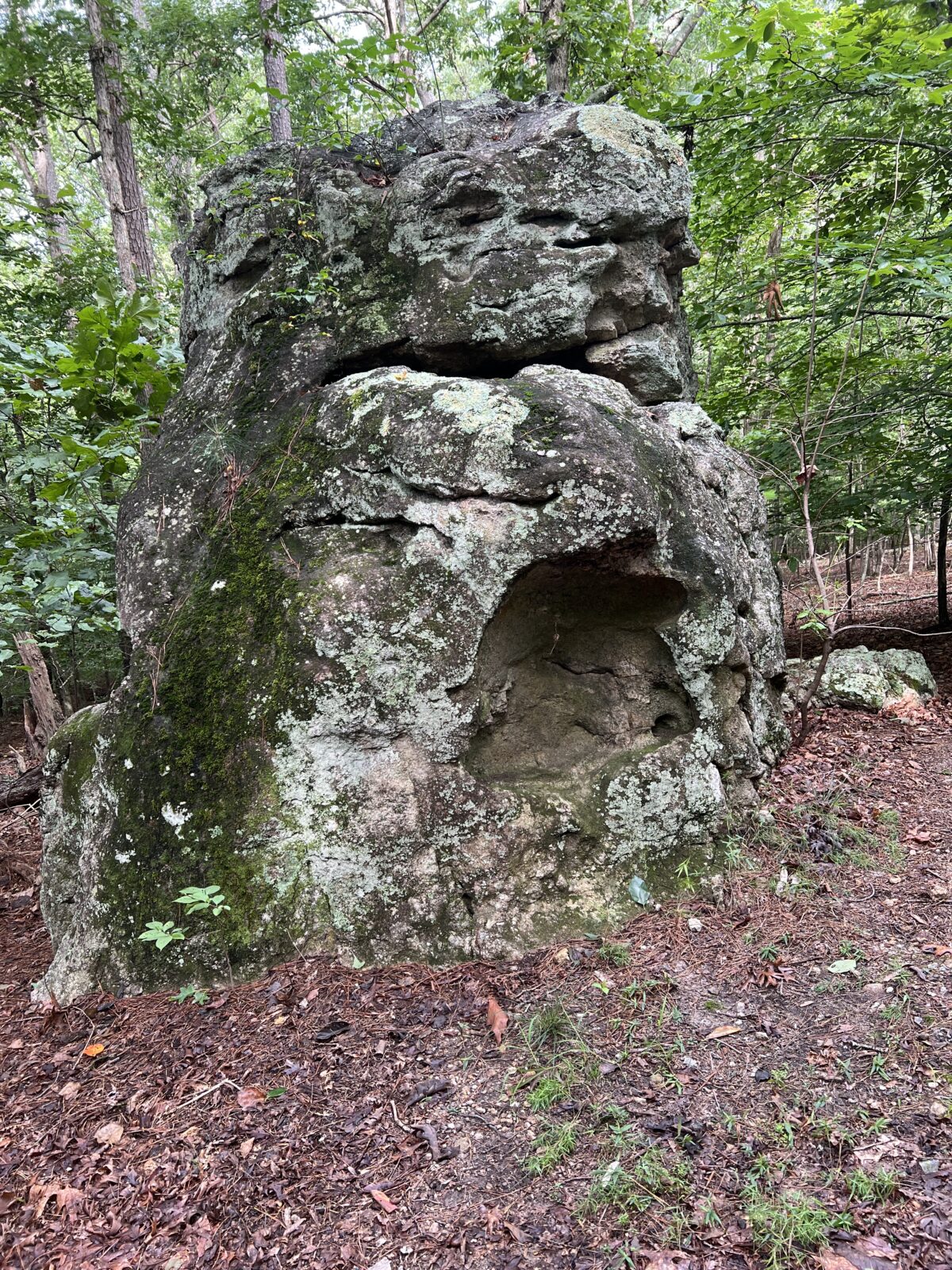
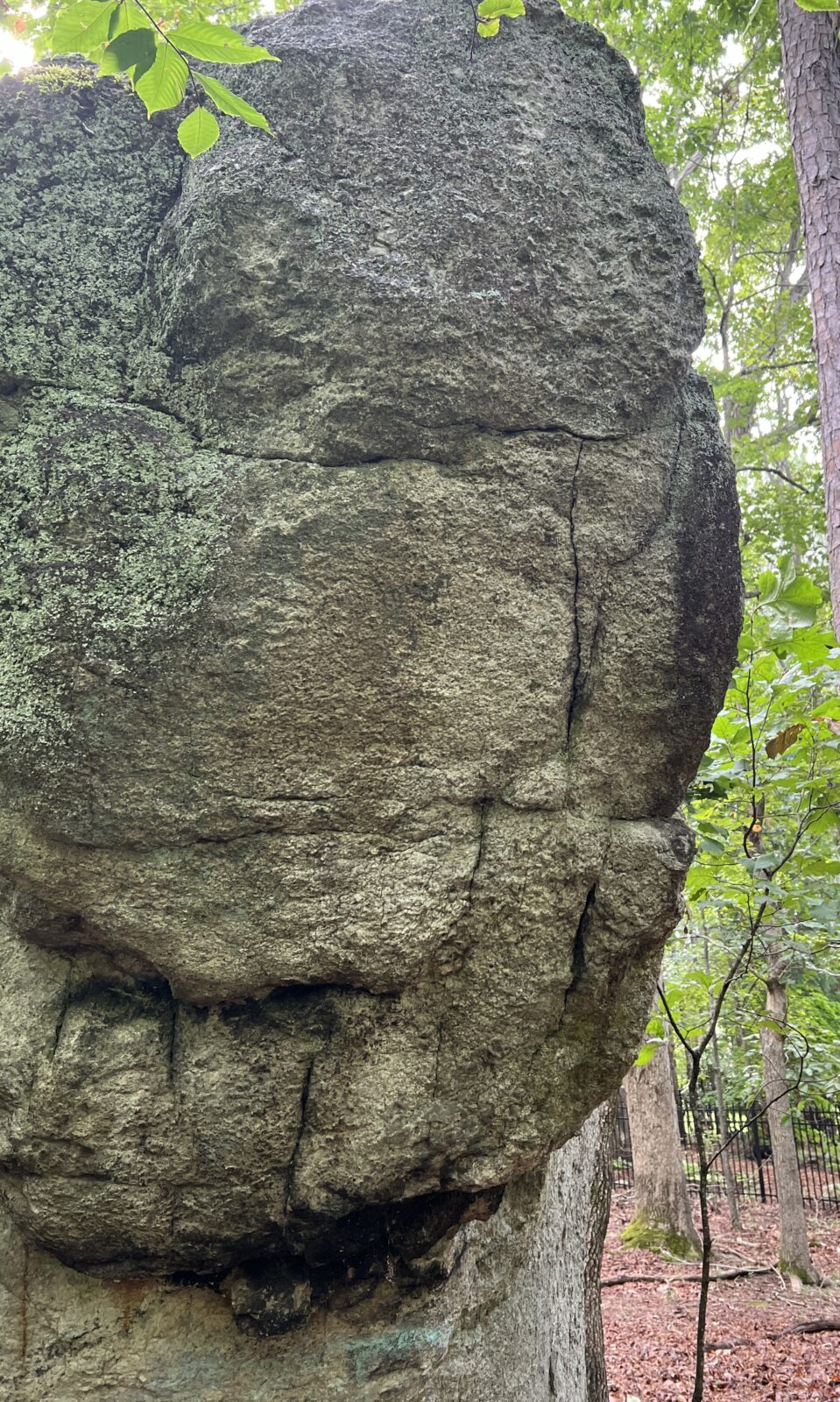
The massive, 30 by 15 foot, flat-top rock was chiseled and artistically transformed by indigenous humans, possibly ancestors of the Cherokee or Muscogee (Creek) Indians who lived in the area as many as 3000 years ago. Not only is the size of the rock impressive, but the carvings on the rock demand your attention. Ancestral Indians carved a crude image of a human face on one surface of the rock as well as a silhouette of a buffalo on another surface of the rock. The rock was pitted with a sharp object to create the mane and beard of a buffalo and the rock further chiseled to form the buffalo’s nose and mouth and bearded chin. These features of the rock prompted local historians to call this rock the “Buffalo Rock.” Recognizing the rock’s significance, in the early 1970s, the rock was named as part of the Georgia Trust for Historic Preservation.
Geologists would date the rock back millions of years, but to a historian this rock reveals evidence of a past human civilization. If the rock was modified by pre-historic humans 3000 years ago, it could be among the oldest evidence of human habitation in north Georgia! After the end of the ice age about 10,000 years ago, as the climate warmed, nomadic, indigenous people might have travelled and settled in northern Georgia. During the Late Woodland Period from 1000 B.C. to 1000 A.D., maize horticulture was thought to have been fully developed. This agricultural advancement led to a transition from a nomadic, hunter-gatherer society to a hunter/farm society that established seasonal settlements with permanent buildings and garden plots.
Buffalo Rock is an attention-getter because of its size and its crudely carved human face. The early Indians chiseled out a very large circular area to create a mouth. Above the mouth is a right eye. A linear indentation parallel to the bottom of the stone provides space where a rock was added to insert the artist’s vision of human eyes. A rock eyeball remains intact on the right side, but over time, the left eyeball has vanished. The large, hollowed-out mouth might have served as an artist’s interpretation of the human mouth. My guess is, it was used to grind grain since pre-historic, indigenous peoples raised corn. As agricultural practices improved, the indigenous population added to their cultivated crops and grew beans, squash, blueberries, muscadine grapes, tobacco and sweet potatoes. We also know that buffalo were hunted and served as another important source of food. Buffalo were not limited to the Great Plains west of the Mississippi. They also lived east of the Mississippi prior to the arrival of European settlers. Based on the time period that buffalo lived in Georgia, the silhouette image of the buffalo can be helpful in dating the rock.
If you are interested in learning more about prehistoric civilizations in Georgia, I would suggest you visit the National Historic Landmark, Etowah Indian Mounds, near Cartersville. This prehistoric Indian site is considered the “most well- preserved Mississippi culture site in the southeastern United States.” One thousand years ago, two thousand years after the time of the Buffalo rock, the Etowah Indians built a complex, urban settlement on the Etowah River. At this point in time, agricultural techniques had advanced to the point where these early Georgians built log homes, extensive garden plots, stone tools, pottery, and used the river for fishing and navigation.
Happy Gardening!
Learn More
About the Author

This week’s “Garden Buzz” guest columnist is Carole MacMullan, a master gardener and a Milton resident. She taught biology for 35 years in the Pittsburgh area. In 2012 after moving to Milton, Carole completed the Master Gardener training program and joined the North Fulton Master Gardeners (NFMG) and the Milton Garden Club. Carole uses her teaching skills to create a variety of presentations on gardening topics for the NFMG Lecture Series and Speakers Bureau.
