Boxwood hedges have been iconic features of gardens and landscapes for thousands of years, reportedly dating back to Egyptian gardens from 4000 BC. These evergreen hedges, clipped into boxy vertical and horizontal planes, form walls and borders in countless famous gardens and attractive foundation plantings for family homes. Boxwoods can live for a long time. According to the National Park Service, the dwarf English boxwoods at the Adams National Park in Quincy, Massachusetts, the home of John and Abigail Adams, date back to 1731, when the home was built.
Over the past 15 years, however, a fungal disease known as boxwood blight has wiped out landscape plantings of boxwoods and impacted nursery production in the U.S and Canada. The most notable symptoms of boxwood blight are leaf browning followed by leaf drop (defoliation) and black streaks along green stems.

New information from Dr. Bikash Ghimire, Assistant Professor and Extension Specialist with the University of Georgia Ornamental Plant Pathology Department, warns of a new threat to boxwoods in Georgia: boxwood dieback. Visible symptoms of the disease include unusual branch dieback and wilting of a few to all branches of the shrub, as well as discolored internal tissues revealed from stem cuttings or lesions on the stem.
“Boxwood dieback itself is not a new disease in the United States,” Dr. Ghimire wrote in a communication to UGA Extension agents on September 25, 2026.
But with reports of boxwood dieback increase in other states, the pathologists took a second look at boxwood samples submitted previously.
“Looking back at our diagnostic records, we found that boxwood samples with dieback symptoms had also been submitted through the UGA Plant Disease Clinic, with sample numbers increasing in recent years.”
The records indicate that boxwood dieback is present in at least five Georgia counties. The report to agents was delayed so that the pathologists could retest the samples and conduct molecular identification using DNA sequencing to confirm the presence of the pathogen that causes boxwood dieback, Colletotrichum theobromicola. Visible symptoms alone can’t confirm the disease because insects and environmental stress factors can cause similar symptoms.
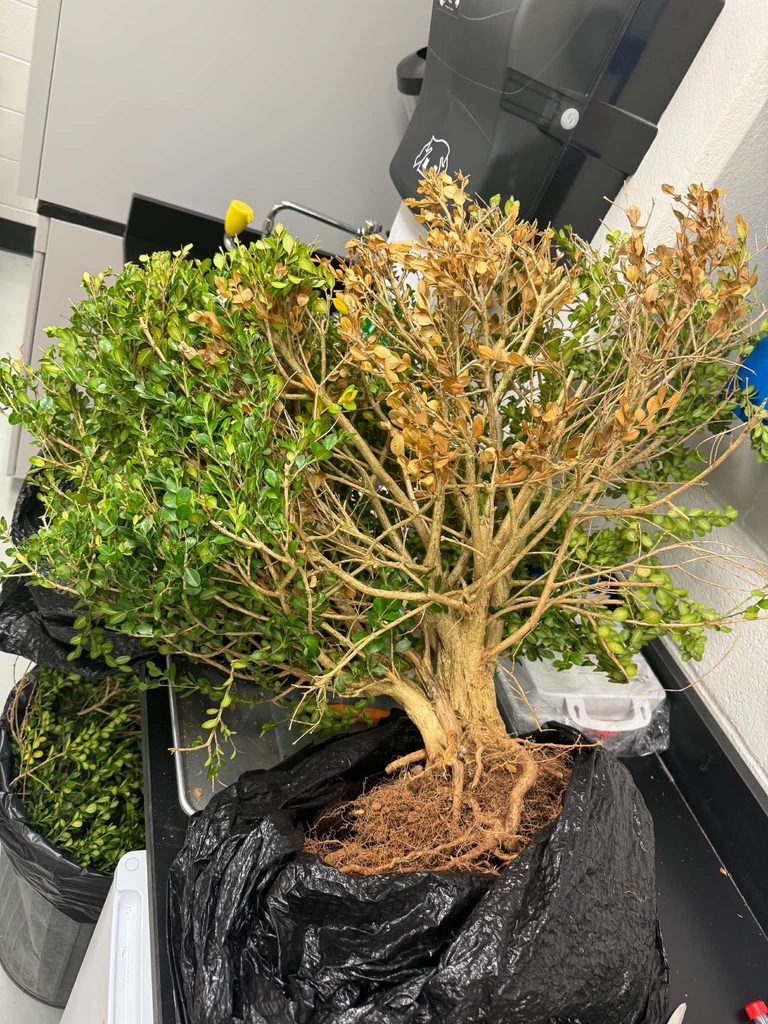
The record review also showed that very few boxwood blight issues have been reported in the past couple of years, while boxwood dieback disease continues to increase.
Boxwood dieback is a progressive and transmissible disease.
“By the time you see a dead or dying branch, the pathogen may already be present in portions of the plant that still look healthy,” Ghimire stated. “We have recovered the pathogen from tissues beyond the obvious symptomatic portions of affected plants, which also surprised us.”
The pathogen can also spread to neighboring plants through pruning and roots contacting each other underground. This means that just pruning out the affected branches will not control the disease. Unfortunately, none of the potential fungicide options have been field tested, so we can’t yet make recommendations for chemical controls.
“For now, sanitation is extremely important,” Dr. Ghimire communicated. He recommended that if you are working with plants that might be infected:
- Disinfect your pruning tools between plants.
- Avoid unnecessarily moving potentially infected plant material from one location to another.
- Be careful with irrigation and other practices that may move spore or contaminated material between plants.
- Uprooting entirely and discarding severely affected plants safely is “the best bet” to stop or slow the spread of the disease.
The cooler temperatures of fall will slow the growth of the fungus and temporarily reduce disease pressure. The fungus will flourish, however, when spring brings warmer, moister weather.

UGA is asking gardeners, homeowners, and nursery growers to help determine how widespread the disease is in Georgia but submitting samples of suspicious boxwood plant material to the lab for testing. If you see a boxwood exhibiting dieback symptoms, take a picture and collect a good sample – branch cuttings that have both healthy and symptomatic regions on the same stem. Seal the cutting in a zip-top plastic bag and label the bag with your name, where the cutting was taken, and when it was taken, and bring them to your local county Extension Office.
Upcoming Extension Events
Fall Tree Identification Walks. Trees change from season to season. Leaves and flowers are good identification clues during the spring and summer, but identification is still possible in the fall and winter as trees defoliate. Come join the Forsyth County Master Naturalists on pleasant fall ambles through county parks to make new friends, see fall leaf color changes, and learn new skills in tree identification.
Upcoming Tree Identification Walks:
- Coal Mountain Park, October 16, 5:30 p.m.
- Bethelview Trailhead of the Greenway, October 20, 9:30 a.m.
- Windemere Park, October 30, 5:30 p.m.
- Charleston Park, November 5, 5:30 p.m.
Winterize Your Home. Denmark Library, 530 Fowler Road, Alpharetta, Oct. 22, 2026, 7-8 p.m.
Prepare your home for freezing temperatures and tornadoes to get through the colder season and keep your loved ones safe.
Honey Bee Control and Removal Certificate Training, Forsyth County Extension Office, November 3, 2026, 9 a.m.-6 p.m. This 8-hour classroom training is a requirement toward earning the Georgia Department of Agriculture Honey Bee Control and Removal license in Georgia. Fee: $50 includes materials and lunch. Click Here to register!
UGA Extension strives to translate the science of life for use in everyday living. Forsyth County Extension is supported by the University of Georgia, Forsyth County Board of Commissioners, Forsyth County Board of Education, and community donors.
The University of Georgia is an Equal Opportunity, Veteran, Disability Institution. If you need reasonable accommodation or language access services, contact the Forsyth County Extension Office at 770-887-2418 or Forsyth.extension@uga.edu at least three weeks prior to the program date.