I had a question or two about using dicamba for preplant burndown in corn. Dr. Prostko has a few comments on this subject below.
It has come to my attention that the recommendations for preplant/burndown applications of dicamba for field corn in the UGA Pest Control Handbook are NOT sufficiently described. After closer review of the product labels, there needs to be some adjustment. Please review the following with any grower who desires to use dicamba for preplant/burndown weed control prior to planting field corn.
1) The newer formulations of dicamba (Stryax®, Engenia®) are NOT labeled for this particular use.
2) Older formulations of dicamba (Clarity®, Rifle®, Sterling Blue®) are labeled for this use depending upon tillage system and soil type as follows:
a) PREPLANT AND PREEMERGENCE APPLICATION IN NO TILLAGE CORN: Rates: Apply 16 fluid ounces of Clarity®, or Rifle®, or Sterling Blue® per acre on medium-or fine-textured soils containing 2.5% or greater organic matter. Use 8 fluid ounces per acre on coarse soils (sand, loamy sand, and sandy loam) or medium-and fine-textured soils with less than 2.5% organic matter.
b) PREEMERGENCE APPLICATION IN CONVENTIONAL OR REDUCED TILLAGE CORN: Rates: Apply 16 fluid ounces of Clarity®, or Rifle® or Sterling Blue® per treated acre to medium- or fine-textured soils that contain 2.5% organic matter or more. DO NOT apply to coarse-textured soils (sand, loamy sand, or sandy loam) or any soil with less than 2.5% organic matter until after corn emergence.
c) Failure to follow these recommendations could result in excessive crop injury. If a grower applies dicamba as a burndown in a field intended to be planted to dicamba-tolerant cotton or soybean and changes their mind and wants to plant field corn, please contact me ASAP.
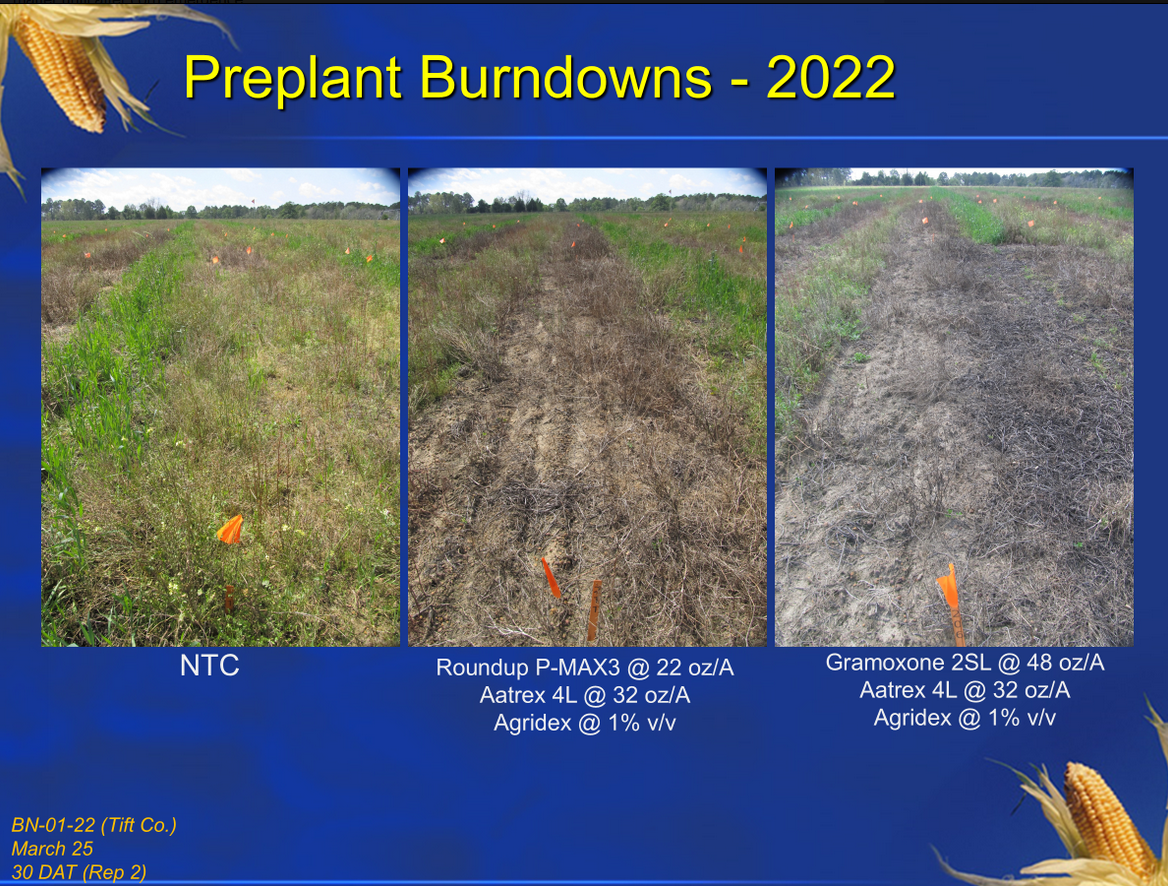
3) Everyone always asks me what my preferred burndown is for field corn. Lots of good choices. But, I prefer Roundup or Gramoxone + atrazine because these combos will control most of our common winter weeds and field corn can be planted immediately without concern for crop injury. See below.