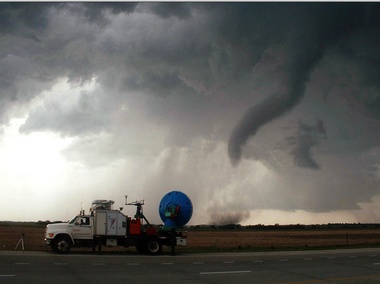
Since many people are working from home now, including most students, I thought it might be helpful to provide some links to educational material about weather and climate.
Today I watched a fantastic live stream on Facebook from the Capital Weather Gang about atmospheric optics like rainbows and mirages, and that is archived along with their other lectures at https://www.facebook.com/watch/157306594301935/ .
The National Weather Service has a long list of links to resources which you can find here.
WeatherSTEM has a series of K12 modules which you can find at https://www.weatherstem.com/learn .
The National Drought Mitigation Center has a role-playing game based on making decisions due to drought. You can find it at https://drought.unl.edu/Education/DroughtGame.aspx or read more at https://newsroom.unl.edu/announce/snr/9644/57271 .
The Southwest Climate Hub has a 5-hour curriculum on agriculture and climate change for grades 6-12 at https://swclimatehub.info/education/climate-and-agriculture.
“RainSphere” is a new educational portal which allows students to explore climate information at different time and space scales. You can read more about it and find links to a tutorial and the portal at https://site.extension.uga.edu/climate/2017/05/rainsphere-a-new-tool-for-exploring-trends-in-satellite-precipitation/ .
The USDA Forest Service has a resource center which provides educational modules on climate change and how it is likely to affect land use and forests at https://www.fs.usda.gov/ccrc/education .
CoCoRaHS has some good resources about using simple weather instruments to study the weather at https://www.cocorahs.org/Content.aspx?page=education .
The National Severe Storms Lab has a good web site with information for students and educators at https://www.nssl.noaa.gov/education/ .
The Kellogg Biological Station has a number of resources on sustainable agriculture and climate change. You can read more about it at https://site.extension.uga.edu/climate/2015/07/resources-on-sustainable-ag-and-climate-change-available-from-kellogg-biological-station/ .
If you have other resources you like, please email me at pknox@uga.edu and I will add them to the list.