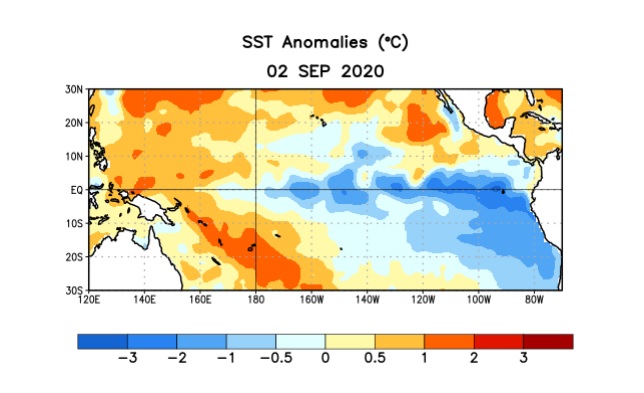
As expected, NOAA’s Climate Prediction Center has issued a La Nina Advisory this week to note that a La Nina has officially been observed to occur. You can find their text advisory at https://www.cpc.ncep.noaa.gov/products/analysis_monitoring/enso_advisory/ensodisc.pdf. There is a 75 percent chance that it will continue through Northern Hemisphere winter. In the Southeast, a La Nina is normally associated with warmer and drier conditions that normal, especially in Florida and southern AL and GA, due to a northward shift in the subtropical jet which pushes rain-producing storm systems through the region. A La Nina over winter is linked to an increased chance of drought in the following summer, but it does not happen every cycle. The La Nina is also contributing to the active hurricane season we are presently in.