The Fruit Growers News republished a story this week from the University of Idaho discussing how trends in minimum temperature over time are likely to change where some crops grow. The annual coldest temperature is linked to some crops’ ability to thrive, and is the basis of the USDA plant hardiness zone map. These temperatures are expected to continue to climb in coming years in concert with the average minimum and mean temperatures.
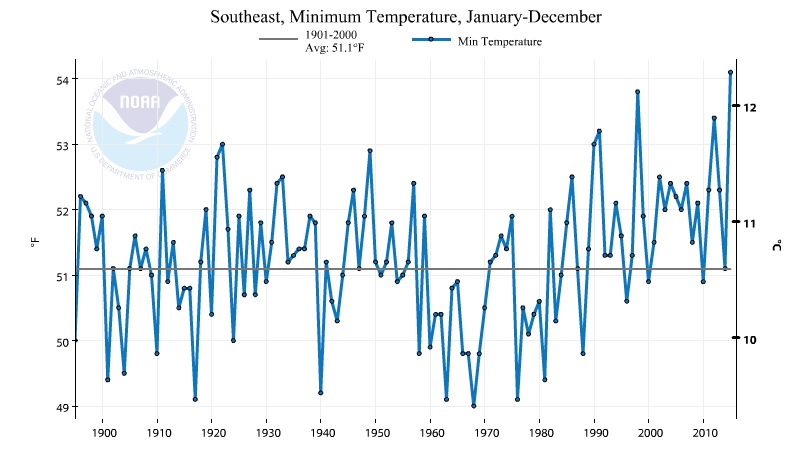
The graph below shows the trend in average minimum temperatures for the Southeast as a whole. Over the last fifty years there has been a significant increase in the average minimum temperature across the entire Southeast, and in fact 2015 set a record for the warmest minimum temperature ever for the region.
Warming of the annual coldest temperatures could allow for an expansion of areas suitable for growing high-value tree crops such as almonds and oranges that are currently limited by cold winter temperatures, although other factors like water availability and suitable soil are also important. In fact, citrus growers are now expanding north into Georgia, with some satsuma farmers already doing well in southern Georgia. Olives are another cold-sensitive crop that is starting to be grown in the Southeast.