The content on this page is retained only for recordkeeping, historical reference, or research. These materials are preserved in their original form and may not meet current WCAG 2.1 AA accessibility standards.
These archived materials are not required to be remediated. However, we remain committed to equitable access. If you need an accessible version of any archived item to participate in our current programs and services, we will provide one when feasible upon request at caesweb@uga.edu.
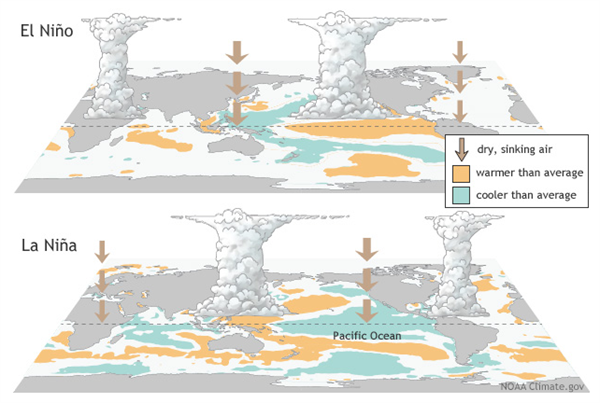
The El Nino-Southern Oscillation, or ENSO, is the single most important predictor of seasonal climate in the Southeast, so we tend to watch it fairly closely to see if it can give us clues to future conditions. But researchers have found that a shift in ENSO patterns has reduced our ability to make useful predictions. This shift happened around 1999-2000 and reduced the accuracy of model predictions after that point. You can read more about it and find a link to the original research paper here.
Sea surface temperature anomaly and atmosphere circulation during El Niño and La Niña events. Credit: https://www.climate.gov/enso