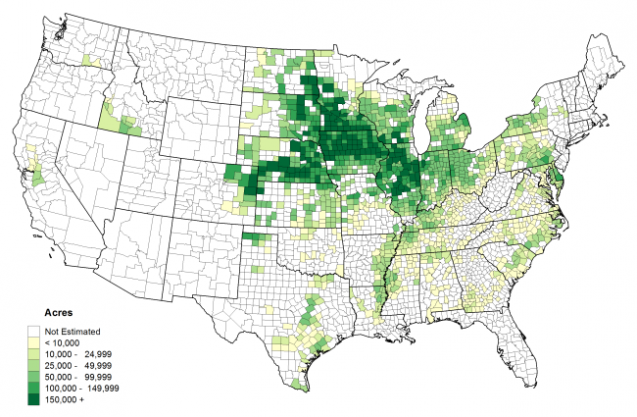
The Earth Institute at Columbia University posted a story this week which discussed a new study about how climate change is affecting the Corn Belt in the United States. There are two main effects: the first is that warming temperatures are increasing the rates of evaporation of soil moisture, leading to more droughts. This is not a surprise and will also be occurring in the Southeast. The second effect is more surprising: as the temperature gradient between the equator and poles decreases, convective rain storms become weaker and effectively drop less rain on the area, which further dries out the region. The stronger storms and rainfall shift north where the gradient is greater. This is the double whammy that will increase hydrological stress and drought in the area more rapidly than expected. You can read more about the research here.