Hunt Sanders
With the rapid approach of October, we are truly in the “short rows” of the 2026 field season. Here are four steps I encourage for your growers between now and the end of the season; certainly before first frost.
1. With harvest, make an assessment of how well (or poorly) your disease and nematode management programs performed. If you are satisfied, great. If you are not satisfied, for any reason, efficacy, performance, cost, maybe UGA Extension can help with recommendations for 2027.
2. Take a look specifically at what could only be managed with tactics applied before the furrow closed- how was your nematode control? How was your spotted wilt control? How was your Fusarium wilt in cotton control?
3. Identify problematic areas in a field you can’t figure out and ask for help from Extension now. Coming back in March may be too late to figure anything out, especially after the anticipated rains this season from an El Niño.
4. Take nematode samples. Certainly from worrisome spots, but also from a general survey pattern in your field. The best ways to know how you might need to prepare for nematode damage in 2027 are to a) sample now for nematodes, b) identify damage from nematodes in a field THIS season, and c) consider how your recent crop rotation might increase (or decrease) risk to nematodes.
Cotton Defoliation Update:
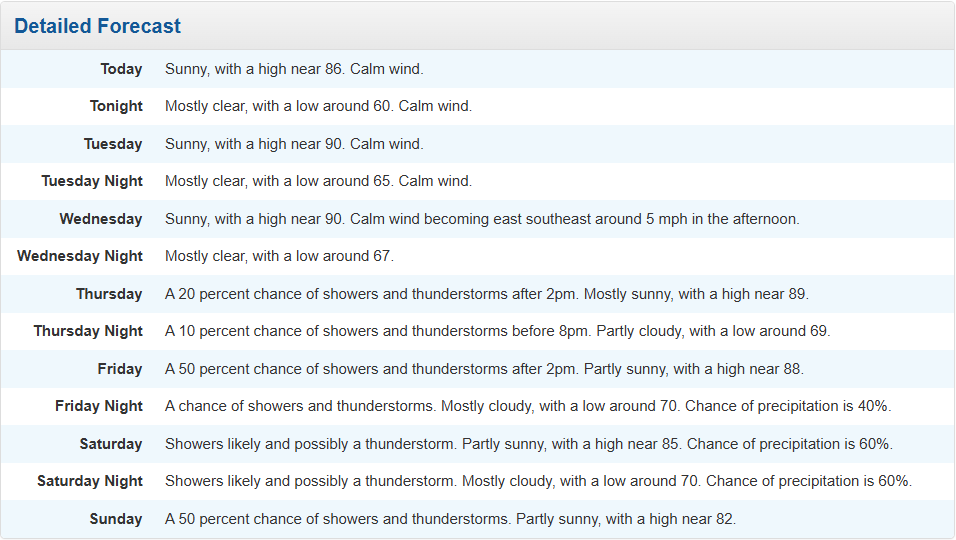
Across the state, it looks like this is the last “hot” week in the foreseeable future. Upper 80s statewide with lows in the 60s-70s. Defoliation should be fairly straightforward for this. Major things to keep in mind:
- Spotty rains leading up to the weekend, with rain Saturday and Sunday. If your growers are going to defoliate this week (which I would do if I had cotton ready), they likely need to wrap up spraying on Thursday so rainfree period is not a concern.
- As mentioned, it looks like it is going to cool off for a while starting after the rain this weekend. While this rain is much needed (particularly to facilitate harvest of dryland peanuts), if I had cotton that was 60% open or more, I would try my best to defoliate it this week because the cool temps next week will definitely affect what we spray from here on (think higher rates/different products).
Rates for the week:
3-4 oz/acre thidiazuron (Dropp/Freefall/Klean-pik/etc.)
6-10 oz/acre tribufos (Folex/Def/etc.) – lower rates on high temp days, less foliage to remove. Higher rates as we approach the weekend prior to rain/cool down.
32-42 oz/acre ethephon (Prep/Super Boll/Setup/etc.)
Reminder – if you are going to use a PPO to target morningglories, pull the tribufos from the tank (i.e. don’t add ETX or Aim to the three-way… asking for trouble in my opinion).
Peanut Update:

Two takeaways from the trail a) leaf spot (especially late leaf spot) was present and there were varietal differences. B) white mold was mostly contained.
I’m two weeks out from digging; do I need to spray fungicide?
2-3 weeks until digging and NO leaf spot? You are d-o-n-e with leaf spot fungicides. 2-3 weeks to go and a little leaf spot? Maybe hit with 1.5 pt chlorothalonil. 3-4 weeks to go and more leaf spot then you expected then maybe chlorothalonil + topsin, chlorothalonil + Domark, Provost Silver or generic, as examples. Save products like Priaxor and Lucento for earlier in the season. Provysol is very good but would probably use it before 120 days. 3-4 weeks to go and 50% defoliated, or more- time to get a digging date set. Those peanuts won’t wait.
Estimating Harvest Loss
1.Measure and mark a sample area behind the combine using a tape measure and some flags or a rectangular device the width of the entire windrow. Note: the larger the area, the more accurate the estimation will be.
2. Record the length and width of the sample area and calculate the area in square feet. Note: If you are measuring the length of the windrow, you are taking two peanut rows into account with a sample width of 72 inches or 6 feet based on 36-inch row spacing. This may vary slightly and adjust as needed.
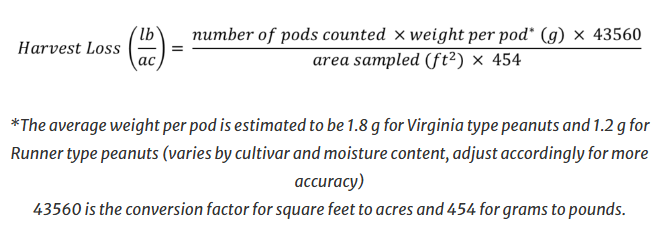
3. Take into account account moisture content in the pods with the formula below.

4. Within the sample area, count the total number of pods and use the formula to estimate the harvest loss in pounds per acre
- Keep in mind that not all pods are mature harvestable peanuts
- Check to count between harvestable pods and pops to adjust accordingly
- For best measurement, at least three to five different areas is ideal
5. For a more precise measurement, you can weigh the total number of pods in grams collected from the sample area and use the formula below. Note: this does not account for pod moisture, which is not easily measured in-field.

Example Harvest Loss Calculation:
If the average number of pods counted in three, 6 ft wide by 6 ft long sections were 15, then using the sampled area as 36 ft2 and assuming Runner peanuts in the formula from step 3, the total harvest losses would be 48 lb/ac.

Winter Annual Forage Selection:
It’s time to start thinking about what winter forages we want to plant this year. Cool season annual
grasses can offer temporary winter grazing during the late fall until spring depending on chosen species.
These species are listed below in the order in which they tend to provide grazing and mature. You can
check out the updated variety list for winter forages and small grains at:
Oats
Oats (Avena sativa L.) are later maturing and can provide more spring growth than rye when grown in
South and Central Georgia. Oats are not as winter-hardy as rye and can winter-kill in some years.
Although it is difficult to quantify, the leaves of oats are “softer” than those of rye or other small grains.
Recommended varieties for the 2026-2027 growing season include:
- Gladiator
– Good late season production in Piedmont and Coastal Plains - Horizon 214
– Good early season production in Coastal Plains
-Good late season production in Piedmont and Coastal Plains
– Good season long production in Coastal Plains - Horizon 306
– Good early season production in Piedmont and Coastal Plains - Horizon 578
– Good late season production in Piedmont and Coastal Plains
-Good season long production in Piedmont - Horizon 720
– Good early season production in Piedmont and Coastal Plains - Maximus
-Good season long production in Coastal Plains
TriCal Cadillac, Legend 567, and LA99016 have performed well in the past but not been recently
evaluated. No varieties have been recently tested in Limestone Valley.
Other varieties may provide satisfactory yields but were not submitted to the Statewide Variety Trial
program.
All these varieties may be susceptible to prevalent strains of crown rust, scout routinely. Avoid planting
earlier than recommended for your region.
Wheat
Wheat (Triticum aestivum L.) can be grown across the state, but it is not tolerant of acidic soils. This
winter-hardy small grain can provide forage from winter to spring and makes a good grazing, silage, or
baleage crop. Overall, wheat is the lowest yielding species in this list and should not be used except for
cover or when low production is acceptable.
Recommended varieties for the 2026-2027 growing season include:
- SSI 30-06
-Good late season production in Piedmont and Coastal Plains
-Susceptible to Hessian fly
These varieties were not submitted for testing but were included on last year’s recommended list: - SSI 30-06
– Good late season production in Piedmont and Coastal Plains - AGS 2024
– Good early season production in Piedmont and Coastal Plains
– Good season long production in the Coastal Plains - AGS 4023
– Good early season production in Piedmont and Coastal Plains - AGS 4043
– Good late season production in Piedmont and Coastal Plains
– Good season long production in Piedmont and Coastal Plains - Johnson
– Good late season production in Piedmont
– Good season long production in Piedmont Dyna-Gro Plantation, Pioneer 26R10 and Pioneer 26R41 have performed well in the past but have
not been recently evaluated. No varieties have been recently tested in Limestone Valley. Other varieties
may provide satisfactory yields but were not submitted to the Statewide Variety Trial program.
Annual Rye Grass
Annual ryegrass (Lolium multiflorum Lam.) is one of the most productive forages we can grow. There are
several varieties recommended for each region in Georgia that are early maturing, late maturing, or capable of
providing growth throughout winter and spring. Overall, ryegrass is still later maturing than small grains so
many producers will plant ryegrass in mixtures with a small grain to provide season long grazing. Ryegrass is
an excellent choice for grazing, baleage, or silage. The biggest limitation of ryegrass is the rapid increase in
herbicide resistance, specifically in the southern portions of the state.
- Centurion
– Good early season production in Piedmont
– Good late season production in Coastal Plains
– Good season long production in Coastal Plains - Lonestar
– Good season long production in Piedmont and Coastal Plains - More
– Good early season production in Coastal Plains - Nelson
– Good season long production in Piedmont and Coastal Plains - Tetrastar
– Good season long production in Piedmont and Coastal Plains - Wax Marshall
– Good season long production in Piedmont and Coastal Plains
Other varieties may provide satisfactory yields but were not submitted to the Statewide Variety program.