
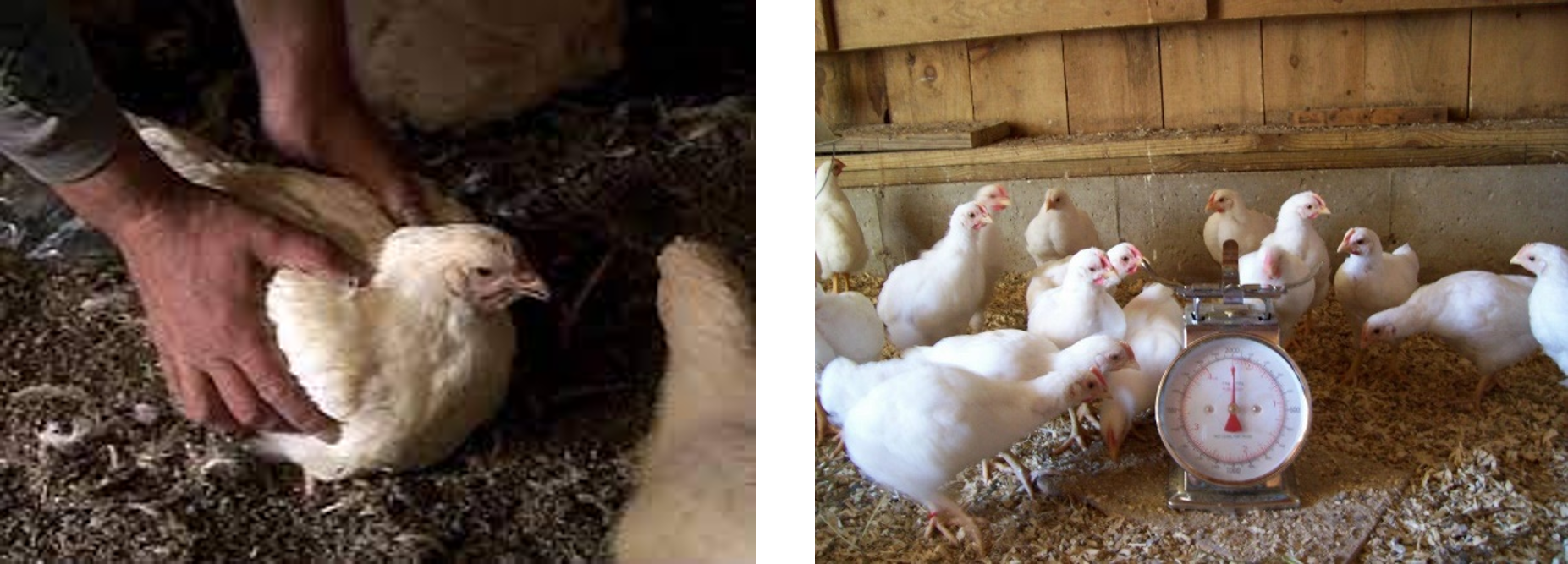
Monitoring poultry body weight is important for evaluating the growth and performance of a flock. The bodyweight and uniformity of the flock are essential to understand growth pattern, efficiency, health condition, and production prediction. The traditional protocol is to manually sample and weigh a portion of the flock by using a platform scale or hanging scale (e.g., 2% of the flock or 50 birds, whichever is larger (Figure 1). However, conventional methods (i.e., catching several birds periodically) are time-consuming, labor intensive, and tend to increase stress on birds. Additionally, a commercial broiler house has about 20,000 – 30,000 birds, making it difficult to know body weight of birds in real-time. Incorporation on an automatic monitoring system for chicken body weight may be important tool for precision poultry production and enhanced animal wellbeing.
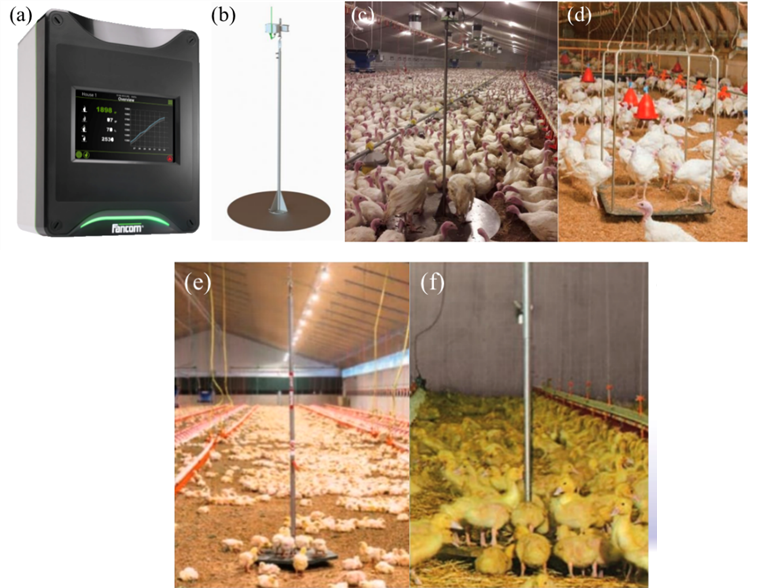
Body weight monitoring methods have been tested in different countries, primarily based on digital scales and data collection (Figure 2). Popular systems are mostly electronic scales manufactured by such companies as Fancom, Big Dutchman, and Veit, etc. Most products employ an installation mode of hanging the scale from a secure frame or structure and can be difficult to install and stabilize. Those products usually have a high level of accuracy (>90% accuracy).
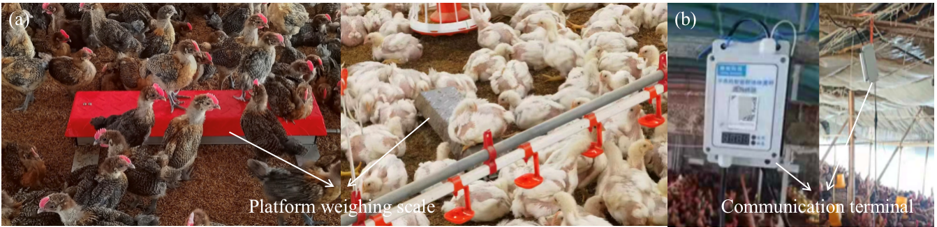
Automatic Weighing Systems – A floor-based digital weighing scale (Figure 3; Zhou et al., 2023) was tested in a poultry house (away from feeder and waterlines to avoid interference from chicken feeding and drinking behaviors). To ensure the horizontal position and stability of the main body of the platform scale, the equipment was placed on solid, level ground, resulting in higher data collection and accuracy (up to 99.5% ±2.3%).
In recent years, artificial intelligence technologies such as machine vision or imaging-based technologies have been under development for estimating the body weight of broilers. Figure 4 shows an automatic 3D camera-based weighing system for broilers chickens. The systems have been developed and evaluated in a commercial production environment. In the system, a low-cost 3D camera (Kinect) that directly returned a depth image was employed to capture depth images for 3D reconstruction and body weight prediction.
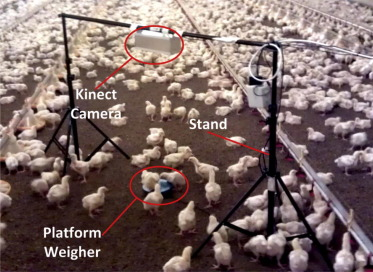
Due to feathers on birds, the accuracy in these kinds of systems is not as high as initially expected. Future studies should consider how to reduce the influence of feathers on weight prediction accuracy. A combination of 3D thermal imaging techniques may address the issue and make this form of automatic weighing a viable product for the poultry industry.