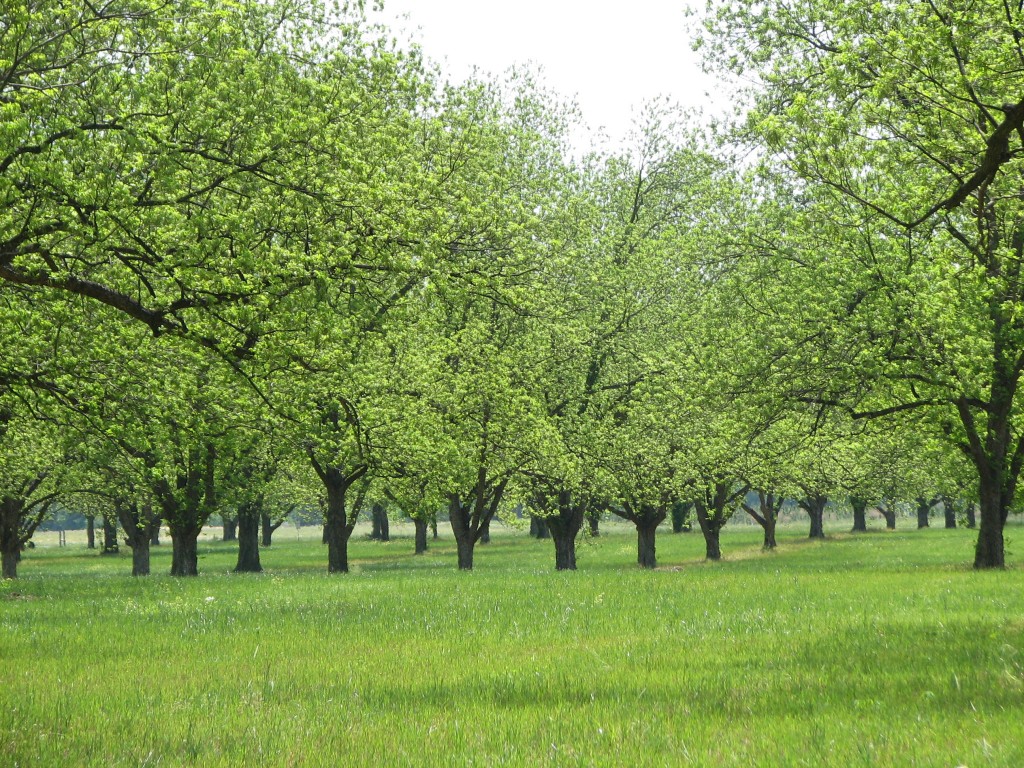
If you are spending much time in pecan orchards composed of Desirable and Pawnee trees right now, you can likely find at least a little scab on a few nuts here and there if you look hard enough. In some cases, you will find a lot more than you would like to see. Our wet June led to significant scab pressure throughout much of the state. When we are getting rain on a near daily basis for a solid week during nut sizing, it becomes challenging to keep the nuts covered for several reasons; 1) The rain prevents spraying . 2) The rain washes the fungicide off. 3) Scab thrives in the free moisture created by rainfall. 4) The nuts are sizing rapidly and there is always some un-sprayed tissue available for scab to infect. Even the best fungicide programs will be challenged under such conditions. All you can do is shorten your spray interval and hope for the best. Given this situation, most orchards remain in good shape. Low and moderately susceptible varieties are by and large, clean. As I mentioned, you can find at least a little scab in most Desirable orchards but from what I see, they are still largely in good shape. My greatest concern at this point is for Pawnee.
Last year, across the state, we began to see more scab on Pawnee than we were seeing on Desirable. I had hoped this was a fluke and that we wouldn’t continue to see this pattern. But we are seeing it again. In the back of my mind I have been concerned for several years now that we would see this heavier scab pattern develop on Pawnee because we had so many acres of Pawnee trees planted between about 2012 and 2022. It was easy to see why. In 2012 Pawnee was bringing well over $3.00/lb in-shell and even after China’s exit as a customer of U.S. grown pecans, Pawnee has still brought a higher price than any other nut. This, of course, is due to the fact that it beats every other nut to market with a late September harvest date.
But anytime you have one variety planted that heavily, especially a variety that is already highly scab susceptible, it is expected that the scab will get progressively worse on that variety. And it appears that it may have in some places. Given the high market price of Pawnee, growers could afford to spray Pawnee 10-12 times to make them. Also, Pawnee can take more scab than a lot of varieties and still produce a good quality nut, probably because it has such a thick shuck. Still, there is a limit to everything.
If you still have mostly clean Pawnees, that’s great but be vigilant. Watch them closely. I have heard from a number of growers and seen a few orchards already this year where Pawnee is scabbing to an alarming level, while Desirable remains largely clean under the same spray program. We are seeing the same thing at our research orchard at the Ponder Farm. In the case of the Ponder farm, we have had them on a 2-week spray interval so I am not at all surprised to see scab on them (we have now gone to 10 days and should have done so a spray or 2 ago) but I am surprised they have so much scab while Desirable remains mostly clean with the same program. The grower orchards I have seen this pattern in are good growers, spraying top-notch programs at appropriate intervals, and Pawnee is still scabbing. One grower has even told me he is considering the option of removing his Pawnee because he just can’t control the scab any more.
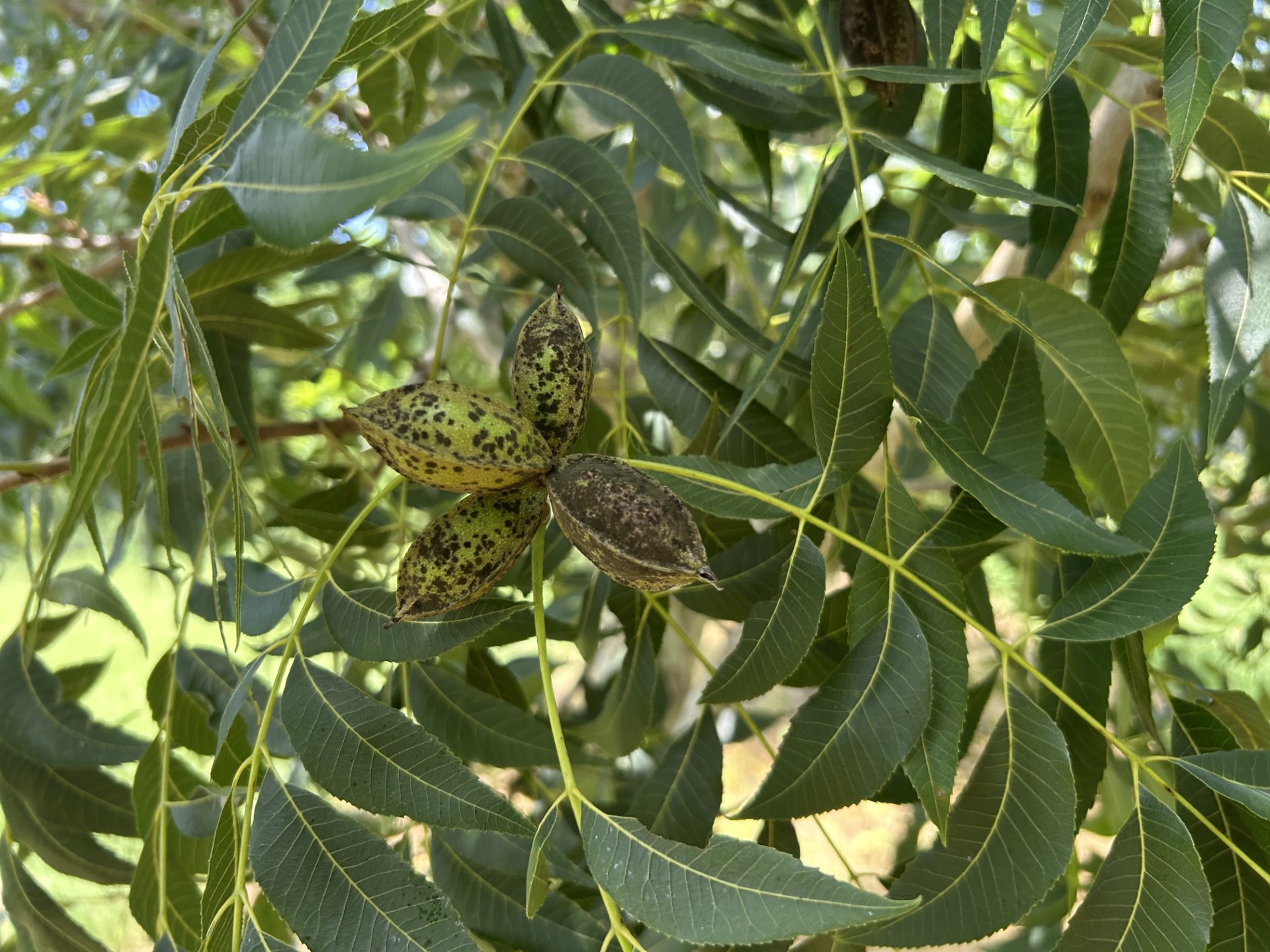
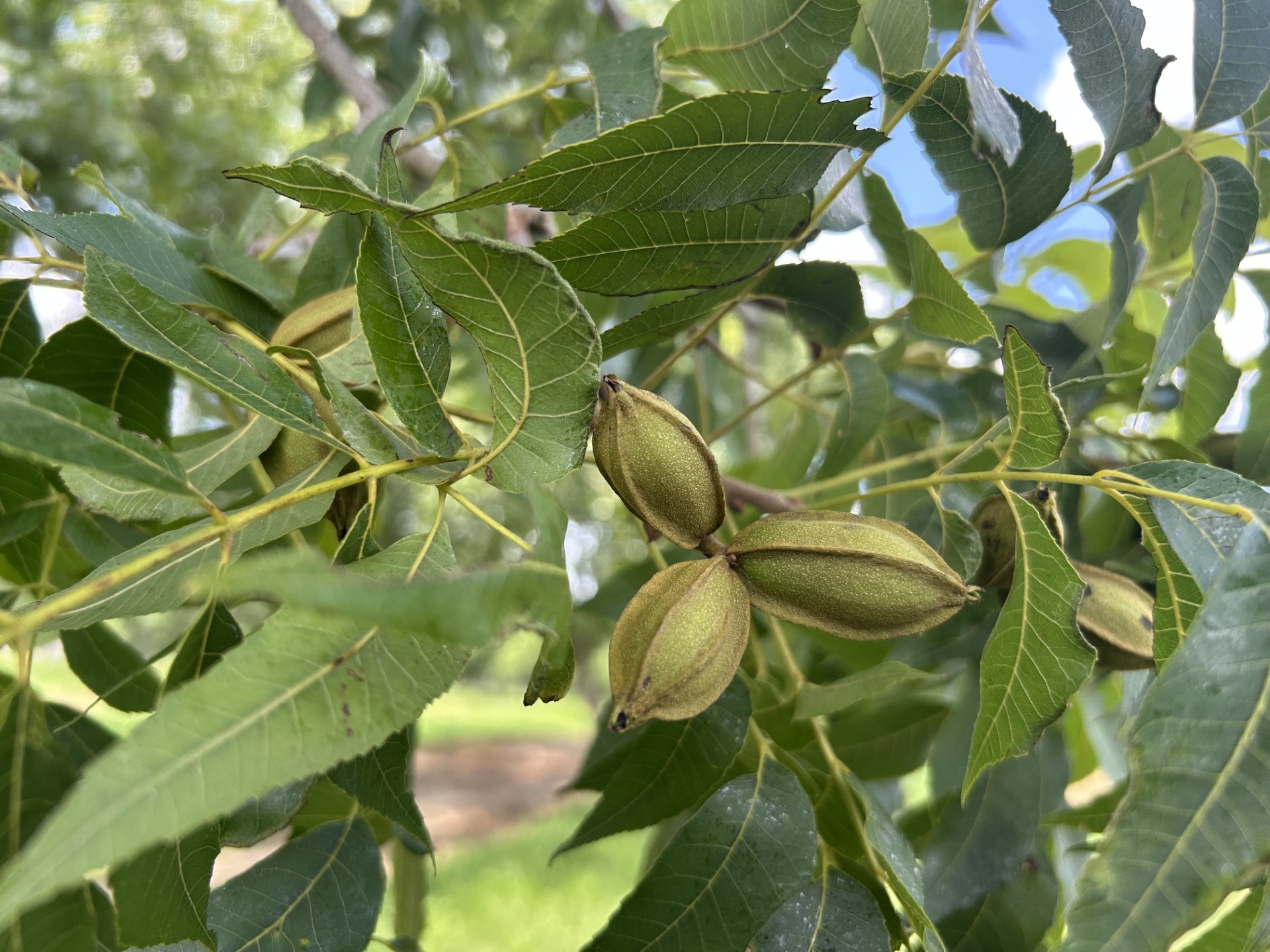
Pecan scab on Pawnee (top) and Desirable (bottom) under same spray program.
What does this mean for Pawnee in our state? It’s still early in the course of this saga. Fungicide resistance may play some role in this, although we don’t know to what extent yet. If you are growing Pawnee, you should make sure that you give yourself every advantage. Make the environment in which you are growing Pawnee optimal for managing scab. This means do everything you can to increase air flow—push back wooded edges, hedge, thin the orchard if needed—but increase your air flow. If you are considering planting Pawnee (and it is highly questionable as to whether you should or not), don’t plant them on a tight spacing and put them in a location that has good air flow. Pawnee shells will be hardening by late July or early August at the latest. This means you may have only 2-3 more sprays to go. Don’t go longer than 10 days between sprays on Pawnee from here out, especially if you are seeing more scab than you are comfortable with.
