As everyone is aware, recent events have led to a big increase in fuel prices. As usual, when fuel prices increase so do fertilizer prices. Like fuel, fertilizer is a global market. 45% of the world’s urea comes through the Strait of Hormuz. Even if we aren’t getting our fertilizer directly from there, that pinch point creates a potential shortage and thus, a price increase. This couldn’t come at a worse time for pecan growers as we are entering budbreak and orchards will soon be receiving the bulk of their annual fertilizer applications. So, exactly how should we manage this? Fortunately, as a pecan farmer you are in a much better position to weather this storm than someone growing an annual crop.
Urea and most other forms of N are directly tied to the cost of fuel because natural gas is used in their production. As of last week the 18% and 19% liquid formulations that are made as a by-product of another process had not gone up and shouldn’t go up as much as other forms because they’re not tied directly to fuel costs. This may offer an alternative, although I don’t know the current pricing specifics for these formulations. As of this week, urea has increased by about 52% over last year’s price. That’s a big increase. Thus, it may lend additional urgency to our regular recommendation to split nitrogen (N) applications for pecans.
Normally we recommend a total rate for mature trees of 100-125 lbs N/acre. There has never been a study that I’ve seen for pecans in the Southeastern US that indicates a need for more than this. However, pecans like to be spoon fed a little all along throughout the year and the nitrogen demand of the tree is based mostly on crop load. Additionally, you can have leaching and N loss if you apply a large slug of N all at once, particularly on sandy soils, which is why under normal conditions we recommend splitting your N applications with approximately 1/2 to 3/4 of that being applied within 2 weeks after budbreak. Usually, that would be about 75 lbs N applied in the spring. Given the current situation, it would likely be a better idea, economically, to apply 50 lbs N/acre as a spring N application and then wait to see what your crop load looks like this summer. If the crop load is there to justify it, you can come back with another 50 lbs N in June (hopefully prices will be down by then) or split that again between June and August. But you also have to consider, given the rumors of restricted supply, will we have a supply of N available for purchase at that time? If the crop load is not there, it won’t matter. The 50 lbs you apply in spring will be enough.
In all actuality, if your orchard has been well managed in the past and push comes to shove, that 50 lbs N per acre applied in spring would likely be enough even with a crop load for one year. That is the beauty of growing pecan trees. Most studies on pecan N fertilization show that control trees receiving no N will take 2 to 6 years of no fertilization before any noticeable drop is observed in yield, quality or leaf N. I am not recommending that you do not fertilize your trees, but if economics dictate that you put out a little less in 2026, it won’t hurt anything in the long run as long as the fertility of your orchard has been kept up in the past and you can return to normal fertilization practices the following year. If you have a good stand of clover in your orchard (especially if it has been there for a few years) you can count on significant late season N availability from the clover as well. Make sure when you make any N applications to the orchard, you apply it only over the tree row and not to the middles between the rows where clover is growing. If clover receives an application of N it will not fix its own N from the atmosphere.
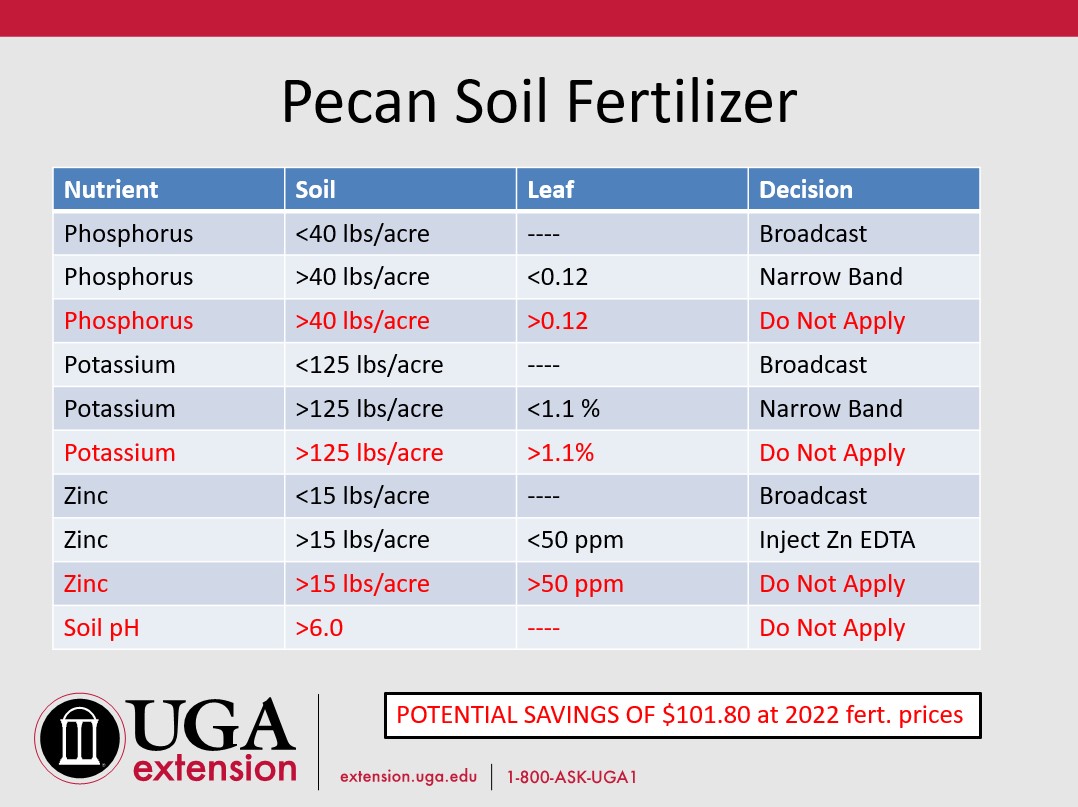
I am told the price of phosphorus (P) is also up. There is also a big opportunity for many growers to save money on P, K, Zn and lime (if you haven’t already applied). You can find the details about this in a previous blog post found here. In short, most well managed orchards have adequate to high levels of P and Zn in both soil and leaf samples. As a matter of fact, this is quite common. When this is the case, an annual maintenance application won’t move the needle on anything. The same may be true for K in some orchards, though to a lesser extent. Sandy soils will need K more often. For lime, if your pH is above 6.0 there is no reason to lime. See the table below to help you determine if, when, and how you truly need to apply P,K, Zn, and lime. Save your money where you can. As mentioned, details about this are listed in the previous blog linked at the beginning of this paragraph.