Native plant species are the best options for the pollinator garden, as they provide valuable pollen and nectar for a wide range of insects, mammals, and birds. What about if your garden area is mostly shaded? Native species in the shade garden provide for a wonderful array of color, fragrance, and texture.

Crownbeard – A gold/yellow perennial that attracts pollinators like bees and butterflies. It also attracts soldier beetles which are natural predators for pests such as aphids and mites. It flowers in summer and fall.
Dogbane – A green, pink, or white perennial that has individual flowers about 1/4 inch. Additional clusters occur in the upper leaf axils. Flower blooms from May to July. It is used by Native Americans and in herbal medicine to treat a variety of ailments. Fibers were used as thread for sewing or to make string, netting, and other items. Note: Dogbane is poisonous to humans. Symptoms includecardiac arrest, nausea, vomiting, weakness, diarrhea. The milky sap from stems can cause blisters on skin as well.
Indian Pink – Indian pink is also known as spigelia or pinkroot, however the origin of its common name remains a mystery since no part of the plant is pink in color. However, it is a clump-forming perennial that reaches heights of 12 to 18 inches (31-46 cm). Pinkroot’s emerald-green foliage provides delightful contrast to the vivid red flowers, which appear in late spring and early summer. You can extend your plant’s blooming time by deadheading faded flowers. Indian pink plants are terrific for low light areas of the garden. This plant is a clump-forming perennial with no danger of spreading. It is a hummingbird magnet.
Meadow Rue – A perennial beloved for its foliage just as much as for its delicate, airy flower clusters, meadow rue is a wonderful plant for adding eye-catching texture to the garden from spring through fall. This easy-to-grow perennial has petite, columbine-like leaves. Its foliage is compact and tidy while its flower stems tend to be pleasingly wayward and frothy.
There are many different species of meadow rue. They vary in size, hardiness, and bloom time. Some species stand a lofty 8 feet tall, while others hug the ground and are at home in alpine gardens and near the front of a garden bed. The foliage color varies from chartreuse to grass-green to striking shades of blue green. Meadow rue is slow to emerge from the soil in late spring. The nectar of the flowers attracts bees, including honeybees, and butterflies.
Solomon’s Seal – A woodland perennial known for its small, tubular flowers and graceful, arching stems with burgundy tones. It thrives in shade gardens that are cool and moist, gradually spreading its beauty over time. It flowers in late spring to early summer (May-June), small, bell-shaped flowers appear in pairs (occasionally single or in groups of three) hanging from the leaf axils on thin stalks called peduncles. Each flower is ¼ to ½ inch long, tubular to bell-shaped, and greenish white to cream-colored, often with a slight yellowish tinge. This plant prefers slightly acidic soil and does well in moderate climates. However, be aware that its berries are mildly toxic to both humans and animals.
Spiderwort – One of the most practical things spiderwort is good for is eating. The flowers, stems, and leaves are all edible, either raw in salads or cooked as a culinary herb. The vivid purple flowers, which last only a single day before wilting, can be candied with sugar for desserts or used as a cake topping. The flavor is mild, making it easy to work into dishes without overpowering other ingredients. The leaves have traditionally been cooked into soups, and the roots brewed into teas.
For gardeners, spiderwort’s ecological value is a major draw. Both common species found in North America attract native pollinators and beneficial insects, and smooth spiderwort specifically serve as a larval host for some native insect species. Since the flowers open fresh each morning and close by afternoon, they provide a reliable daily food source for bees during the bloom period. Clemson Cooperative Extension recommends planting spiderwort as part of pollinator gardens or naturalized plantings, noting that the delicate flowers work well in a variety of garden styles.
Violets – They come in a whole rainbow of colors. They’re usually found in bright jewel tones, but softer pastel varieties exist. While many of the 500+ species of violet flowers are perennial, these rugged plants can also be treated as fragrant annual plants for early spring color. Since violets tolerate cold temperatures. They can be the first flowering plants placed outdoors in the garden or containers. Once violets are in the ground, they’ll reseed for years.
This small plant can stand up well as a cut flower in a small bud vase. Plus, edible violet petals can be used to garnish cakes and pastries or tossed in a salad for a bright dose of color.
Woodland Phlox – It is also known as wild blue phlox, an herbaceous perennial prized for its colorful, fragrant flowers. It grows in mild climates, doesn’t need much sunlight, and performs well in a variety of well-draining soil types, making woodland phlox a versatile option for your garden.
Wild red columbine– It is an early spring blooming native pollinator plant. It has eye-catching crimson flowers that provide early season forage for insects, before other plants begin to bloom. It will tolerate part sun to part shade and is easy to grow, seeding itself to increase the number of flowering plants each year.
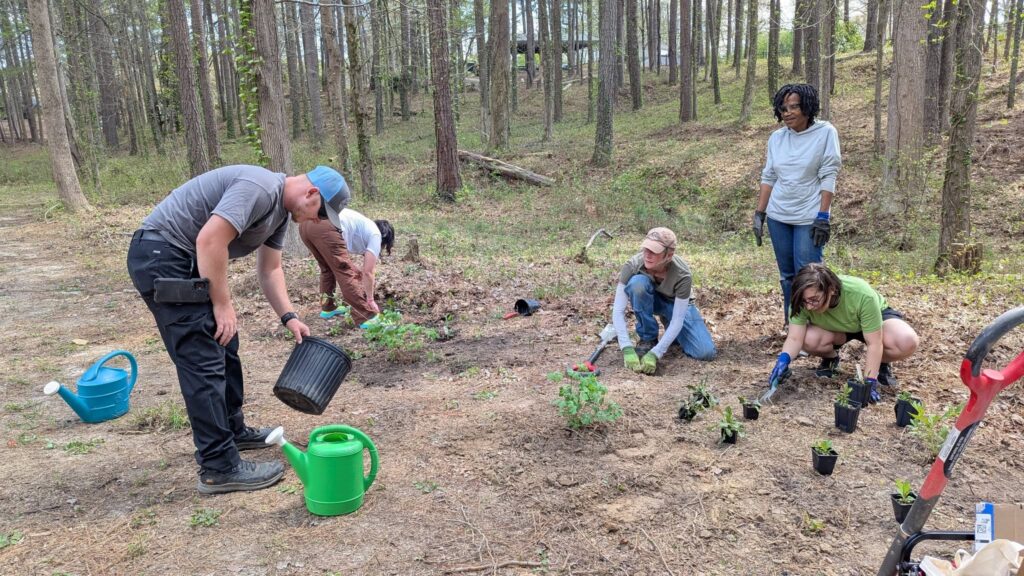
You can see a native shade pollinator garden at Ben Hill Strickland Park in the City of Hiram. Paulding Master Gardeners and Northwest Metro Master Naturalists installed the garden as a part of the Connect to Protect Initiative to provide pollinator habitat across landscapes that can connect more suburban and urban areas to more natural places, giving pollinators pathways and habitats across those landscapes.
Excellent resources for researching shade-loving plants are:
Native Plant Finder https://nwf.org/Native-Plant-Habitats/Plant-Native/
Georgia Native Plant Society https://gnps.org/
UGA Extension https://fieldreport.caes.uga.edu/news/a-pollinator-friendly-garden-can-be-created-in-the-shade/
Some other shade tolerant perennials: astilbe, bleeding heart (Dicentra), bugbane (Cimicifuga), campanula, columbine (Aquilegia), coral bells (Heuchera), foxglove (Digitalis), goatsbeard (Aruncus), hellebore, daylily (Hemerocallis), hosta, Virginia bluebell (Mertensia pulmonarioides), fern, monkshood (Aconitum), phlox, primrose (Primula), lungwort (Pulmonaria), cardinal flower (Lobelia), Siberian iris, and veronica.