
Agents in cotton producing counties,
It is that time of year again – the calls have begun rolling in and it is getting time to start putting the smell of fall in the air. Phillip Edwards’ favorite time of year – defoliation time.
There will always be situations that will need have to talk through, so while this email won’t address every intricate situation we may see, I hope that it provides you some general tools for “normal” situations.
The big call I’m getting right now is on timing. Our crop as a state is all over the board, ranging from early to late and areas that got rain and those that didn’t. The main question comes down to “Do I defoliate if it’s ready or keep pushing it?” This is mainly surrounding dryland cotton that has started growing again. There are a few things to keep in mind when having this conversation. First, our last effective bloom date (or the last day a flower is likely to mature into a harvestable boll) is right around September 15 (i.e. in the next week). So unless it has been blooming for 2 weeks or more I’m not sure I’d chase it. The other question is how much more money do they want to put in it?
There are three major ways to determine if a cotton crop is mature:
- 60 to 75% open boll (Open bolls/Total Bolls*100)
- 4 Node Above Cracked Boll (Illustrated below)
- Sharp knife method (Use a sharp pocket knife or PVC cutters to cut into the uppermost harvestable boll – if seed coats are dark and cotyledons in the seed are developed, it is mature and will open)
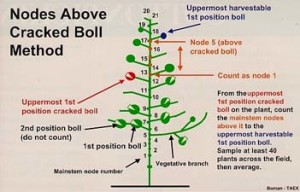
After looking at the weather for the next week or so, it looks like we are still in a scattered shower type pattern. Little chances every day, probably coupled with some overcast conditions. The good news is that temperatures will come down this week. However, it does look iffy in terms of applying defoliants. First, I prefer a few sunny days after application to ensure good uptake and activity. But secondly, rainfree periods do become a concern. Thidiazuron (Dropp/Freefall/Klean-Pik/etc.) has a rain free period of 24 hours, but if mixed with a phosphate (tribufos – i.e. Folex/DEF), that can be cut to 12 hours. With the pattern we are currently in, it’s tough to guarantee 12 hours, much less 24. Although I don’t like waiting if the crop is ready, if conditions aren’t conducive for optimal defoliation we may need to push a few days.
In terms of recipes for the week IF someone NEEDS to spray this week:
3.2 – 4 oz/acre thidiazuron (Dropp)
8 oz/acre tribufos (Folex/DEF)
32 – 42 oz/acre ethephon (Prep/Setup/Super Boll)
I doubt a bunch of folks are chomping at the bit to get started, but just in case. I’ll provide more info next week on why rates are adjusted certain ways – but just know things vary with environmental conditions as we go from here on – temperatures and rainfall are the big contributors for this.
