Heather Kolich, County Extension Coordinator | Agriculture and Natural Resources Agent, University of Georgia Extension Forsyth County
Earlier this year, I described how to use vegetative parts of turfgrass – stolons and plugs – to repair damaged areas of lawns. We can also replicate ornamental plants in our landscapes through vegetative propagation.
Unlike seed propagation, which produces plants that express a range of genetic characteristics of the parent plants, vegetative propagation allows us to replicate the exact genetic characteristics of a particular plant. Vegetative propagation through grafting is why every Red Delicious apple looks and tastes the same. We can also use stem cuttings, root divisions, and layering to easily propagate ornamental landscape plants.
The magic of vegetative propagation is contained in meristematic areas of the plant, which occur in the shoot and root tips and along plant stems where leaves grow. Meristematic areas are where plant cells divide and grow. Because meristematic cells are undifferentiated, they can develop into the type of tissue that the plant needs at that growth point. This is why stem cuttings can grow roots to support a new plant.
How to propagate stem cuttings
Stem cuttings are best taken from the actively growing tip of a plant shoot or root, or from a mid-stem section that contains at least one node. Vines may already have adventitious roots growing at mid-stem nodes. They use these above-ground roots to attach to trees and fences and “climb.”
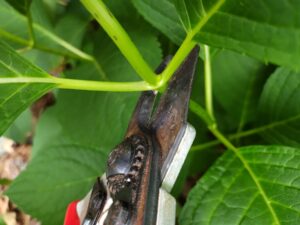
Stem cuttings should have at least two nodes, but not too many, since the developing roots won’t be able to support a large cutting. Two years ago, I took softwood cuttings from the green, growing stems of a hydrangea in my yard. May through July is a good time to take softwood cuttings from hydrangeas. One of my cuttings survived our wild weather swings and is ready to be transplanted into my landscape. I’ve reproduced my annual coleus containers from cuttings for the past three years, without needing to purchase new plants.
To get these cuttings started, I cut a stem from the parent just below the third pair of leaves. Then I removed that lowest pair of leaves near the stem, making sure not to damage the bud that is tucked into the leaf axil between the stem and the leaf petiole. Next, I dipped the trimmed stem and buds into plant rooting hormone, which helps cuttings root more quickly and abundantly. Finally, I planted the stem end into a small pot that was filled with moist, loose, light propagation media that provides a good growing environment for cuttings. I use small pots to start cuttings because it is easier to manage soil moisture in smaller pots than in larger ones.

With appropriate moisture, light exposure, and temperature, the cutting rooted in a few weeks. When new leaves begin to grow, you’ll know the rooting was successful. I grew my new hydrangea and coleus plants on the screen porch until the fall, then moved them indoors for the winter. When temperatures warm in the spring, I gradually expose the plants to outdoor conditions for a few hours each day until they are hardened off for life outside. Then I transplant them into larger pots to live outdoors.

Other landscape propagation methods
Layering and division are other vegetative propagation techniques we can use on landscape plants. Layering involves anchoring a branch of a shrub down to the ground and covering a stem node with soil to encourage rooting. The parent plant continues to nourish the branch, but when the section forms good roots, it can be cut from the parent and transplanted elsewhere.
Division is useful for thinning overgrown clumps of perennials such as daylilies, hostas, and flowering bulbs. In the fall, dig up the clump and divide it into smaller clumps of 3-5 healthy, vigorous, well-rooted shoots. Replant one division in place and find new locations (or new owners) for the other divisions. For bulbs, wait until the foliage turns yellow and wilts, then dig around the area to expose the bulbs. Gently separate secondary bulbs (bulblets) from the large bulbs. Discard diseased bulbs. Replant healthy bulbs and bulblets at the appropriate depth for the bulb size – 2-3 times the largest diameter of the bulb for large bulbs; 3-4 times the diameter for small bulbs.
Vegetative plant propagation is a fun, easy, and economical way to enhance your landscape and to keep special plants growing year after year.