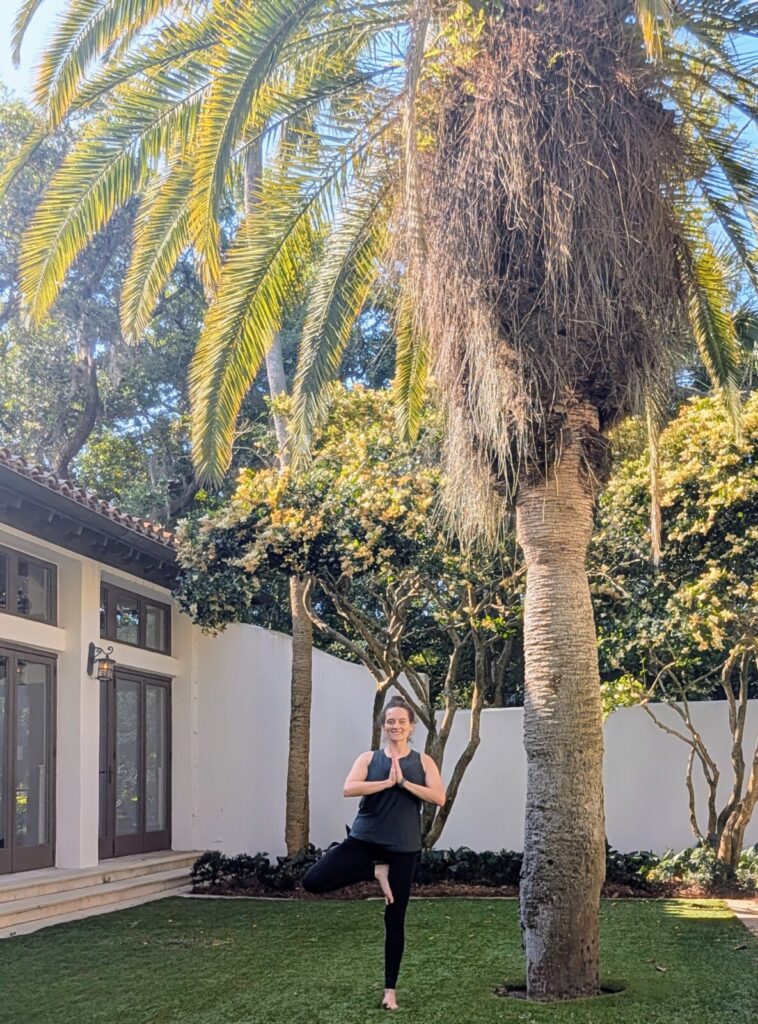
Michelle Quick, MS, RDN, LD, is the Glynn County Extension Coordinator and Family and Consumer Sciences Extension agent for Glynn and McIntosh counties. Read on to learn more about Michelle’s passion for well-being, stress management, yoga, and nutrition.
Tell us about how you became involved with UGA Extension.
My career with UGA Extension began in 2022, but I had been familiar with Cooperative Extension long before this, through my home state of Tennessee. During my time at the University of Chattanooga, where I earned my undergraduate degree, I spent time with UT Extension where I learned of EFNEP (Expanded Food and Nutrition Education Program). I also had the opportunity to work with Texas A&M AgriLife during my dietetic internship in 2012. After relocating to Georgia in 2014, I worked as a Clinical Dietitian for a local health system, but my passion has always been in community education and service, so when the FACS position opened up in Glynn/McIntosh counties, I knew I was in the right place at the right time.
What programming or activities are you most proud of?
That is a tough one! I truly enjoy teaching stress management. We all experience stress and directing our energy toward healthy techniques is crucial for reducing the risk of stress-related chronic diseases. My approach to stress management education varies depending on the setting, but it often includes teaching breathing exercises, yoga, physical activity, or practicing mindfulness, and promoting overall well-being – mind and body. It is always rewarding to help others develop tools for managing stress positively and sustainably.
You completed your 200-hour yoga teacher training (YTT) in 2024. Can you tell us about the health benefits of yoga, especially for people living with diabetes?
Yoga combines physical movement with mindfulness, making it a great tool for managing the physical and emotional challenges of living with diabetes. Physical postures can help improve blood circulation, especially to the extremities, while also encouraging digestion through twisting, stretching, and bending movements. Breathing techniques and meditation can be very therapeutic and have been proven to reduce stress and lower cortisol levels—a hormone that, when elevated, can raise blood sugar levels. By keeping blood glucose levels within your target range, yoga can help reduce the risk of complications such as heart disease, kidney and nerve damage, or vision problems.
Are there any special considerations an individual with diabetes should take into account as a yoga beginner?
Yes, you should always consult your healthcare provider before beginning, especially if you have any underlying health conditions. Those with uncontrolled diabetes or uncontrolled high blood pressure should refrain from yoga. Also, yoga should not be painful. If you are in class and your posture causes sharp pain, burning, or tingling, do not do it! There is no shame in returning to child’s pose, sitting or lying on your mat. Modifications are encouraged as all bodies are not created equal. Use blocks, straps, and bolsters to provide support between you and the ground and know that your limits will be different than someone else’s. It’s also important to know what classes suit you best, so try out several different styles and teachers. Stick with those classes that speak to you and your body the best.

Do you have a favorite pose?
I’d have to say Crow Pose is my favorite. Not just for its physical benefits, but for what it represents in my own journey. Working toward it has shown me how much I’ve grown, both in strength and in perseverance. It’s a pose that demands more than just physical ability; it requires focus, confidence, and a willingness to trust yourself, otherwise, you’re meeting the mat face-first – which I have done many times!
A few years ago, I couldn’t do Crow Pose at all. But I kept showing up. I embraced modifications, stayed patient, and trusted the process.
Also, let’s be real. Shavasana (flying flat on the mat) is ALWAYS the best.
In addition to being a Registered Yoga Teacher, you’re a registered dietitian nutritionist. What do your passions of yoga and nutrition have in common?
Life is all about balance. Yoga, by nature, is a practice, and as with any practice, it fluctuates. There are days when I feel full of energy, effortlessly flowing through balancing poses, and able to silence my mind’s chatter on the mat. On other days, I feel fatigued, struggle to find my balance, and feel like my to-do list is trying to invade my practice. But each time, I return to my mat, knowing that my body and mind are different from one day to the next.
The same applies to nutrition. As a dietitian, I always encourage a balanced approach—enjoying the foods you love in moderation. There will be days when you feel proud of your food choices, physical activity, or hydration. But there will also be days when you feel off-track. Perhaps you crave something sweet or realize you’ve skipped your fruits and veggies for the day or barely drank any water. This is the ebb and flow of life! When these moments arise, acknowledge them, reflect, and make a plan for the future. And once you have done that, LET IT GO!
