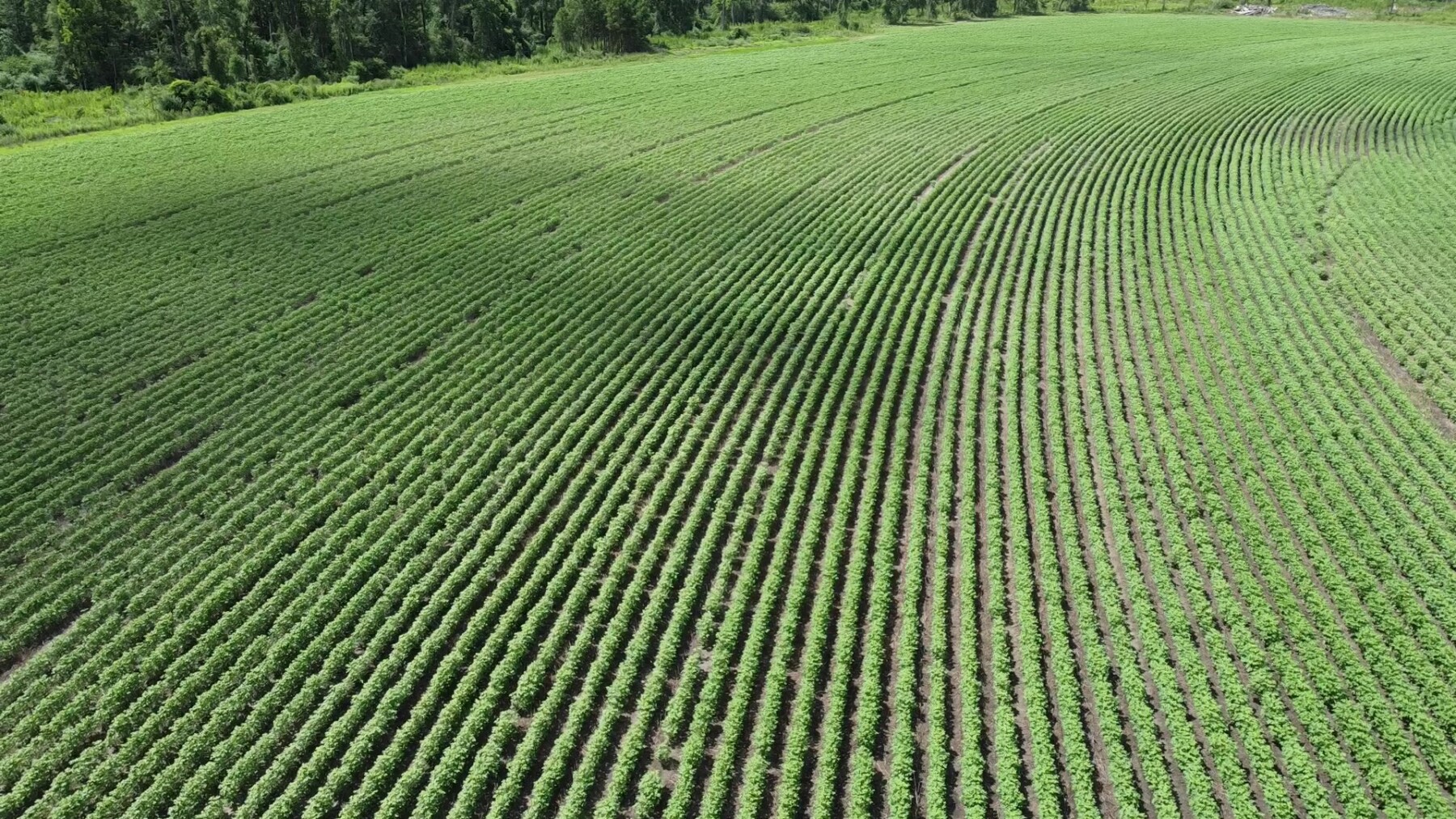
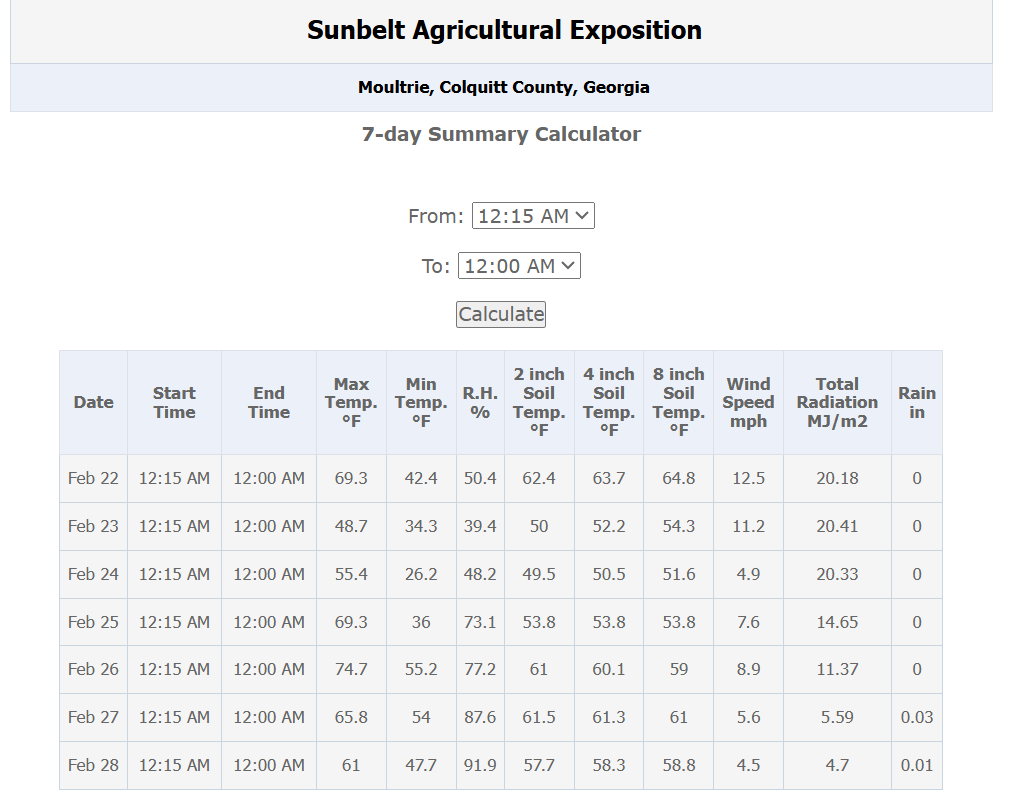
Corn planting time is around the corner for Colquitt County corn growers. To increase your chances of avoiding yield-limiting disease pressure, corn should be planted as early as possible. At planting soil temperatures at the 2-inch depth should be at or exceed 55o F. Germination progresses slowly at temperatures between 55 and 60o F and emergence will take between 7 to 12 days. Conversely, germination will progress rapidly when corn is planted in soil temperatures greater than 60o F and emergence will be prompt. The illustration below shows the soil temperatures for the period of February 23-28, 2026, from the Sunbelt Ag Expo location of the UGA Weather Network.
Nitrogen Management: Apply 25 to 30 percent of the projected nitrogen needs before or at planting. The remaining nitrogen can be applied sidedress and/or injected through the center pivot systems (fertigation). If all the nitrogen is applied with ground equipment, apply 50 to 75 pounds per acre at or before planting under irrigated conditions and 20 to 50 pounds per acre in dryland environments and the rest when the corn is 12 to 16 inches tall. If nitrogen is to be injected through the irrigation system, apply 40 to 60 pounds at or before planting and begin ground or injected applications of 30 to 60 pounds of nitrogen per acre when the corn is 8 to 12 inches tall. Continue on a bi-weekly basis until the total required nitrogen is applied. Three to five applications of nitrogen will be needed during the growing season. Nitrogen rates are based off 1.2 lbs per bushel yield goal.
Below is info from Dr. Glenn Harris (retired UGA Soil Agronomist) about “How Much Fertilizer Do I Need for 300 Bushel Corn?”


Phosphate and Potash: Apply all the phosphate and, on most soils, all the potash at or before planting. Some of the phosphate requirements may be obtained with starter fertilizer. On deep sands, you should probably apply potash in split applications, half at planting and half at layby.
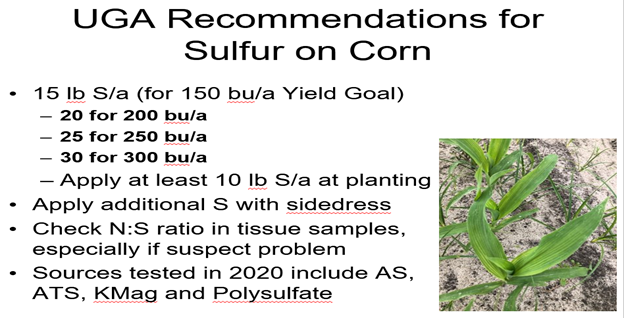
Secondary and micronutrients: Corn requires a relatively large amount of sulfur, generally 20 to 30 pounds per acre. On deep sands, apply sulfur in split applications. All sulfur should be applied in the sulfate (SO4) form. Applications with nitrogen may prove efficient.
Base magnesium fertilization on soil tests. If the level is low, apply 25 to 50 pounds per acre of water-soluble magnesium by layby. Zinc deficiency can be prevented by using three pounds per acre of actual zinc. Do not use zinc unless soil test levels are low. If needed, apply pre-plant or at planting. Boron deficiencies can occur on sandy soils low in organic matter. Generally, use one to two pounds per acre of boron applied in split applications. It is best to apply boron with the nitrogen applications. The application of other essential nutrients should be based on plant analysis results.
If you have questions please contact your local county Extension agent.