I get questions about hay sampling on a regular basis. A forage test contains a lot of valuable information that can be used in your winter-feeding program. Remember it is just guess unless you test.
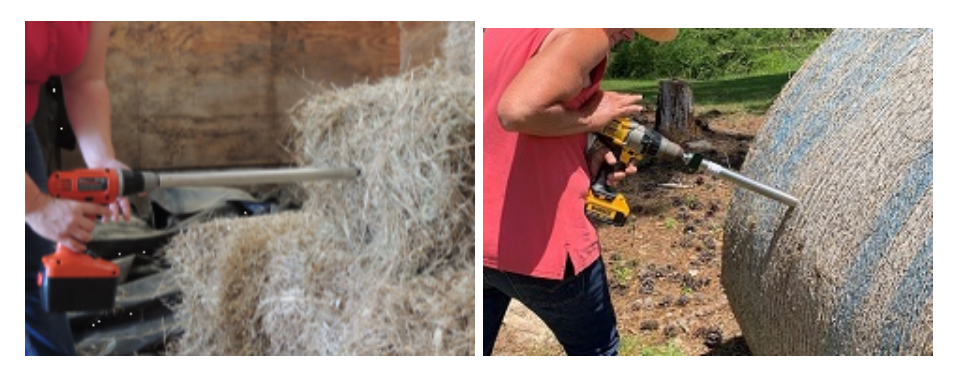
When taking a hay sample please use a hay probe. The probe should have an internal diameter of at least 5/8 inch. One of the challenges of a hay probe is keeping the cutting edge sharp. If they are dull then collecting a good sample could be difficult. A narrower diameter or dull sampler may move between flakes or layers of hay and may not provide an adequate representation of the leaf-to-stem ratio of the forage. If you need information about hay probes, please check this out. I would suggest a good drill and take extra batteries. The last thing anybody wants is to sample hay with a dead drill.
I get questions about just grabbing a sample from a couple of bales and if that is good enough. It is not recommend because a grab sample will NOT provide a good representative sample of the hay you are feeding.
How much do I need for a sample? It would be great to collect 15–20 cores from each lot. One reference defined a lot as forage taken from the same farm, field, and cut under uniform conditions within a 48-hour time period. To collect a core, insert the hay probe on the side of the bale, coring toward the center so you cross several windrows of forage.
If you are sampling rectangular bales of all sizes, insert the hay probe 12 to 18 inches deep at a right angle into the center of the ends of bales. If you are sampling round bales, the probe should be inserted into the curved side of the bales.
When the probe gets full, empty the contents into a clean container (e.g., bucket or bag). Please be careful when you empty your probe because the tips can be sharp. I have cut myself a couple of times. Make sure to mix the collected hay thoroughly to decrease bias and then pour in enough sample to fill a 1-quart plastic bag. Label each sample to make it easy to remember the location and lot sample. Fill out the UGA Feed and Forage Testing Application, attach the form to the sample, and submit to your UGA County Extension Office.
I have taken a few samples last month, which is summarized in Table 1. Table 1. shows the average and the range (min and max) of forage quality such as RFQ, % TDN, % CP and nitrates.
Table 1. The Average and Range for RFQ, TDN, %CP, and Nitrates of 17 Bermudagrass and Peanut Hay Samples Taken in Colquitt County, Dec 2025

If you have questions about forage sampling, please contact your local county Extension agent.