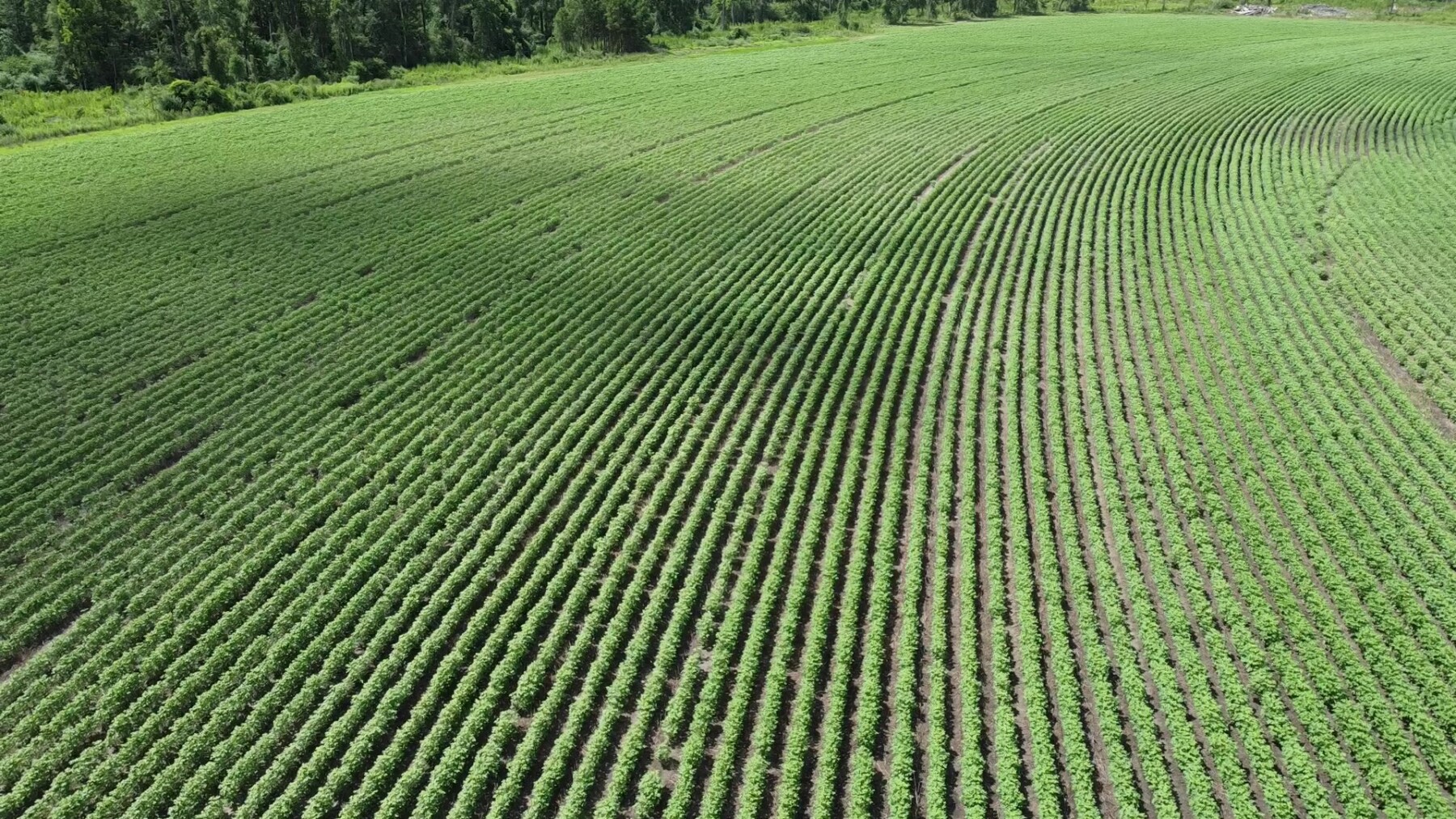
Tankmixing Grass herbicides with fungicides on peanuts. This has been a common question. According to Dr. Eric Prostko, for optimum grass control, it not a great idea to mix POST grass herbicides with a fungicide due to the increased potential for antagonism. Generally, Abound, Bravo WS, Headline, and Folicur have all reduced grass control at some point when tank-mixed with POST grass herbicides. When a grass/fungicide interaction has occurred, grass control has been reduced by as little as 3% (Poast + Bravo WS – large crabgrass) or as much as 45% (Select + Bravo WS – large crabgrass). It all depends upon the grass species and fungicide used.
Tank-Mixing Chemicals Applied to Peanut Crops: Are the Chemicals Compatible?
https://www.peanut.ncsu.edu/pdffiles/004993/tank_mixing_chemicals_applied_to_peanut_crops.pdf
And how late is too late to apply boron to peanut? According to Dr. Glenn Harris, peak pod fill for peanuts occurs 60 to 90 days after planting, once peanuts are 80 days old or older, the chances of applying boron and getting a yield increase decrease dramatically. And what about rate? The UGA recommendation for B on peanuts is 0.5 lb. B/a. This can be applied in one application or split into 2, 0.25 lb. B/a applications. Rates higher than 0. 5 lb. B/a in a single application can cause burn to the foliage.
Here’s the UGA recommendations for applying foliar fertilizer to cotton:
Nitrogen: Feed grade urea is the most reliable, economical and proven foliar N material. The standard recommendation is to apply 4.5 lbs of nitrogen/acre as urea in at least 5 gallons or more of water per acre (5 gal/acre assumes aerial application, 10 to 12 gallons of water is preferred for ground application). Both liquid urea (23% N) and granular urea (46% N dissolved into water) can be used.
10 lbs of feed grade urea (granular 46% N) per acre will give you approximately the recommended 4.5 lbs of nitrogen per acre.
Potassium: Potassium nitrate is the most common material used for foliar K applications. The standard recommendation is to apply 4.4 lb of potassium per acre in 5 gallons or more water per acre. (Again 5 gallons assumes foliar application, 10 to 12 gallons is preferred for ground application). Both liquid and granular potassium nitrate can be used.
10 lbs of granular potassium nitrate (44% K2O) per acre will give you the recommended 4.4 lbs of potassium per acre.
Keep in mind that there are other products out there available to use for foliar feeding cotton. Some of these may not contain as much fertilizer as the products mentioned above and you may not be able to apply them at the same rates as mentioned above. Use caution with all fertilizer products as improper rates could cause leaf burn.
How late is too late to foliar feed cotton?
Foliar feeding is most effective when applied during peak bloom, or the first 4 weeks of bloom. Foliar feeding during weeks 5-7 of bloom may or may not be effective depending on the variety grown.
Once you pass the 8th week of bloom, it is too late. No foliar feeding is recommended after this point.
Tank-Mixing Cobra or Ultra Blazer with Cadre in Peanuts (Prostko)
Over the last few days, I have had a few questions about tank-mixing Cobra or Ultra Blazer with Cadre + Dual Magnum + 2,4-DB. Most are concerned about potential crop injury but this tank-mix has not been overly caustic in my research (Figures 1 and 2). But, keep in mind that crop injury with tank-mixes can vary greatly depending upon many factors including time of application, GPA, air temperature, leaf wetness, and humidity. Thus, I can provide no guarantees when 4-6 products are dumped in 1 spray tank.
Peanut growers who suspect (or are not sure) that they have ALS-resistant Palmer amaranth and/or other weeds that Cadre is less effective on (i.e. tropic croton) would greatly benefit from this tank-mix. In this scenario, Dual Magnum could be replaced by Outlook, Warrant, or Zidua (grower preference not mine). Also, I would probably avoid Anthem Flex in this particular situation because of the Aim (carfentrazone) in the Anthem Flex. When using Warrant or Zidua, a NIS should be included (0.25% v/v or 1 qt/100 gals).
What about using sulfur with my peanut fungicides?
There has been a few questions about using sulfur as “tank mix” partners for managing leaf spot in peanut fungicide programs. According to Dr. Bob Kemerait, UGA Plant Pathologist, those circled have all performed VERY well when tank mixed at 5 lb/A with fungicides such as azoxystrobin (Abound) pyraclostrobin (Headline) and, more or less, with tebuconazole. Those encircled products restore leaf spot activity to some fungicides that have lost activity. These sulfur products also performed well when mixed with Umbra and Excalia.
Hello Dr. Bob, can growers mix at lower rates of sulfur, say 3 lb/A? The answer is probably”yes” but I am most comfortable recommending 5 lb until I receive further data.
Hey Bob, can growers mix other sulfur products with same results? The answer is “probably” but some products have not performed as well as those encircled. More will be tested. I do not recommend any that are not on that list, no matter how close the name may be..
Can Growth Regulators Boost Peanut Yields?
Barry Tillman, UF/IFAS Peanut Breeder, and Scott Monfort, UGA Extension Peanut Agronomist
Excessive peanut vine growth can be problematic in several ways. First, too much vine can increase disease because of the ability of the canopy to hold moisture and the inability of fungicides to penetrate the dense canopy. Second, excessive vine growth can slow harvest operations, costing time and money. And finally, damaged vines during mid-season pesticide applications can increase disease and yield losses.
Appropriate use of the growth regulators Apogee or Kudos (prohexadione calcium) can help to manage vine growth and increase yield. A recent article in Peanut Science (Studstill et al., 2020; Influence of Prohexadione Calcium Rate on Growth and Yield of Peanut) showed that the growth of peanut was reduced by growth regulator application AND that the pod yield of runner-type varieties was increased in farm-scale studies in Georgia and Mississippi. Using the 0.75X rate (5.4 oz/acre Apogee) reduced the plant height by about 4 inches and increased yield by about 700 pounds per acre, translating to about $85 per acre net return. It is important to note that yield increase is not guaranteed, due to specific conditions in each field and season, but on average, the treatment pays for itself or makes money. The Apogee label specifies that peanut should be actively growing and without stress from disease or drought when the application is made. The first application should occur when 50% of the stems are touching in the row middles (not before) and a second application 14 days later. Panhandle Agriculture
How do I determine forage moisture?
I have received a question or two about how to determine forage moisture this week. Growers need to make sure they are baling forages at the proper moisture depending on storage method. The most accurate method of determining moisture is by using a microwave.
Also, Dr. Lisa Baxter, UGA Forage Specialist, has a great job discussing various methods of moisture determination in forages.
What about managing foliar diseases in cotton?