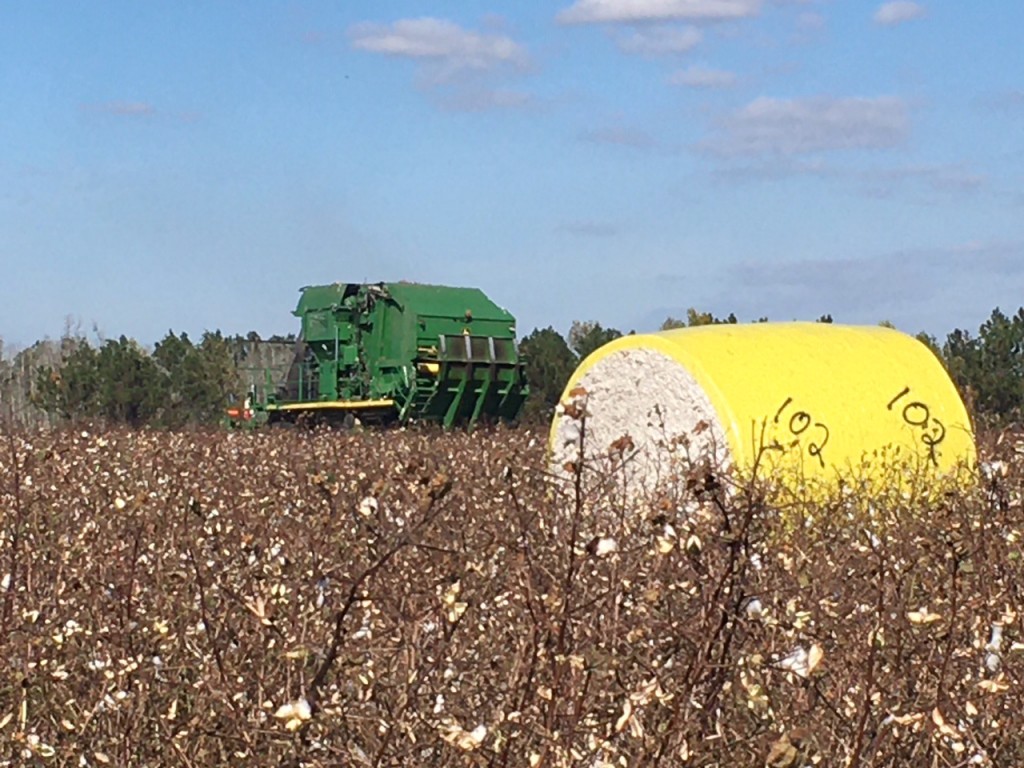
Happy New Year! The Colquitt County area received some much needed rain of the weekend. The Drought Monitor indicated that 72.69% of Colquitt County was suffering from D3 conditions. Rainfall amounts over the weekend ranged from 0.5 to 0.7 inches. According to the Drought Monitor, drought conditions will persist through January.
Below are questions that I have been receiving .
I have white mold in my baleage! Once the plastic has been removed, one may find molds of various colors on the exterior of the bale. One of the most common is white mold (Figure 1). White mold is usually associated with baleage bales that were baled too dry to ferment well, but it can occur even if they were baled at the proper moisture level. It often grows on the flat sides of the bale or just under small holes in the plastic. White mold is a harmless yeast, but molds that are green, blue, yellow, or red are indicative of a problem.

What is going on in the oats? I have received a question or two about weed control in oats. Oats range from 1 to 3 tillers in stage of development. Henbit and wild radish have been common in these fields. Control options for henbit include Harmony Extra, which can be applied to oats after 2 leaf and before flag leaf. Wild radish has to be small <1 inch for Harmony Extra. 2,4-D or MCPA can be tank-mixed with Harmony Extra but oats have to be fully tillered per label. If you want more information about weed control please go to the UGA Pest Management Handbook.

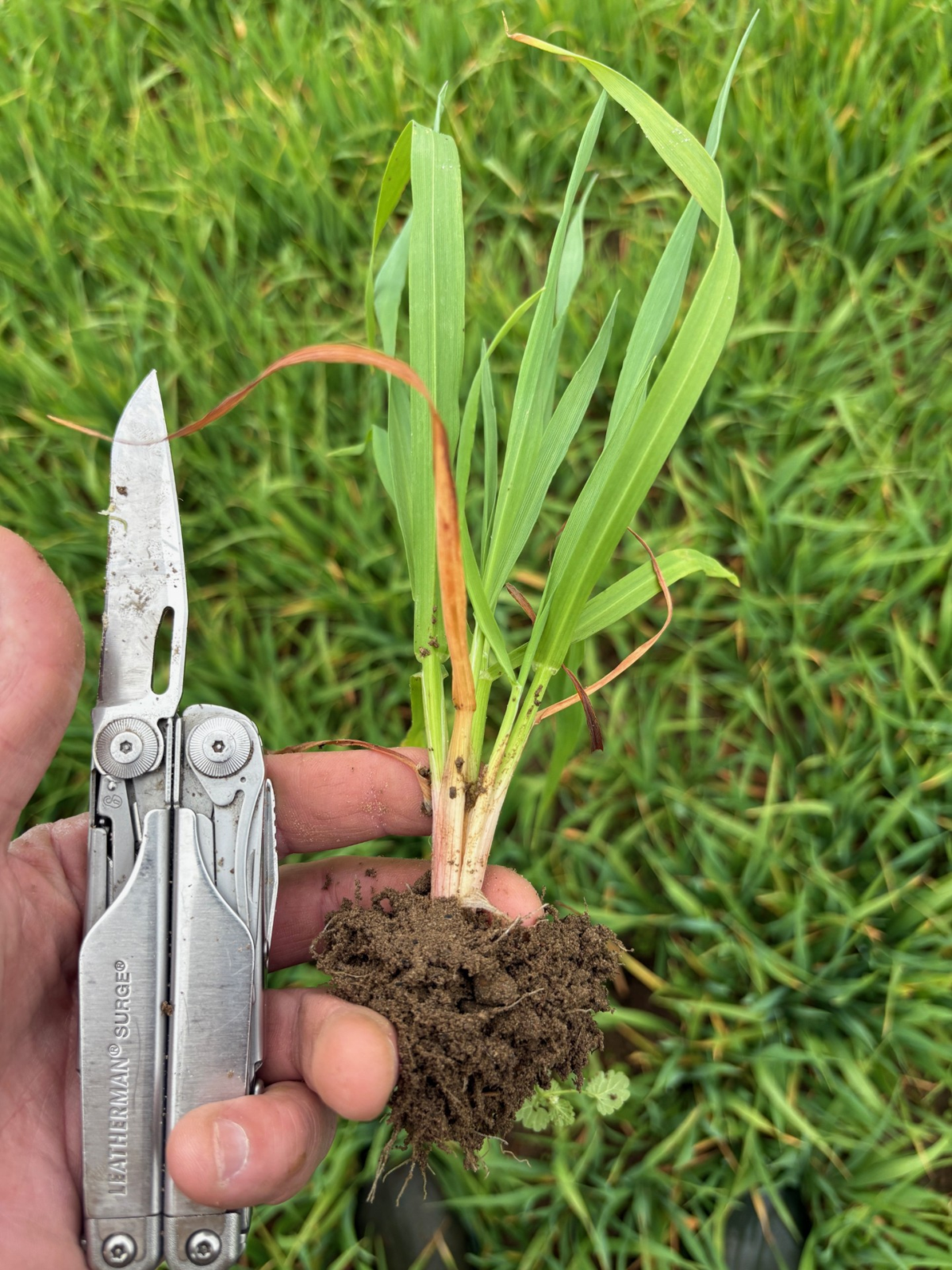
I have received a call or two about fields of small grain that is yellow due to cold weather, and fertility. Nitrogen management has been the topic of conversation. If your small grains are following cotton then they may be running out of gas if they were planted first of November. If you are taking tissue samples, the above ground portion of the plant needs to sampled up until boot stage.
What about nitrogen? Well it depends. For oats following a legume apply 60 pounds nitrogen per acre; for oats following cotton, corn, etc. apply 80
pounds nitrogen per acre; for oats following grain sorghum apply 100 pounds nitrogen per acre. Apply 20 to 40 pounds of the recommended nitrogen per acre in the fall and the remainder in February. Timing of N fertilization should be based on the pattern of uptake by the crop. Demand for N is
relatively low in the fall but increases rapidly in the spring just prior to stem elongation.
What about my grazing? Temporary winter grazing such as rye, wheat, oats can use about 100 pounds of nitrogen per acre during the growing season. Split the nitrogen (N) application, applying 50 pounds nitrogen per acre at planting and 50 pounds nitrogen per acre in late winter before spring growth begins. If you have ryegrass in the winter annual mixture then apply another 50 pounds per acre in early spring. Ryegrass has a longer than
normal grazing season. The spring application of nitrogen will help extend the grazing period.
Aphid pressure has been variable in fields. Aphid treatment thresholds for 6–10 inch plants is 6/row ft. The UGA Pest Management Handbook has more information on the this.
What variety of bahiagrass do I need to plant? According to UGA Forages, recommended bahiagrass varieties include Tifton 9, TifQuik, or UF-Riata. All of these are higher yielding than Pensacola and better suited for pasture and hay production.
According to the UGA Bahiagrass Production Guide, bahiagrass seed has variable germination rates. Some seeds germinate quickly after planting, while others may not germinate until the following year. Generally, 50 to 60 percent of the seed will germinate within 30 days. TifQuik is the exception, as most of its seed will germinate readily within one to two weeks after planting if soil conditions are favorable.
The best time to plant bahiagrass is in the early spring on upland soils or in late spring on low, moist soils. Plantings made later in the summer can be successful, but weed competition (primarily aggressive summer annual grasses, such as crabgrass, goosegrass, and crowsfootgrass) can be a problem. For warm-season grasses, soil temperatures need to remain above 59°F for optimal germination and growth.
I have a twin-row planter. Will it increase my corn yields? This is a question that comes up occasionally. According to the UGA Corn Production guide, most farm equipment in Georgia is set to plant in 36″ rows. Wider rows, 38 to 40″ rows, usually result in little space between plants within a row. This creates in-row competition for water and nutrients. Studies conducted in corn reveal that yields increase as rows narrow at high plant populations (Table 3). This allows plants to exploit more moisture, nutrients, and light due to greater space between plants. Narrow row spacing also helps weed control by shading the lower canopy. Row widths of 30 to 36 inches are adequate for top yields in Georgia. Twin-row configurations vary in Georgia from 7 inches to 12 inches between the twins on 36- to 30-inch centers. It is important to achieve a complete hardpan disruption under each row. Most winged subsoil shanks will only fracture a 6- to 7-inch span and therefore will not completely cover the width of the twin-row configuration. Para plowing, or V-ripping, will provide full root zone fracturing of the hardpan, but these methods can result in delayed field entry if high levels of rainfall occur.
Have a safe week,
Jeremy M. Kichler
Colquitt County Extension Coordinator
The University of Georgia Cooperative Extension does not endorse or guarantee the performance of any products mentioned in this update