By Lawton Stewart and Uttam Saha
This year has proved to be quite an interesting one. Many parts of the state have seen periods with above-average amounts of rain, but also periods of well below-average amounts. Most producers were able to put up plenty of hay. However, based on the samples submitted to the UGA Feed and Environmental Water Laboratory, there is quite a range in forage quality. For producers with late winter/spring calving season, this could cause potential issues. Combining this with a few other observations, here are a few situations we are seeing, and the potential ramifications.
1.I will restrict feed in the last trimester to decrease calf birth weights.
2.I need more protein to go with my hay
3.There is a tendency to underestimate crude protein and overestimate energy.
I will restrict feed in the last trimester to decrease calf birth weights. Is this correct? Absolutely! The problem is that birth weight is not the only thing it will affect. Recent research has focused on fetal programming. Fetal programming is the concept that maternal stimuli or insults during fetal development have long-term effects on the offspring. One of the most critical aspects of fetal programming involves the adequate nutrition, or lack thereof, of the dam. Research has shown minimal impact on calf birth weights; however, the restricted nutrition during the last trimester decreased weaning weights, finishing weights, and hot carcass weights. Additionally, research from Nebraska indicated that heifers from
nutritionally restricted cows reached puberty 14 days later than those with proper
nutrition.
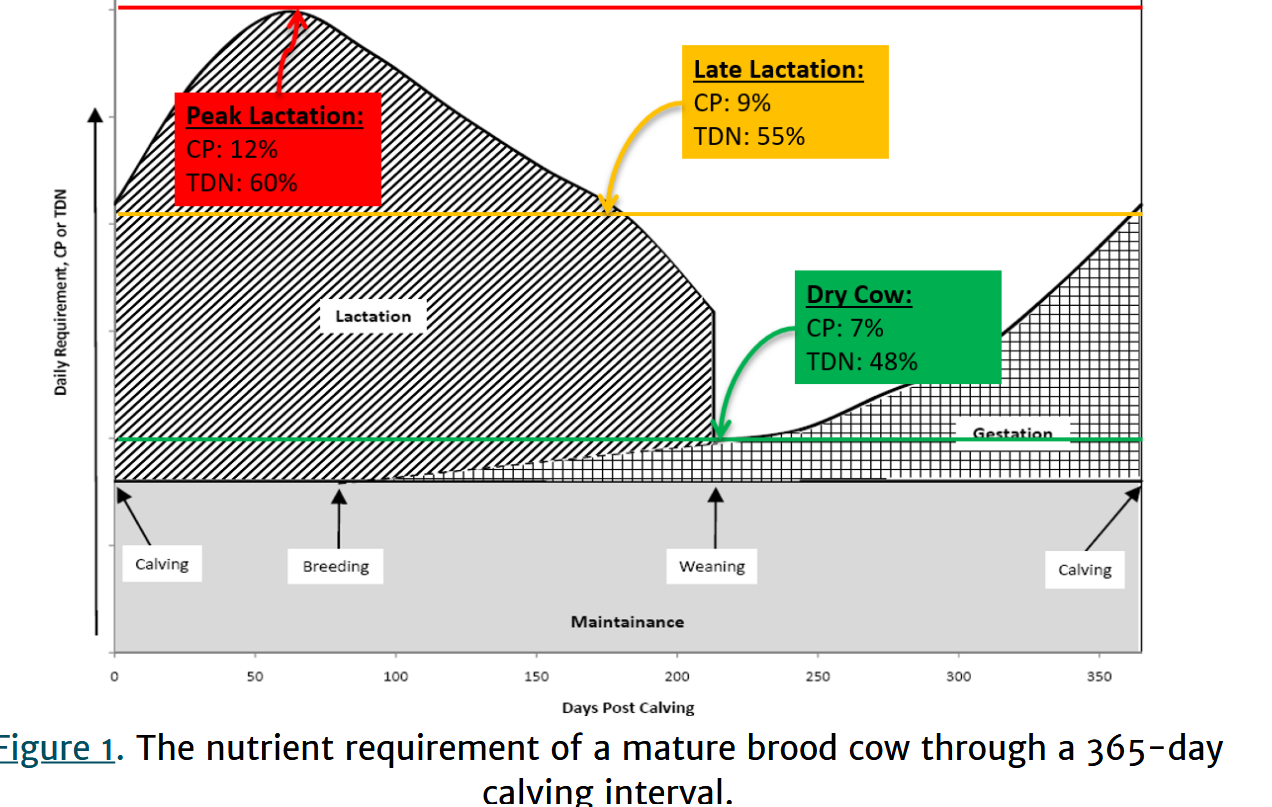
I need more protein to go with my hay. Is this correct? Possibly, however, protein is only half of the equation. From April 1 to October 1 of this year, 773 bermudagrass hay samples were submitted to the UGA lab. The mean crude protein and energy (TDN) value was 11.1%. and 55.7%, respectively. Figure 1 represents the CP and TDN requirements of a brood cow throughout the production year. As you can see, as cows are entering the final trimester, their CP requirement is exceeded by the average bermudagrass sample, but the energy requirement falls short. More importantly, as they calve, enter peak lactation, and the breeding season, the CP requirement is met, but the TDN falls tremendously short.
There is a tendency to underestimate crude protein and overestimate energy. The
cheapest money you will ever spend in a beef cattle operation is a forage test,
guaranteed!!! A great illustration of this happened recently during the UGA Master
Cattlemen’s Program. As part of the program, a free forage test was offered to
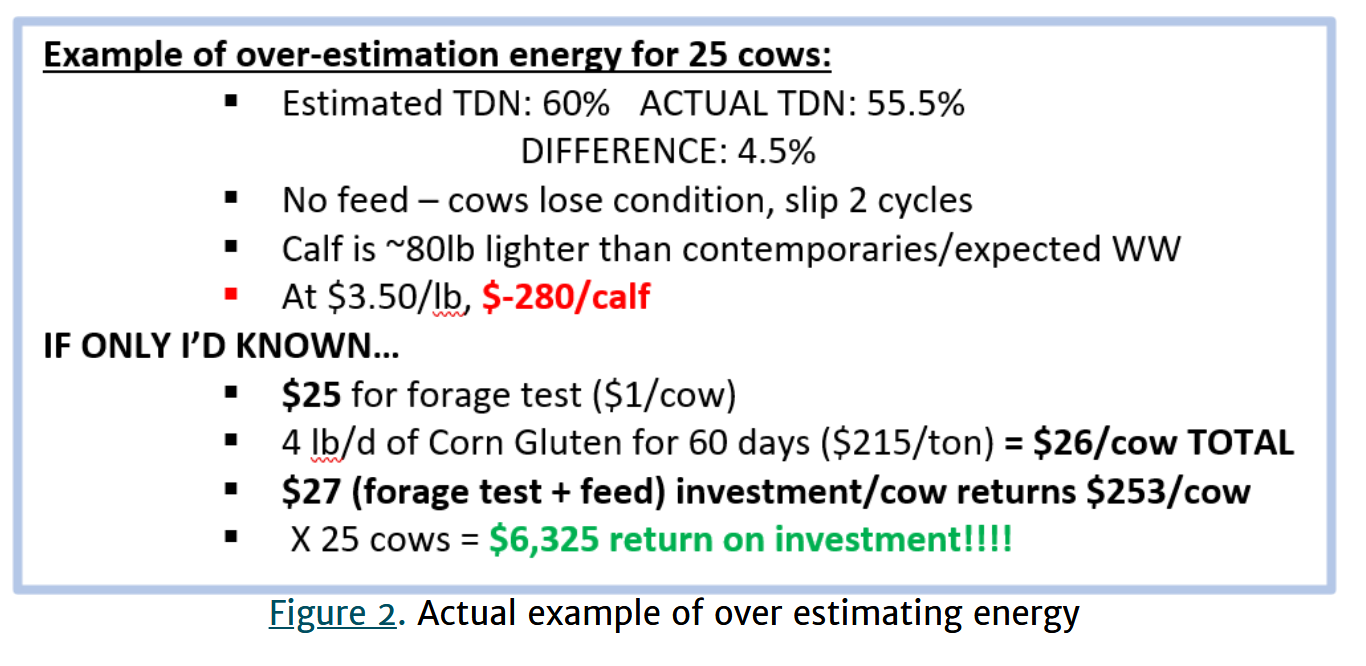
participants along with a survey to estimate what producers thought the quality of the hay was (prior to testing). This allowed for a comparison of what producers thought they An Equal Opportunity, Affirmative Action, Veteran, Disability Institutionhad versus what they actually had. This survey resulted in 83% of producer underestimating the protein of their hay compared to the actual. This would result in purchasing a protein supplement when not needed. For energy, 50% overestimated energy. This would result in depriving needed energy during late gestation and early lactation. In addition to the previously discussed fetal programming issues, this could also cause delayed breeding. An actual example of overestimation of energy is illustrated in Figure 2. The overestimation could likely result in breeding being delayed 42 days. The resulting loss in weaning weight could easily reach 80 lb, resulting in an approximate $280 decrease in value per calf. Through forage testing, the producer would know to feed 4 lb/d of a supplement such as corn gluten feed. Based on a 25-cow herd, this could easily return $6,325 above cost. That is a no-brainer!
Brood cow nutrition is a crucial part of a beef cattle operation. Between fetal programing and maintaining the proper calving interval, it is imperative for producers to pay close attention to the nutrients available in their forages, and if they meet the requirements of their herd. If you have any questions on nutrition, hay testing, or developing winter feeding strategies, contact your local Cooperative Extension office (extension.uga.edu, or 1-800-ASK-UGA-1).