The Weather Underground blog today discusses what the summer climate is likely to be across the country for the next few months. Generally summer is the hardest time of year to predict, and this year is unusual because of the El Nino which is currently present in the eastern Pacific Ocean. El Nino is usually a winter phenomenon, so there are not a lot of historical analogs to use for prediction.
Bob Henson, the author of today’s blog, indicates that he thinks it is likely that the summer weather will be cool, particularly in the central Plains. There the tremendous amount of rain that has fallen will keep temperatures cool by using all the solar energy to evaporate surface moisture as well as increase cloudiness instead of heating up the air. You can read the details at https://www.wunderground.com/blog/JeffMasters/comment.html?entrynum=2996.
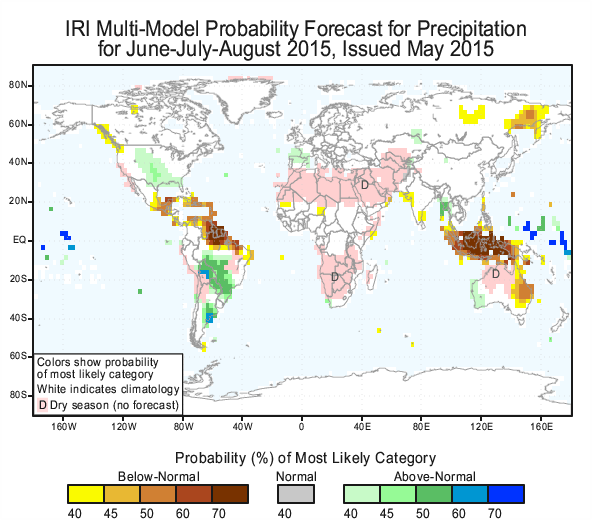
Outside of the US, the International Research Institute for Climate and Society at Columbia University has provided the maps below for their predictions for global climate anomalies (you can get them at https://iri.columbia.edu/our-expertise/climate/forecasts/seasonal-climate-forecasts/). The forecasts show that with a few exceptions including the south and central Plains, temperatures across most of the globe are expected to be above normal. Precipitation in the US is expected to be a little above normal, but dry conditions are expected to prevail in northeast Brazil and in Indonesia as well as eastern Australia. Very wet conditions are likely in central South American under the influence of El Nino there. Note that in IRI’s precip map, deserts are blocked out (pink regions) since it is normally dry there at this time of year.