The content on this page is retained only for recordkeeping, historical reference, or research. These materials are preserved in their original form and may not meet current WCAG 2.1 AA accessibility standards.
These archived materials are not required to be remediated. However, we remain committed to equitable access. If you need an accessible version of any archived item to participate in our current programs and services, we will provide one when feasible upon request at caesweb@uga.edu.
As the eclipse passed us yesterday, scientists were carefully studying not only the outer atmosphere of the sun, or corona, which is normally hidden in the glare from the main ball of the sun, but also the impacts of the eclipse on Earth’s atmosphere. In Athens we noticed that the fair-weather cumulus clouds we often see during the day were going away as the temperature dropped and did not return until after the eclipse ended. The temperature in Athens dropped several degrees (it felt great!) and the light dimmed significantly, although it was more like twilight than true dark and happened very quickly (although long enough for the stadium lights to come on). Bob Henson of Weather Underground has a nice summary of some of the meteorological findings so far from locations around the country at https://www.wunderground.com/cat6/personal-eclipse-weather-impacts-atmosphere?__prclt=7nOSaHa2. I know there will be a lot more to come!
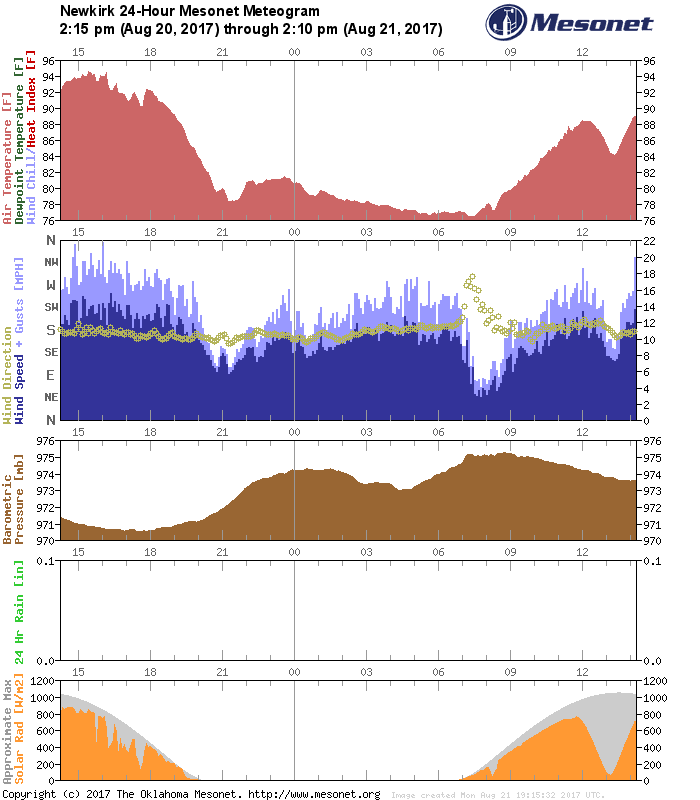
This trace of conditions from the Oklahoma Mesonet site at Newkirk, OK (around 90% totality) shows the impact of the midday eclipse, with a temperature drop from around 88°F to 84°F just after noon on Monday, August 21 (top panel, far right side of graphic). Solar radiation (bottom panel) dropped from more than 700 watts per square meter to less than 100. Image credit: Oklahoma Mesonet. Thanks to Steve Koch (National Severe Storms Laboratory) for flagging this example.