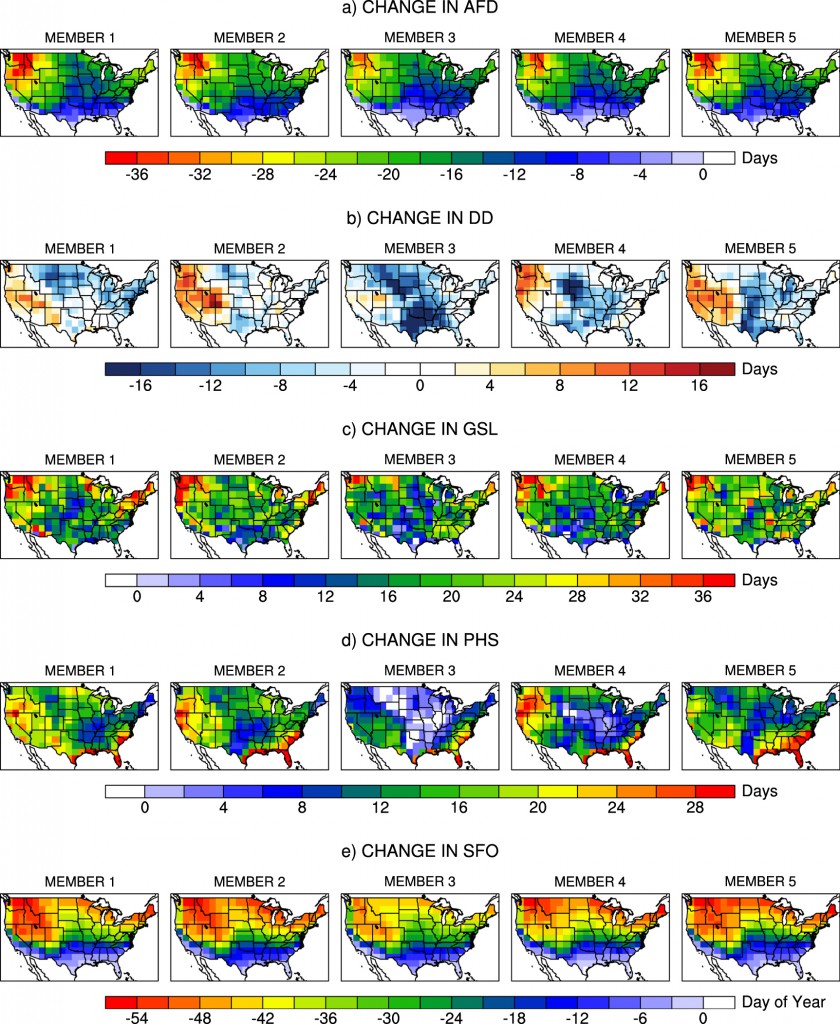
One of the comments I often hear when giving talks about changes in climate is that a change in annual average temperature is not very useful for most farmers, since temperature varies on a wide variety of scales and they can adapt to a fairly wide range of climate conditions. A recent article published in Environmental Research Letters addresses that by looking at projected changes in several variables that are more useful for crop producers, including accumulated frost days, dry days, growing season length, plant heat stress and start of field operations. The projections are for 2100, so that is quite a ways in the future, but they do show changes across the US in all of these variables. Each projection is shown for several different climate models and projections of C02 increase, so you can get a sense of the range of possibilities. The Southeast generally has less changes than other parts of the country.
In general, what the graphs show (and you can see a clearer picture in the article) are that average frost days decrease by 8-12 days per year, the number of dry days slightly decreases, the growing season length increases by 10-30 days depending on location and scenario, the days with plant heat stress increases by up to 30 days (especially in coastal areas and south Florida), and the start of field operations is 1-2 weeks earlier, with the biggest increases coming in northern areas.