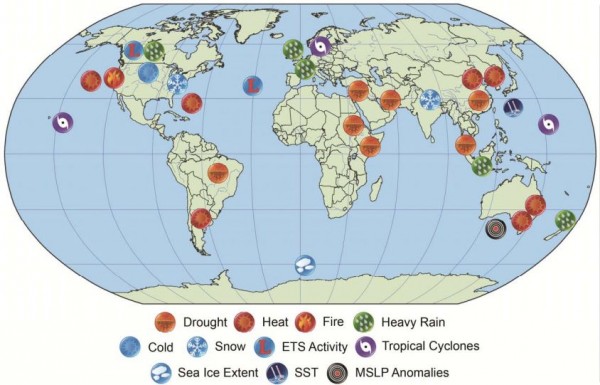
Last week NOAA released their annual evaluation of 28 separate weather disasters that occurred in 2014 along with a discussion of which if them were affected by trends linked to changing climate and other human factors like changes in land use. This evaluation is published by the American Meteorological Society and is based on evaluations from 32 groups of climatologists in 20 different countries.
In some cases like extreme heat waves, the probability of occurrence has increased due to rising temperatures. In other events, no link to changing climate could be seen and these events were attributed to naturally occurring variability in weather. Most of the droughts were linked to water use patterns and normal precipitation variability, not climate change. Floods were linked to artificial drainage patterns and land use changes from urban development and land subsidence as well as rainfall anomalies.
There have been a number of articles on this news release. A short description of the project can be found from NOAA here. A good summary list of key findings can be found on this NOAA News post. EarthSky also published the map from NOAA below showing all the disasters described in the report. Seth Borenstein of AP provided a list of the 14 events that were most likely affected by global warming here. An archived slide show from the press briefing is available here. The full report can be found at https://www.ncdc.noaa.gov/news/explaining-extreme-events-2014.