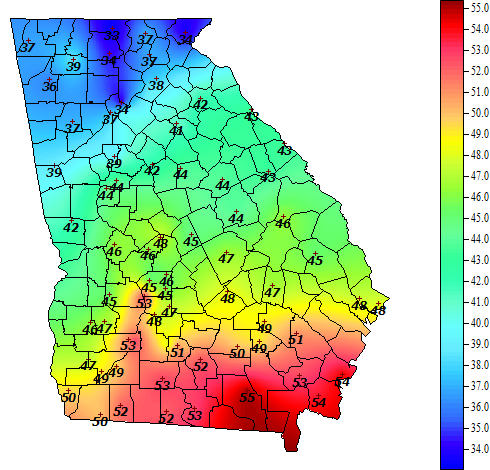
I subscribe to Walter Reed’s newsletter, The Georgia Gardener, and was interested to read his recent article on crabgrass prevention and how it is tied to climate data. For years he has recommended putting down pre-emergent herbicide for crabgrass in Atlanta on March 15 based on a combination of long-term climate statistics and gut feelings. Crabgrass seed germinates around 50 F, and Walter says weed scientists use the metric of 52 F at 1/2 inch depth as the trigger to apply pre-emergent herbicides to keep the seeds from developing.
However, based on his research, the soil temperatures are reaching this point about two weeks earlier than he thought, and he is now changing his recommendation to put the herbicide down on March 1 rather than March 15. Of course, if you are in other parts of the Southeast, you will need to adjust your schedule to your local conditions. In Georgia, you can get soil temperatures at 2 inch, 4 inch, and 8 inches from the Georgia Automated Environmental Monitoring network at https://www.georgiaweather.net. Other states have similar monitoring networks and may have their own soil temperature measurements. Soil temperatures at the 1/2 inch level will respond more to daily weather conditions than the 2 inch value and will swing up and down more with the amount of sunlight as well.
The map below shows today’s 2-inch temperatures.