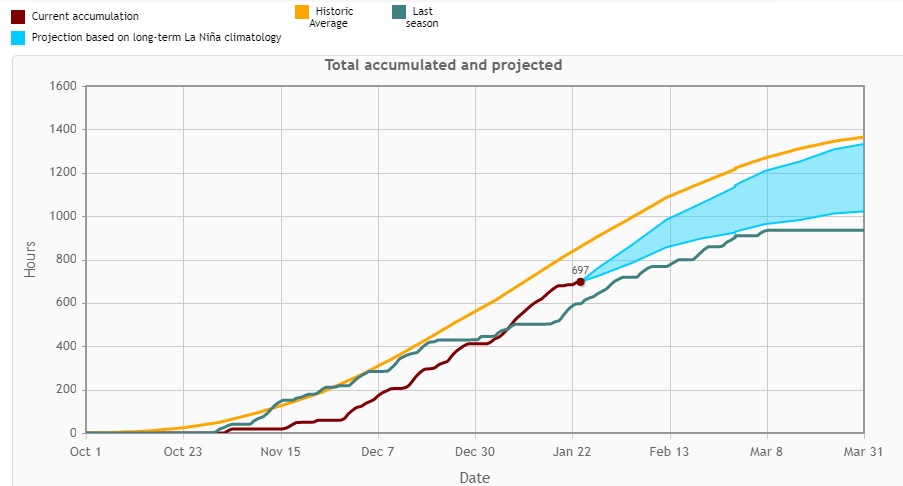
At this time of year, fruit farmers are anxiously watching their chill hours to see if they have received enough cold weather to help their plants produce a good set of flower buds for spring bloom. In the past few years, some winters have been touch or go with having enough. Early this year, it looked like we might be in the same boat, with the La Nina predicted to bring warmer weather than normal to the Southeast. Fortunately, after a warm November, we have received a lot more cold air, and the chill hour accumulation has increased rapidly. Now we expect to see chill hours that are better than last year’s, although they continue to be below the long-term average. With warmer weather for the next week, the curve will flatten, but based on previous years, we still look like we are in decent shape for the rest of this winter. You can view chill hours for your area at https://agroclimate.org/tools/chill-hours-calculator/. The graph below shows the curve for Peach County, GA.
You can also find maps at https://mrcc.illinois.edu/VIP/indexChillHours2.html.
If you are wondering what chill hours are and why they are important to fruit growers, Vegetable and Specialty Crop News has a good basic article at https://vscnews.com/peach-chill-hours-growing-season/, including methods that farmers can use to help their plants when winters are warmer than normal.