Cotton:
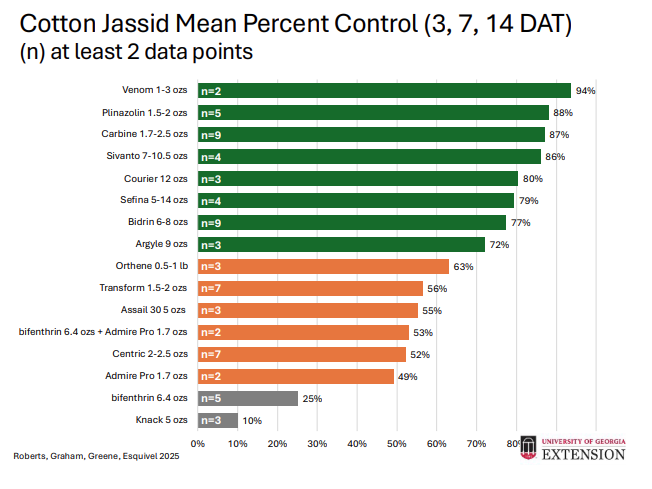
Areolate mildew is well established in at least one cotton field in the area. Given our current environmental conditions, including high humidity, dense canopies, and intermittent rainfall, this disease has the potential to develop rapidly. Fungicide applications are recommended where areolate mildew is present to help protect yield potential. In the past, azoxystrobin has been an effective option; however, fungicide resistance has now been confirmed, making it a less reliable choice. Currently, Priaxor and Miravis Top are the safest management options. The ideal fungicide timing is during the third week of bloom or later, and when disease is detected through scouting. For cotton that has reached the third week of bloom but has not been scouted, growers should consider current disease favorable conditions, such as humidity, canopy density, and rainfall, when deciding whether to make a fungicide application. Jassids have now been detected in 16 counties. Reports are showing that Jassids and hopperburn are becoming easier to find. When scouting, we want to look at the 4th leaf down from the terminal and check about 25 plants in the field; Jassid threshold is 1 per leaf. Whiteflies are starting to build rapidly. We do not want to get behind on whiteflies, its very expensive and hard to catch up.

Peanuts:
This lovely humid weather has white mold popping up. I haven’t seen any leaf spot yet, but I’m betting it’s out there somewhere. Keep the heavy hitters out; our crop is really starting to bounce back and look good. Starting to see more Spotted Wilt symptoms show up too. Don’t forget that some sulfur formulations (Microthiol Disperss, Microthiol 80W, Drexel Sulfur 80W, Drexel Suffa 6F, TechnoS 90W, and Accoidal 80 WG; generally at rates of 3-5 lb/A) have significantly improved the control of leaf spot when tank-mixed with products such as azoxystrobin (Abound), Headline, Umbra, EXCALIA, and tebuconazole. As of right now (8/7), the tropics are relatively quiet, but there is a good chance of rain in the forecast for the middle to end of next week. Even if it’s a little early, I’d rather have my fungicides out before the rain; the conditions are too rough to get behind on fungicide sprays.