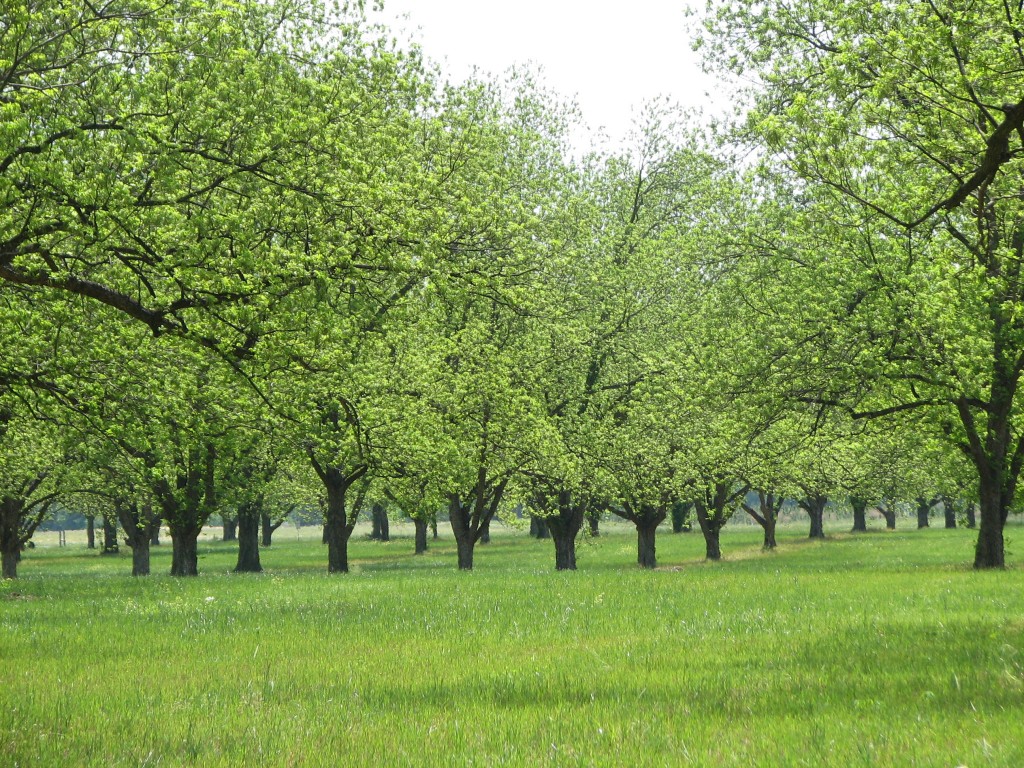

This has been about as dry a fall as we have ever seen. Normally, after shaking this time of year, we don’t worry too much about water. Trees are dormant or nearly dormant and irrigation systems in Georgia have been turned off until spring. Many of them have already been winterized. But, with subsoil moisture at drastically low levels, I have had dozens of calls over the last week asking if we should provide some soil moisture in the orchards via irrigation.
We have to irrigate up until trees are shaken to get the shucks to open properly as mentioned in previous posts. But, after shaking there is generally little need to irrigate our orchards in the SE. To this point I have been hesitant to recommend turning on the irrigation if you have already harvested an orchard. But, since most areas have had very little to no effective rainfall since about mid-August, its time to start thinking more seriously about this. It is important to understand how the pecan tree and its root system works and what the implications are for such a rare overly dry event this late in the year.
From some of our recent pecan water use studies, we know that there is very little water use by the tree after October. Photosynthesis is dependent on chlorophyll, which breaks down due to shorter days and cooler temperatures in the fall. As chlorophyll fades, the hidden yellow and orange pigments are revealed, and red pigments may be produced, but the leaf’s ability to perform photosynthesis is significantly reduced or eliminated. Of course, the same is true when the leaves fall. This, along with our normal rainfall usually eliminates any need for post-harvest irrigation as dormancy arrives.
Pecan trees still need adequate subsoil moisture during the dormant season, not to enhance growth or make the tree more productive, but simply to keep it healthy. This can help keep trees more resilient against potential stresses like cold injury and ambrosia beetle attacks later in the spring. The problem is, we usually have that provided in the form of rain this time of year.
Pecan trees absorb most of the water and nutrients for production via feeder roots during the warm growing season. These roots tend to grow upward toward the soil surface. They are usually short lived because they live in a zone of fluctuating temperatures and moisture. A month of dry weather can result in loss of most of the feeder roots within 8″ of the surface. When rain or irrigation is resumed, new root growth begins within 48 hrs. The extremes (too wet or too dry) kills the young roots. This is a normal process that occurs season long. This time of year, it is a non-issue. When optimal conditions return (primarily in late spring) the feeder roots grow again and there are cycles of this all through the year.
Lateral roots from which the feeder roots branch normally occur at 12-30″ below the surface. A high water table or frequent irrigation may force them to a more shallow depth. Tap roots in our part of the world generally grow to a depth of 3-6 feet. These more perennial lateral and taproot structures do transport water and nutrients but their primary function is storage and anchorage.
The deeper the soil, the better the tree’s resistance to potential drought-related issues. For trees with 42″ or more of well-drained soil, a drought like we are seeing is less likely to cause any serious effects for pecan trees. For those with more shallow soils or those with higher water tables, the drought is more likely to cause negative effects and it probably is a good idea to irrigate once per week where you have very sandy soils with less than 36″ of well-drained surface soil until we get significant rain.
The arid regions out West recommend 2″ every 6 weeks during the dormant season. If we don’t get significant rainfall (1″-2″) the week of Thanksgiving I think it will be a good idea to irrigate about 4 hrs per week until we see a significant rain event. On our deeper soils, this need may be questionable but because we really have no data to go on here, it may be better to be safe than sorry and err on the side of caution. Because the goal here is to maintain subsoil moisture, applications should be made as one long irrigation period per week rather than smaller amounts multiple times per week.
