
As corn harvest begins across the area, one of the most common questions I receive is how to estimate grain losses from combines. The University of Georgia publication Measuring Field Losses from Grain Combines by Paul Sumner and E. Jay Williams provides a simple field sampling method for estimating harvest losses and converting those losses into bushels per acre.
According to the publication, two kernels per square foot are equivalent to a loss of 1 bushel per acre. Using a 10-square-foot sampling frame, 20 kernels found within the frame equal approximately 1 bushel per acre of grain loss. Similarly, one whole ¾-pound ear left in 1/100 acre is equivalent to a loss of 1 bushel per acre. These simple rules of thumb allow producers to quickly estimate harvest losses in the field and determine whether combine adjustments may be needed to improve harvesting efficiency.
The publication outlines a step-by-step procedure for measuring header losses, machine losses, and total harvest losses. Taking a few minutes to evaluate grain losses during harvest can help identify adjustment opportunities and reduce the amount of grain left in the field.
How to Measure Losses from a Corn Combine
First, stop your corn combine (without clearing it) 100 feet or more from row ends (in corn typical of the entire field). Use a wooden frame or four wooden stakes and string for laying out the measured area. Follow the four steps listed below.
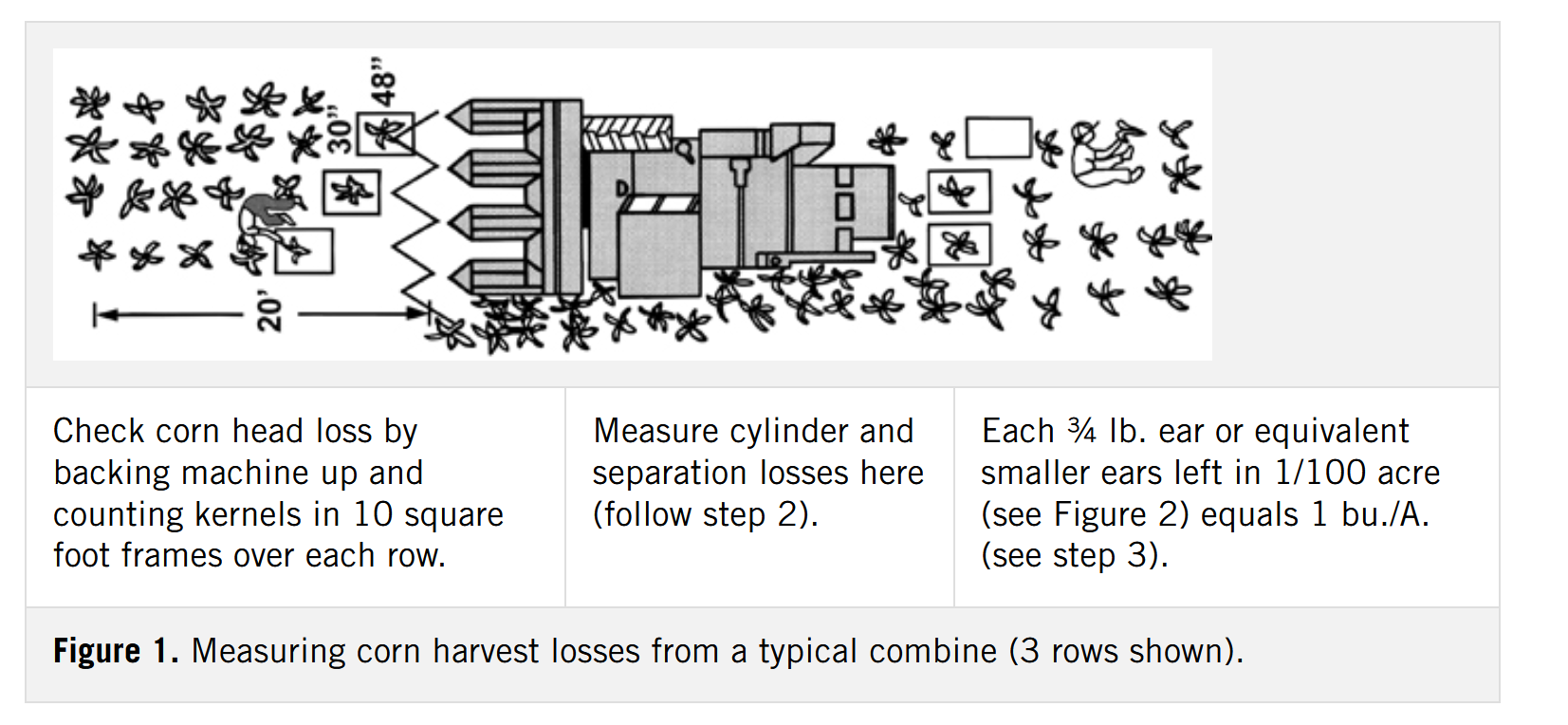
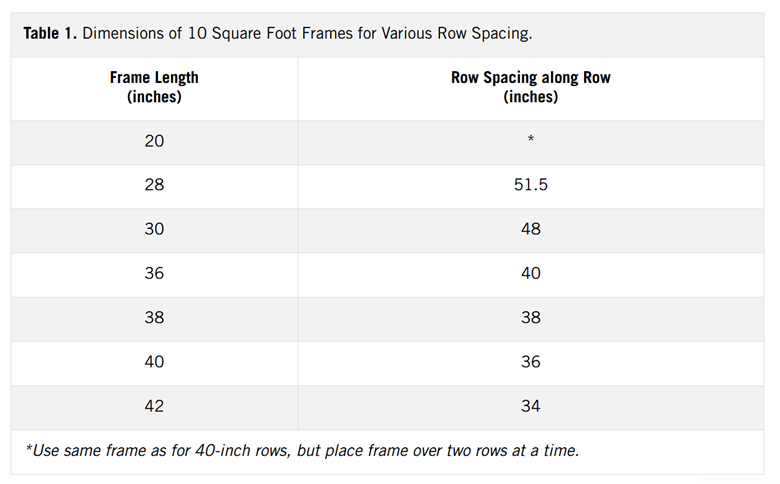
1. Loss from corn head (snapping roll loss): Growers need to back their combines up 20 feet and count kernels in 10 square foot plots over each row in front of the combine. Place a frame of the correct size (see Table 1) over each row, count loose kernels and divide by 20. Then take the average of these to get approximate loss in bushels per acre for each row.
For example, Table 1 indicates that for 30 inch row spacing, you need a 30-inch x 48-inch frame. Place the frame over each row in swath (see Figure 1 on page 2), cut off and remove the stalks, then count the kernels. Assume you find 24 kernels in the frame area in the left row: 24 divided by 20 means a 1.2 bushel per acre loss for that row. Then make a count in the center row, and then the right row. Machine loss is the average of these three row losses.
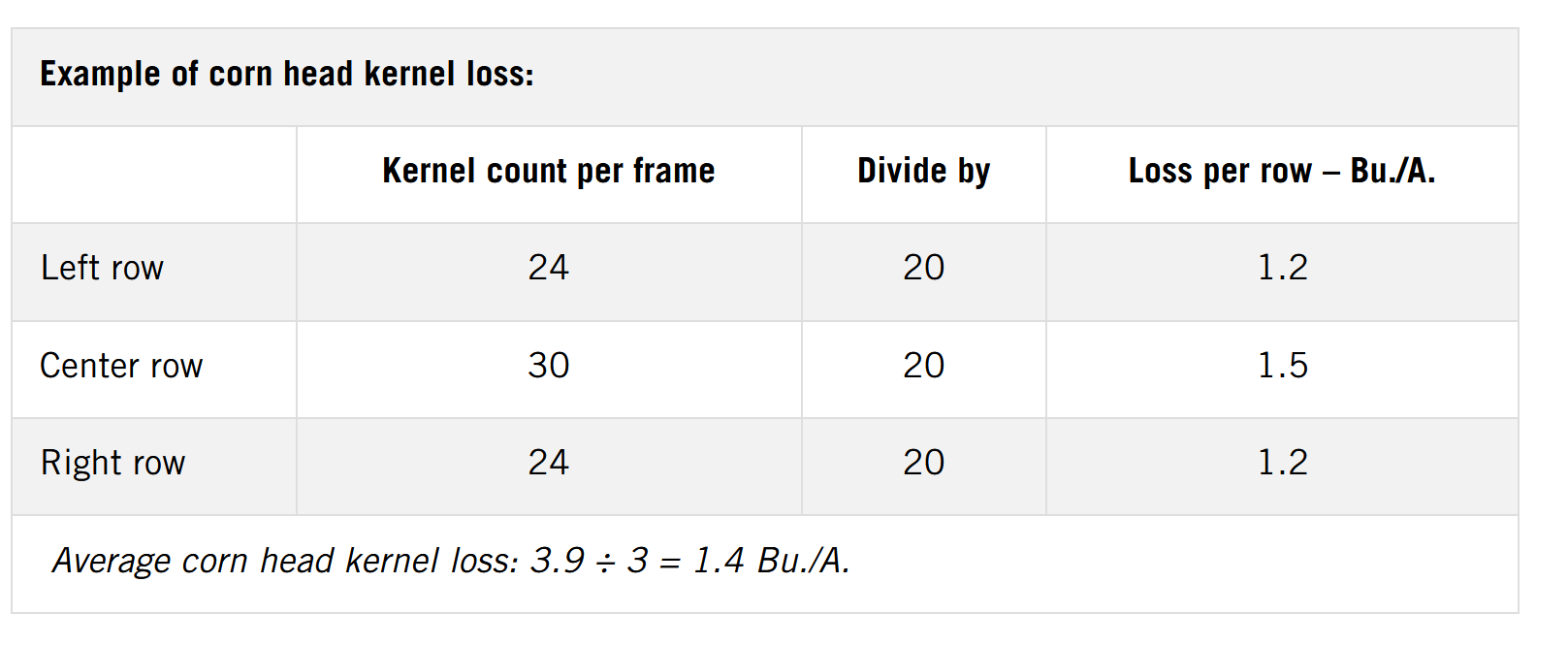
Note: Cylinder loss and separation loss are determined the same as the previous method, but insert the proper counts per frame as follows.
2. Cylinder loss: Divide 20 into the number of kernels remaining on cobs in the 10 square foot areas at the rear of the machine to find cylinder loss in bushels per acre. Again, average the row losses to get the machine cylinder loss. Count the number of loose kernels in the same 10 square foot areas. Divide this number by 20 and subtract the loss from the corn head kernel loss. This equals the separation loss behind the machine.
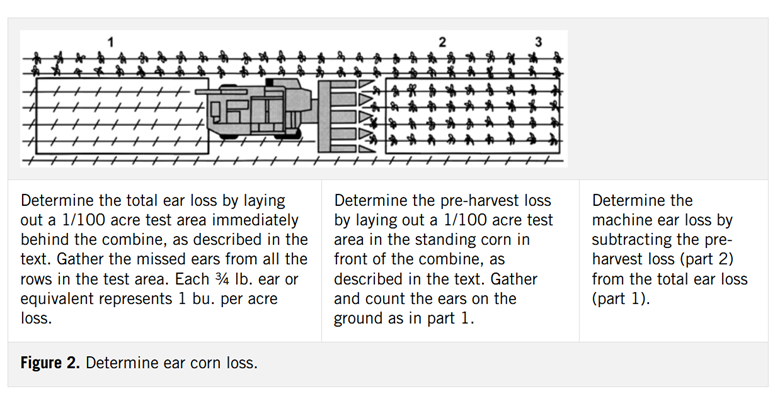
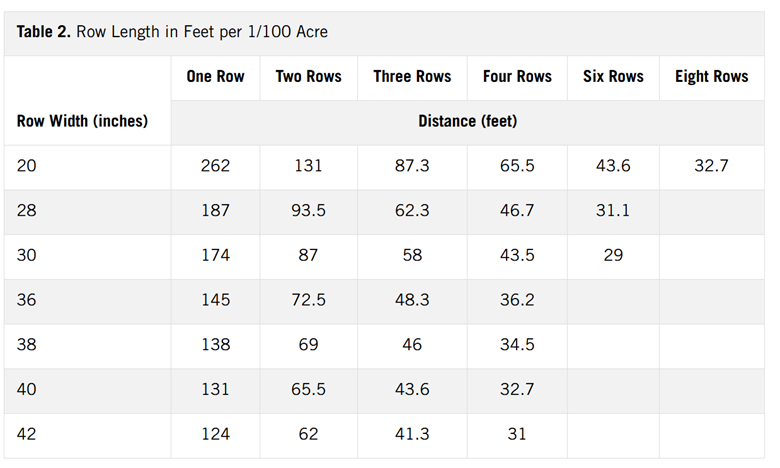
3. Count ears lost: Gather ears from the machine swath covering 1/100 acre (see Table 2 for length of area). Each ¾ lb. ear or equivalent smaller ears represents 1 bushel per acre loss. Ear loss in 1/100 acre behind the combine, minus ear loss in 1/100 acre of standing corn in front of the combine (pre-harvest losses) gives machine ear loss in bushels per acre (see Figure 2 below).
4. Find total machine loss by adding machine ear loss to the total corn kernel loss found in steps 2 and 3.
If you have any questions please contact you local county Extension agent.