The content on this page is retained only for recordkeeping, historical reference, or research. These materials are preserved in their original form and may not meet current WCAG 2.1 AA accessibility standards.
These archived materials are not required to be remediated. However, we remain committed to equitable access. If you need an accessible version of any archived item to participate in our current programs and services, we will provide one when feasible upon request at caesweb@uga.edu.
This has been a pretty wet summer so far, and that means we probably have a better than usual chance of having some clouds for the eclipse on August 21. Even if the sky is completely cloud-covered, we will still experience effects from the eclipse, in particular the darkness that comes when most of the sun’s disk is blocked out and the concurrent fall in temperature. But even if there are some clouds, there may be breaks that you can use to view the sun, and cloudiness has also been known to change because of the falling temperatures. You can read more in this Forbes.com article by Dr. Marshall Shepherd of UGA here.
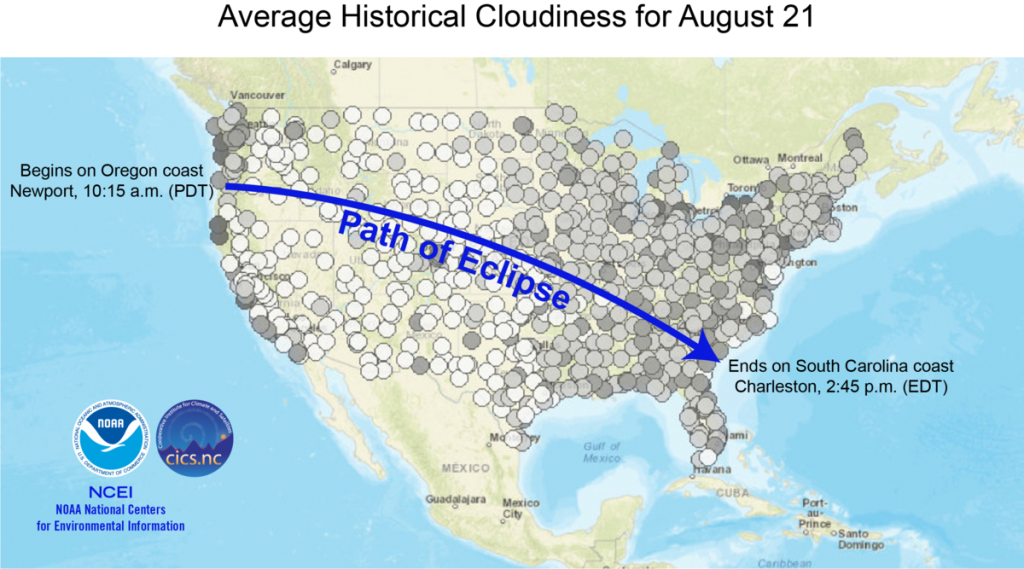
The darker the dot, the greater the chance for cloudiness at the hour of peak viewing during the total solar eclipse on August 21, 2017. Dots represent automated weather stations that reported the cloudiness data and show the 10-year cloudiness average for August 21, 2001–2010. Map developed by CICS-NC in cooperation with NOAA NCEI, Deborah Riddle.