Summer in the Northern Hemisphere is generally the time when the monsoon develops in India. The monsoon provides the major rain that allows crops to grow in that country, and the failure of the monsoon causes immense suffering, crop damage and famine in the area.
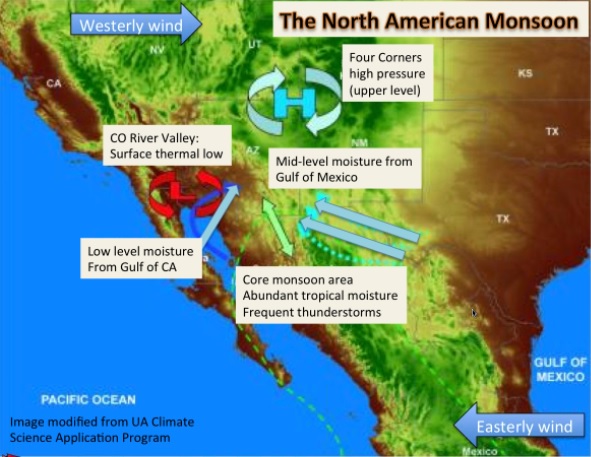
Even though you might think that “monsoon” is just a term for heavy rain, it actually has a very distinct scientific meaning. What’s more, there is also a monsoon in North American, in the desert Southwest. It should be starting any day now and you may hear about it in the news if you are paying attention or have friends or family in the region.
Here are two resources that explain the monsoons in both India and the US.
The National Weather Service office in Tucson AZ has a website with a lot of information at https://www.wrh.noaa.gov/twc/monsoon/monsoon_info.php.
The Weather Channel has a video which explains the scientific basis of the monsoon at https://weather.com/tv/shows/amhq/video/the-science-behind-the-monsoon.