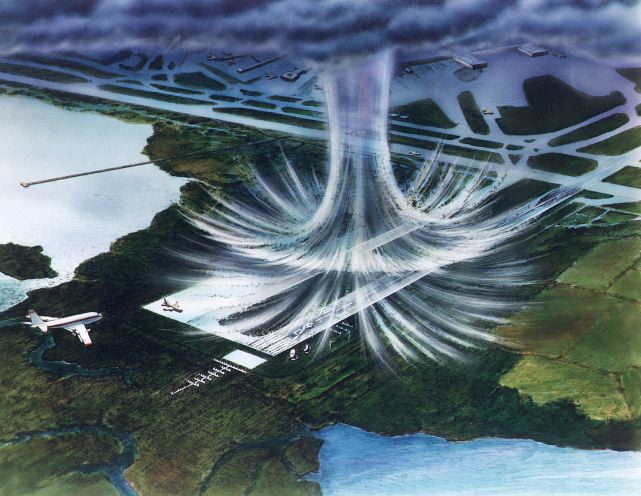
Here’s an interesting story from the Capital Weather Gang on Ronald Reagan’s near-disastrous Air Force One landing at Andrews AFB on August 1, 1983. A microburst hit the airport with winds of up to 149 mph just six minutes after Reagan’s plane landed. Microbursts, which once were considered to be fictitious, have been known to be a proximate cause of numerous aircraft accidents. It wasn’t until August 2, 1985, when Delta 191 crashed in Dallas, that they were finally accepted and a number of technological fixes put into place at airports to help identify microbursts before they could cause another crash. You can read the story from 2013 here.
Microbursts can occur anywhere that strong thunderstorms develop. I’ve seen them occur just a few blocks from my house in Athens, and the damage they can do is as severe as a tornado. When the strong downdraft associated with the microburst occurs, the wind basically hits the ground and “splashes out” in all directions from the point of impact, which helps to identify it in post-storm surveys.