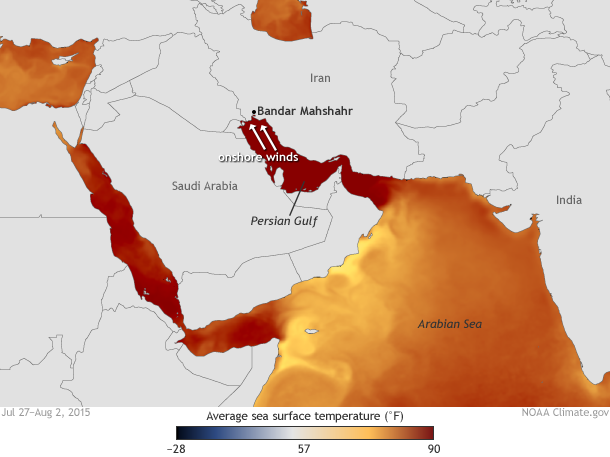
Summer in the Southeast can be hot and humid, but nothing like what has been experienced lately in the Middle East. Climate.gov‘s recent blog post on the conditions in Iran near the Persian Gulf shows the impacts of extremely warm water on dew point temperatures in an already hot climate. On July 31st, a heat index of 165 F was observed in Bandar Mahshahr, on the northern end of the Persian Gulf, with a temperature of 115 F and a dewpoint of 90 F.
If water temperatures and the Gulf of Mexico rise in the future, as well as land temperatures (as predicted by climate models), life in the Southeast could get a whole lot more sultry in the future, especially in areas close to the water. However, water temperatures will still be cooler than land during the day and so could provide some limited relief in the form of sea breezes.