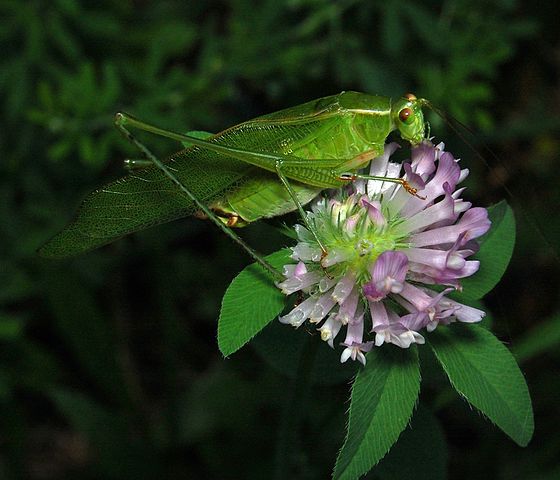
Did you know that you can use cricket and katydid chirps to estimate the temperature? Dolbear’s Law is the formula from the late 19th century that can be used to accurately estimate the temperature based on the number of chirps a cricket emits. Basically, crickets chirp faster when it is warm than when it is cool. It also depends on the species of cricket, which I did not know before I read this article. Here’s the formula: “Count how many chirps the cricket makes in 14 seconds. Add 40 to the average number of chirps in 14 seconds. This equation (which is one of the oldest and easiest to use cricket-thermometer equations) is published in the Farmers’ Almanac. It should give you the approximate temperature in degrees F.”
You can read more about Amos Emerson Dolbear and his discovery at https://sciencevibe.com/2016/09/20/the-forgotten-man-who-discovered-crickets-were-natural-thermometers/.